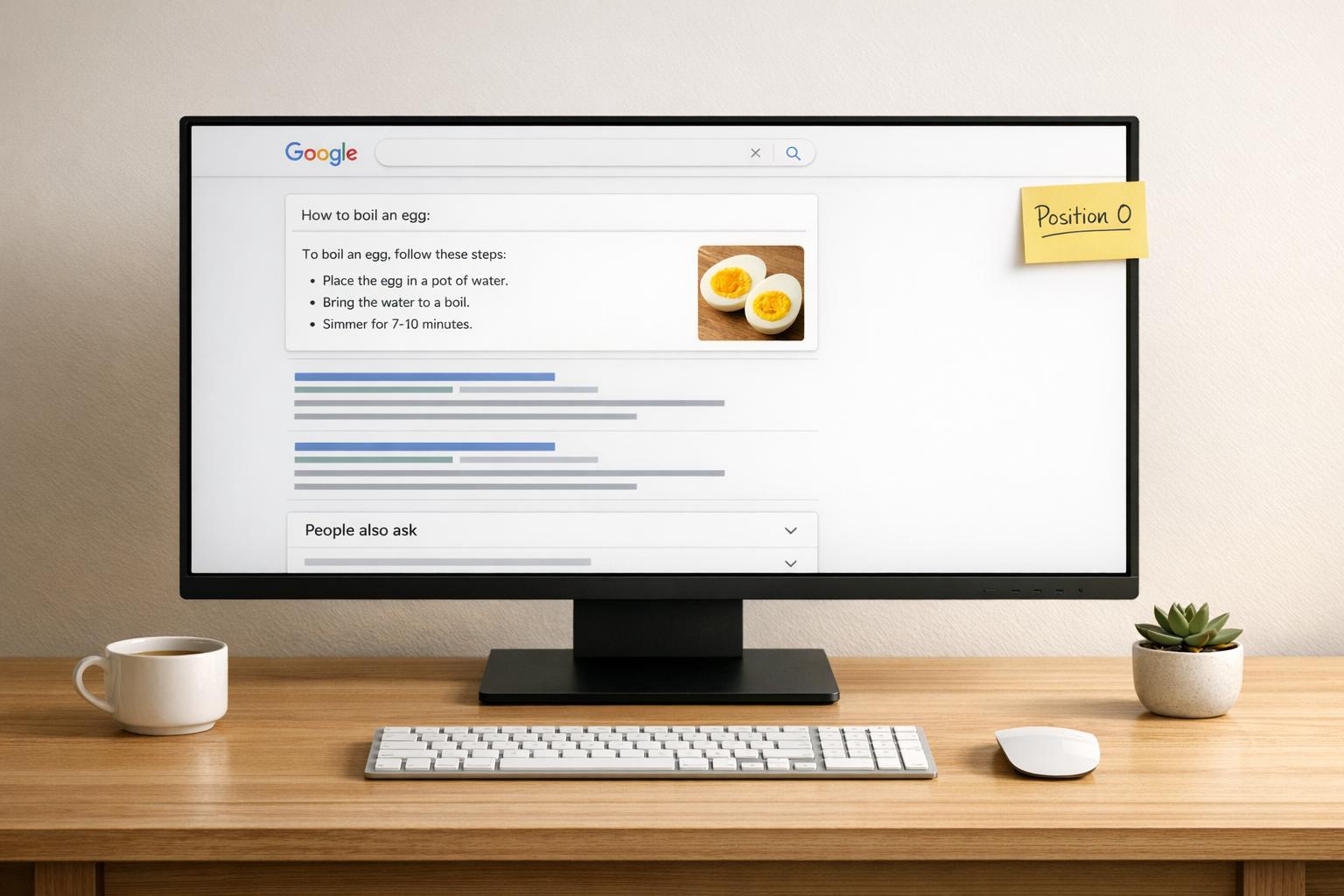
Want to increase your visibility on Google? Securing Position 0 – Google’s featured snippets – can help you stand out by appearing above organic search results. These snippets directly answer user queries with concise content like paragraphs, lists, tables, or videos. Here’s the key takeaway: 99% of featured snippets come from pages already ranking in the top 10.
Why Position 0 Matters:
- Featured snippets appear in 12–19% of searches.
- They account for 35% of clicks on average.
- Holding both Position 0 and a #1 organic spot can capture over 40% of clicks.
- Snippets improve authority, as Google trusts your content for direct answers.
How to Win Position 0:
- Target the Right Keywords: Focus on question-based queries starting with "What", "How", or "Why", and keywords where your page already ranks on the first page.
- Structure Content for Snippets: Use short, direct answers (40–60 words) under clear headings. Match Google’s preferred format (paragraph, list, table, or video).
- Optimize for Technical SEO: Use proper HTML tags (
<p>,<ul>,<table>) and ensure your page loads in under 2 seconds. - Leverage Schema Markup: Add structured data like
FAQPageorHowToto help Google identify key content. - Monitor and Update: Track snippet performance regularly and refresh content every 3–6 months to maintain rankings.
Pro Tip: If competitors hold snippets for your target keywords, improve your content’s clarity, structure, and format with white-label SEO services to overtake them. With consistent effort, you can secure and retain Position 0, boosting both traffic and credibility.
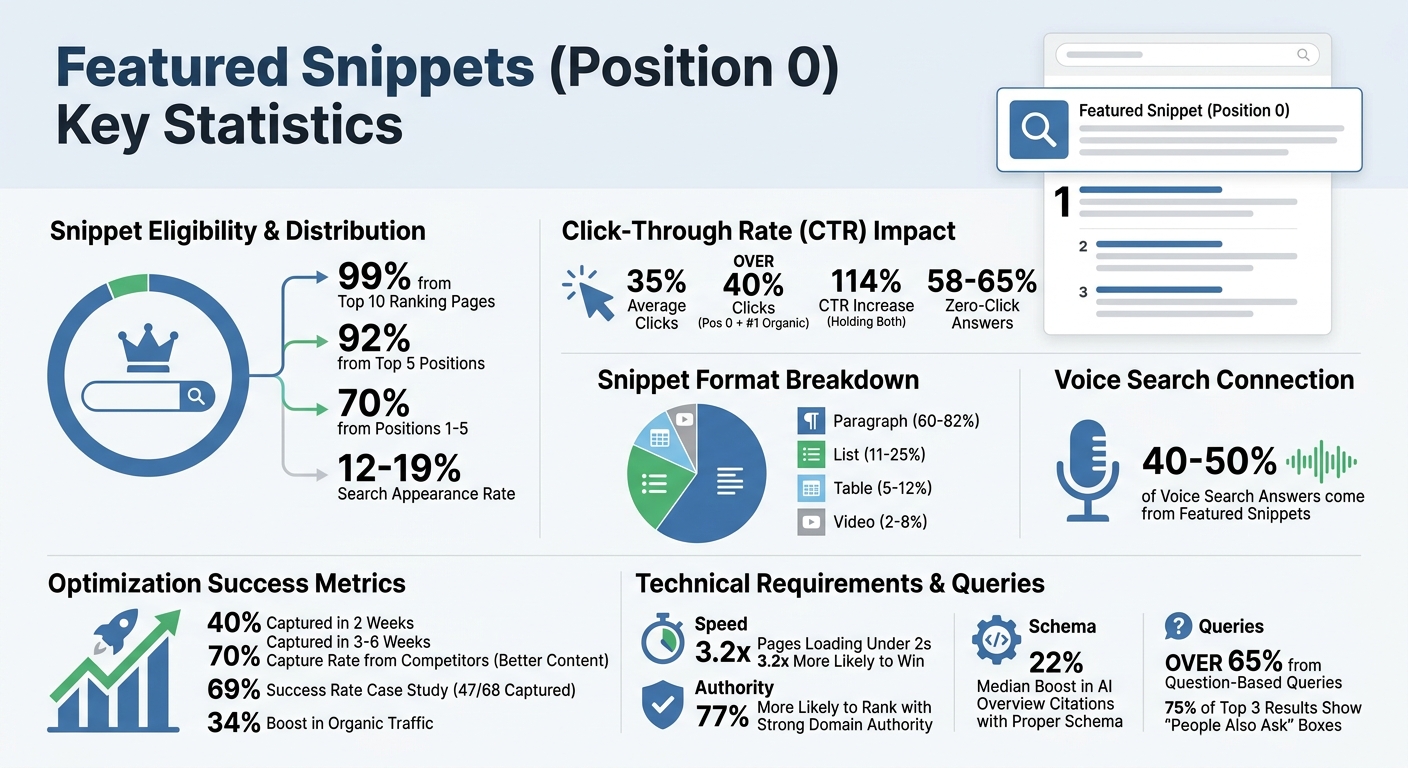
Featured Snippets Statistics: Why Position 0 Matters for SEO
How To Optimize For The Featured Snippets | Step By Step Process
sbb-itb-7a4ada9
What Position 0 Is and How It Works
Position 0 refers to the search results that appear above the traditional organic listings on Google’s search results page. These results, known as featured snippets, are designed to provide direct answers to user queries. Unlike standard search results that display a title and meta description, featured snippets pull specific content from a webpage in formats like paragraphs, lists, tables, or videos. Google selects this content as the most accurate and relevant answer to the query.
Although featured snippets visually stand out in search results at the top of the page, Google Search Console typically categorizes them as position 1. However, to qualify for Position 0, your webpage generally needs to already rank on the first page of search results. In fact, 99% of featured snippets come from pages in the top 10 results, with about 70% originating from pages ranked in positions one through five.
Let’s break down the different formats featured snippets can take and how they work.
Types of Featured Snippets
Google uses four main formats for featured snippets, each suited to different query types:
- Paragraph snippets: These are the most common, making up 60% to 82% of all snippets. They work best for definitions or straightforward explanations, typically containing 40 to 60 words. Structuring your content with headings that directly answer user questions can increase your chances of being featured.
- List snippets: Representing 11% to 25% of snippets, these appear as either numbered or bulleted lists. Numbered lists are ideal for step-by-step guides, while bulleted lists work well for rankings or collections. If your list exceeds eight items, Google may include a "More items…" link to encourage users to visit your site.
- Table snippets: Accounting for 5% to 12% of snippets, these are perfect for presenting comparisons, pricing, or technical data. To qualify, you must use standard HTML
<table>tags, as Google cannot extract this information from CSS grids or div-based layouts. - Video snippets: These make up 2% to 8% of snippets and usually feature YouTube content with specific timestamps. They are particularly effective for visual "how-to" queries, as they direct users to the exact segment of the video. Including timestamps and chapters in your video descriptions helps Google identify the most relevant parts.
Each snippet format plays a unique role in addressing user queries effectively, making them a valuable tool for improving visibility.
Why Position 0 Matters
Securing Position 0 offers clear advantages that go beyond standard rankings. Featured snippets can capture 35% of all clicks on a search results page. If your page already ranks #1 and also earns the snippet, your click-through rate could increase by 114%. Holding both positions can even lead to capturing over 40% of clicks.
Beyond clicks, Position 0 strengthens your site’s authority and visibility. Featured snippets often handle direct, factual queries, such as "what is" or "how to" questions, while AI Overviews tackle more complex, multi-source answers. They also play a key role in voice search, as platforms like Google Assistant, Siri, and Alexa pull 40% to 50% of their responses directly from snippet content.
One example highlights the impact of targeting featured snippets. In 2026, a B2B SaaS company identified 180 queries where they ranked in positions 1-5 but competitors held the snippets. By rewriting content and adding FAQ schema, they captured 47 of the 68 target snippets within 16 weeks – a 69% success rate – and saw a 34% boost in organic traffic, even without improving their average rankings.
Even when users don’t click through, featured snippets establish your content as a trusted source of information. Around 58% to 65% of users find their answers directly in the snippet. While this might reduce direct traffic, it builds credibility because Google recognizes your content as authoritative. Voice assistants further amplify this trust by citing your snippet as the definitive answer to spoken queries.
Finding the Right Keywords and Questions to Target
Once you understand the perks of Position 0, the next step is figuring out which keywords and questions can help you secure that coveted spot.
Start by focusing on keywords that are already ranking on page one. Export data from Google Search Console to identify queries with high impressions but low click-through rates. These often represent quick wins for featured snippets.
Pay close attention to question-based queries. Searches starting with "What", "How", "Why", "When", or "Where" account for over 65% of featured snippets. Queries like "X definition" or "How do I" are especially likely to trigger snippets, while transactional searches such as "Buy X" usually do not.
Another strategy is to target weak snippets from competitors. Look for snippets that are outdated, unclear, or poorly structured. If your page ranks in the top 1–5 results and a competitor holds the snippet, you have a 70% chance of overtaking it by providing clearer, better-organized content. For example, if a query calls for a step-by-step guide but the current snippet is a paragraph, creating a properly formatted list can give you the edge.
Using SEO Tools for Question Research
Google’s "People Also Ask" (PAA) boxes are a treasure trove for finding snippet-worthy opportunities. These boxes appear in 75% of the top three search results and reveal related questions that Google considers important. Expanding each PAA question uncovers additional queries, which can lead to clusters of long-tail keywords. Even if the main keyword doesn’t trigger a snippet, these related questions often can.
For more in-depth research, tools like Answer The Public offer visualizations of question-based searches. While the free version covers the basics, paid plans range from $9 to $99 per month. Platforms like Ahrefs (priced from $129 to $449 monthly) and Semrush (ranging from $139.95 to $499.95 per month) allow you to filter for keywords already triggering snippets on the SERP. Additionally, your own site data – like internal search logs or customer support queries – can reveal the specific questions your audience is asking.
Once you’ve identified a pool of valuable questions, narrow your focus to low-competition, high-intent queries for the best chance at success.
Targeting Low-Competition, High-Intent Queries
Long-tail keywords (phrases with three or more words) account for 70% of search traffic and often have lower difficulty scores, making them easier targets for snippets. Queries with difficulty scores between 0 and 30 are particularly promising for securing a spot on the first page – and potentially the snippet – even if you’re competing with larger, more established sites.
While search volume is important, don’t overlook keywords with moderate traffic. For instance, a query with just 100 monthly searches but a 60% chance of triggering a snippet can drive more qualified traffic than a high-volume keyword with only a 3% snippet rate. The key is aligning search intent with snippet potential. Informational and comparative queries (like "X vs Y") often have snippet rates between 8% and 44%, while transactional queries rarely trigger snippets.
Even as AI Overviews reshape the search landscape, focusing on specific, technical questions remains a reliable way to capture Featured Snippets. While snippets peaked at 19.2% of SERPs in early 2025, they declined by about 35% by mid-2025 due to AI Overviews dominating broader informational queries. However, snippets for technical, fact-based questions – like "what is a canonical tag" or "how to add schema markup" – have remained stable. Avoid broad topics like "what is SEO", where AI Overviews are more dominant, and instead target niche, detail-oriented queries.
"When AI Overviews went live globally in May 2024, I tracked snippet volatility across 47 site audits… pages with question-format H2/H3 headings and 40–60 word direct-answer paragraphs held their featured snippets through the turbulence."
- Rohit Sharma, Author
Finally, consider the snippet format Google currently displays for your target keywords. For example, if "X vs Y" queries in your niche show a table snippet, create a well-structured HTML table to compete effectively. Matching your content to the format Google favors can significantly boost your chances of winning Position 0.
Creating Content That Wins Position 0
Once you’ve identified your target keywords, structuring your content effectively becomes the next crucial step to claim Position 0. The majority of featured snippets – over 99% – are pulled from pages already ranking on the first page of search results. So, if you’re in the top 10, you’re in the game. The challenge is formatting your content in a way that Google can easily extract.
Start with an answer-first approach. Place the direct answer immediately after the heading, not buried under layers of text. Google’s algorithm prioritizes clear and concise blocks of information, and a staggering 67% of content misses out on snippets because the answer is buried too deep. Use the inverted pyramid method: deliver the answer upfront, then expand with supporting details.
Headings play a key role, too. Use H2 or H3 tags that directly reflect user queries, such as "What is a canonical tag?" or "How to add schema markup." These headings signal to Google that the content addresses the user’s question. Pair them with short, factual, dictionary-style answers. Skip opinions, fluff, or promotional language.
"Answer the question in 40-60 words immediately, not after three paragraphs of throat-clearing. With the flooded market of AI-generated content, Google’s 2026 algorithms are hyper-focused on EEAT."
- Vadim Kravcenko, SEOJuice
Stick to standard HTML tags like <p>, <ul>, <ol>, and <table> to ensure Google’s crawlers can properly interpret your content. This not only increases your snippet chances but also positions your page as a reliable source for AI-generated summaries.
How to Structure Content for Snippets
The format of your content should align with the type of query you’re targeting. Here’s how to approach the most common snippet formats:
- Paragraph snippets: These dominate, making up 70% to 82% of all featured snippets. They work best for "what is", "why", and definition-based queries. Write a direct, factual answer immediately below the heading, keeping it between 40 and 60 words. Longer responses risk being cut off.
- List snippets: Representing 10% to 19% of snippets, these are ideal for "how-to" and "types of" queries. Use
<ol>tags for sequential steps and<ul>tags for unordered lists. Ensure each list item is concise and consistent – starting with a verb for guides or maintaining uniform phrasing for feature-based lists. Lists with more than 8 items often trigger a "More items…" link, which can boost click-through rates by 32%. - Table snippets: These account for 5% to 7% of snippets and are perfect for comparisons, pricing, or detailed specifications. Use proper HTML
<table>tags so Google can easily extract the data. Aim for compact tables with 3 to 5 columns and 4 to 8 rows to ensure they display cleanly. - Video snippets: Though less common (2% to 5% of snippets), video content works well for visual "how-to" queries. Upload videos to YouTube, include timestamps in the description (e.g., "0:45 – Step 1: Install the Plugin"), and add chapters to make it easier for Google to direct users to the exact answer. A detailed description of at least 200 words can also improve your video’s snippet eligibility.
Using Lists, Tables, and Visuals
To further enhance your content’s clarity, integrate structured lists, tables, and visuals:
- Lists: Use consistent formatting to make your content scannable. For example, if you’re writing a "How to Conduct a Technical SEO Audit" guide, structure it like this:
- H2: How to Conduct a Technical SEO Audit
- H3: Step 1: Crawl Your Site with Screaming Frog
- H3: Step 2: Check for Indexability Issues in Google Search Console
- H3: Step 3: Audit Page Speed with PageSpeed Insights
Lists longer than 8 items are particularly effective, as they often trigger a "More items…" link, encouraging clicks.
- H2: How to Conduct a Technical SEO Audit
- Tables: When comparing options like SEO tools, create a table with clear headers, such as "Tool", "Price Range", and "Best For." Keep the table compact – 3 columns and 5 to 6 rows – to ensure it displays cleanly in the snippet box.
Writing for User Intent
Formatting alone won’t win Position 0 – you also need to align your content with user intent. Google’s algorithms prioritize content that directly answers the query. For definition-based queries like "What is a meta description?" users expect a concise explanation. For process-based queries like "How to optimize for featured snippets", a step-by-step guide works best.
Study the current snippet for your target keyword. If Google is displaying a table for a comparative query, create a well-structured table. If it’s showing a list for "types of backlinks", format your content similarly. Matching Google’s preferred format increases your chances of replacing the existing snippet.
Keep your tone direct and actionable. Avoid filler phrases like "In this guide, we will explore…" Instead, deliver the answer immediately. For example, instead of saying, "A canonical tag is an important HTML element that helps with SEO", write, "A canonical tag is an HTML element that tells search engines which version of a duplicate page to index."
While 65% of users find their answers directly in the snippet, you can encourage clicks by providing additional value right after the direct answer. Include case studies, advanced insights, or expert tips to give users a reason to explore further.
Technical and On-Page SEO for Featured Snippets
Securing Position 0 requires more than just well-crafted content – it demands a site that Google can easily interpret and extract data from. For starters, pages that load in under 2 seconds are 3.2 times more likely to win featured snippets. And here’s another key insight: 92% of snippets come from pages already ranking in the top 5 organic positions. If your site’s technical setup is flawed, even the best-written content won’t make it to Position 0.
A clean HTML structure is essential for snippet eligibility. Use semantic tags like <p>, <ul>, <ol>, and <table> to help Google extract content accurately. For example, table snippets should rely on proper <table>, <tr>, and <td> tags, while list snippets should use standard ordered (<ol>) or unordered (<ul>) lists. Avoid relying on CSS-styled <div> elements, as Google’s algorithm may not interpret them correctly.
Also, keep the design around your answer blocks simple. Pop-ups, intrusive ads, or heavy design elements can interfere with Google’s ability to extract content. Your answers should be visible immediately when the page loads – don’t hide them behind JavaScript interactions or accordion menus. These technical tweaks, paired with well-structured content, can significantly improve your chances of landing a featured snippet.
Schema Markup and Structured Data
While schema markup doesn’t directly guarantee a featured snippet, it serves as a helpful signal to clarify your content’s structure. Google prefers JSON-LD format for schema implementation, so use it to add structured data like FAQPage for Q&A sections or HowTo for step-by-step guides. For best results, place the JSON-LD code in the <head> section of your HTML.
Using schemas such as FAQPage or HowTo can improve how Google interprets your content and may increase click-through rates. However, it’s important to ensure that the schema data matches the visible text on your page – any discrepancies could result in manual penalties. Tools like the Google Rich Results Test and Schema.org Validator can help you verify that your structured data is error-free.
| Schema Type | Purpose for Snippets | Key Visual Element |
|---|---|---|
FAQPage |
Q&A sections | Expandable Q&A dropdowns |
HowTo |
Step-by-step instructions | Numbered steps or images |
Article |
Blog posts and news | Author details and modification date |
Table |
Data and comparisons | Structured rows and columns |
VideoObject |
Video content | Suggested timestamps or chapters |
By organizing your content with schema, you not only make it easier for users to understand but also help Google extract the right information for snippets.
Page Speed and Mobile Optimization
A fast-loading and mobile-friendly site is critical for snippet eligibility. Google uses mobile-first indexing, which means your mobile site is the primary version considered for ranking. Make sure your site is easy to navigate on smaller screens – readable fonts, no horizontal scrolling, and responsive design are must-haves.
Page speed is just as important. Aim for a load time under 2 seconds by compressing images, reducing JavaScript, and enabling caching. This is especially crucial for voice search, as 40% of voice search answers come from featured snippets. Voice assistants prioritize quick-loading pages that deliver concise answers, so speed directly impacts your snippet chances.
Internal Linking and Topic Authority
Beyond technical fixes, building topic authority through internal linking can strengthen your position for featured snippets. A solid internal link structure signals to Google which sections of your content are the most relevant. Use descriptive anchor text to highlight snippet-optimized sections. For instance, instead of generic phrases like "click here", use something specific like "learn how to implement schema markup."
Websites with strong domain authority are 77% more likely to rank for featured snippets. A smart internal linking strategy – such as a hub-and-spoke model where pillar pages link to related content – creates a clear topical hierarchy. This not only improves navigation but also helps distribute authority across your site, making it easier for Google to identify your most relevant pages for snippets.
Tracking and Improving Your Position 0 Rankings
Once you’ve optimized your content and technical setup, the next step is to track and refine your featured snippet performance. Maintaining a featured snippet spot isn’t a one-and-done task – it requires consistent monitoring and adjustments. Snippets can change frequently, sometimes several times a week, so it’s crucial to keep an eye on high-value queries daily. Tools like Google Search Console make this process easier. Use the "Search Appearance" filter to identify which queries trigger your snippets, along with metrics like impressions, clicks, and click-through rates. For deeper insight, platforms like Semrush and Ahrefs can help you track snippet changes over time.
Focus on "striking distance" keywords – queries where your content ranks between positions 2 and 10. Since nearly all featured snippets (99.58%) are sourced from pages in the top 10 search results, these keywords offer the best chance of securing a snippet. Also, pay attention to zero-click metrics. If a snippet gets high impressions but few clicks, it means users are finding answers directly on the search results page. While this might reduce site visits, it still builds brand recognition.
Tracking Snippet Performance
Consider creating a custom dashboard to monitor metrics like snippet retention, changes in click-through rates (CTR), and zero-click impressions. For instance, in early 2025, a marketing agency noticed a competitor held the snippet for "email marketing conversion rate" (with a 1.2% average). By publishing updated research with 2025 data, a clearer methodology, and a properly formatted HTML table, they captured the snippet in just nine days. This change boosted their organic CTR for that query from 24% to 52%.
Interestingly, 40% of optimized snippets are captured within two weeks, and 35% take about three to six weeks to materialize. This shows that focused adjustments can lead to quick results.
Updating Content Regularly
Featured snippets aren’t permanent. To hold your spot, update your pages every 3–6 months with fresh data, recent references, and improved answers. This approach helps you stay ahead of competitors who may try to displace your snippet. If you lose a snippet, analyze the structure of the new winner’s content. Sometimes, a simple format change – like switching from a paragraph to a table or list – can make all the difference. For example, if Google favors a list snippet for a specific query, adapt your content to match that format.
"Optimizing for a featured snippet is no longer just about winning ‘Position 0.’ It’s about training Google to see your content as a primary source, making it more likely to be cited in AI Overviews."
- Ilias Ism, SEO Strategist
Analyzing Competitor Snippets
Take time to study competitors who hold snippets for queries where your content ranks on the first page. Look at their use of semantic HTML – such as <table> tags for tables or <ol> tags for ordered lists – rather than relying on CSS-styled divs. If their formatting is weak, you can implement proper HTML tags to improve your chances of capturing the snippet. Additionally, explore "People Also Ask" boxes on competitor SERPs to identify related questions that trigger snippets. Including answers to these questions in your content can further enhance your chances.
"70% of featured snippets can be captured from competitors by creating better-structured content targeting the same query."
- Max Beech, Founder, Athenic
Aim to keep your snippet content between 40 and 60 words, ensuring it’s concise and free of unnecessary filler. Use tracking tools to monitor "Lost" snippets and identify competitors actively optimizing against you. Refresh your content quickly to stay competitive. By combining competitor analysis with your content strategy, you can build a comprehensive plan to maintain and improve your Position 0 rankings.
Conclusion
Earning Position 0 is not a one-and-done achievement – it’s an ongoing effort that requires consistent refinement. Keep in mind, only pages already ranking in the top 10 have a shot at claiming Position 0. Once you’re there, your focus should shift to matching the format, using an answer-first structure, and ensuring technical accuracy with semantic HTML to maximize your chances of being featured.
Today, featured snippets are a cornerstone for AI Overviews and voice search, with about 40% of voice search answers coming directly from these snippets. As SEO expert Nidhi Thakur explains:
"Ranking well and winning position zero are two different skills. Most SEO teams are trained for the first and barely think about the second".
This highlights the need for a targeted, actionable approach.
Start by identifying keywords where your site is already ranking in positions 2–10, especially those triggering a competitor’s snippet. Craft concise answers (40–60 words for paragraphs), structure subheadings as clear questions, and use schema types like FAQPage or HowTo to improve your odds. Research shows that pages with properly implemented schema experienced a 22% median boost in AI Overview citations.
FAQs
How can I find keywords my site can rank for in Position 0?
To aim for Position 0 (featured snippets), start by identifying search queries that already have featured snippets or are likely to generate them. Focus on high-value question-based queries like "how," "what," or "why." These types of questions are prime candidates for featured snippets.
When creating content, provide concise, direct answers – ideally between 40 and 60 words – and structure it with clear headings. Incorporating FAQ schema can also improve your chances of securing a snippet.
Tools like Google Search Console are invaluable for spotting snippet opportunities. Use it to analyze your site’s performance and make necessary adjustments to optimize your content for Position 0.
Why isn’t my content getting a featured snippet even on page 1?
Google might not feature your content for several reasons. To improve your chances, focus on providing clear and concise answers (ideally between 40-60 words), using proper headings, lists, and a logical structure. Content ranking in positions 1-5 has a better shot, but it must also match the search intent, include structured data, and be well-optimized. Regularly updating and refining your content can help meet these standards and increase the likelihood of earning a snippet.
How do I track and maintain a featured snippet over time?
To keep your featured snippet in top shape, it’s important to monitor its performance regularly. Tools like Google Search Console can provide insights into how your snippet is doing. Make sure your content remains well-structured and optimized for the specific queries you’re targeting, and update it as necessary to stay relevant.
Using specialized SEO tools, such as those from Upward Engine, can also be a game-changer. These tools help track snippet rankings and visibility, giving you the data you need to adjust your strategy and maintain your position effectively.