

When it comes to outranking competitors in search results, analyzing their on-page SEO strategies can provide actionable insights. This article highlights 10 tools that simplify competitor on-page SEO audits by automating tasks like keyword analysis, content comparisons, and technical evaluations. These tools help identify gaps in your strategy, benchmark performance, and optimize your content effectively to improve performance.
Key Takeaways:
- SEMrush On-Page SEO Checker: Compare your pages to top competitors and get keyword, content, and readability recommendations.
- Ahrefs Site Audit: Detect technical and on-page issues with detailed reports and a Health Score.
- Screaming Frog SEO Spider: Crawl competitor sites for detailed on-page data, including headings, word counts, and keyword gaps.
- SurferSEO: Optimize content with real-time recommendations based on top-ranking pages.
- Clearscope: Use NLP-driven keyword suggestions and content grading to improve relevance.
- Sitebulb: Track content updates and analyze competitor site structures with advanced crawling.
- SE Ranking On-Page SEO Checker: Get tailored recommendations and monitor competitor page changes.
- SpyFu: Leverage historical SEO data and AI tools for content gap analysis.
- Mangools KWFinder: Discover competitor keywords and evaluate SERP metrics.
- Woorank: Benchmark against competitors and track keyword rankings.
Quick Comparison
| Tool | Focus Areas | Starting Price | Free Trial |
|---|---|---|---|
| SEMrush | Keywords, readability, backlinks | $129.95/month | Yes |
| Ahrefs | Technical issues, backlinks | $99/month | Yes |
| Screaming Frog | On-page elements, JavaScript sites | $279/year | Yes (limited) |
| SurferSEO | Content optimization, NLP phrases | $89/month | Yes |
| Clearscope | Keyword relevance, content grading | $129/month | Yes |
| Sitebulb | Crawling, content extraction | $18/month | Yes |
| SE Ranking | Page monitoring, keyword analysis | $103.20/month | Yes |
| SpyFu | Historical data, AI gap analysis | $29/month | Yes |
| Mangools KWFinder | Keyword research, SERP analysis | $29/month | Yes |
| Woorank | Competitor benchmarking, usability | $19.99/month | Yes |
Each tool offers unique features tailored to specific SEO needs. Start with free trials to find the best fit for your goals and budget.
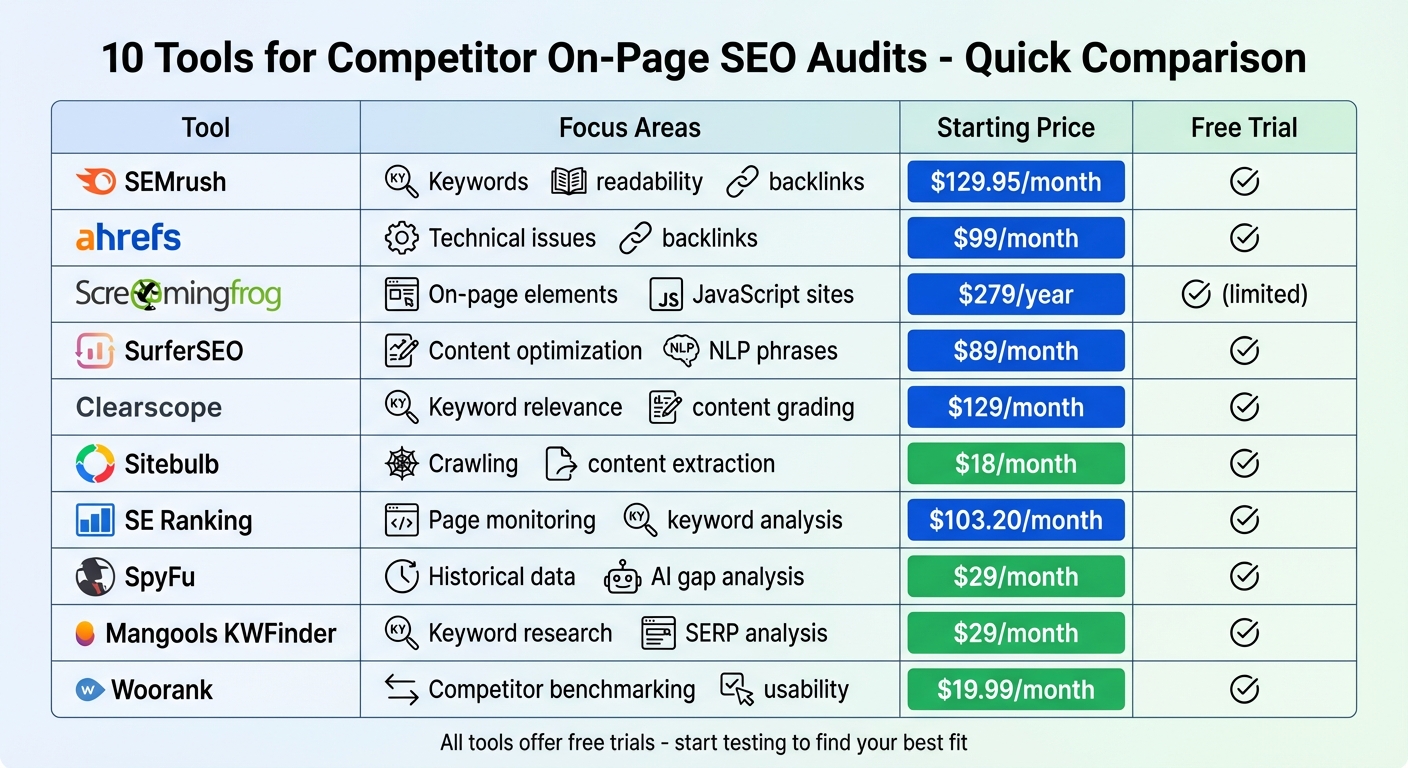
SEO Audit Tools Comparison: Features, Pricing, and Free Trials
SEO Competitor Analysis Explained (With Real Examples) + FREE Tool Access
sbb-itb-7a4ada9
1. SEMrush On-Page SEO Checker
The SEMrush On-Page SEO Checker lets you analyze how your page stacks up against the top 10 organic competitors for each target keyword you’re tracking. It provides a side-by-side comparison with these high-ranking competitors, giving you actionable insights.
The tool focuses on six critical areas during its evaluation:
- Keyword usage, including TF-IDF scores
- Semantic analysis to identify related terms
- Backlink profiles
- Content length
- Video usage
- Readability metrics, such as Flesch-Kincaid scores
Based on this analysis, SEMrush offers recommendations ranked by their potential traffic impact. This helps you prioritize updates that can improve your rankings the most.
You can also integrate it with Google Search Console to import pages automatically and filter keywords in positions 11–100. Pairing it with Google Analytics allows you to track user metrics and identify problems like duplicate content or internal linking gaps, leveraging data from SEMrush Site Audit.
The tool operates on a unit-based pricing model, where each keyword consumes a set number of units. Free accounts can audit up to 100 URLs, while higher-tier plans, such as the Business plan, unlock advanced features like API access and crawling up to 1,000,000 pages per month. For additional functionality, the ContentShake AI add-on is available for $60 per month.
Pro Tip: If competitors block the default SEMrush Bot, switch to "GoogleBot" and schedule a re-crawl on Monday. This adjustment can help you uncover new ranking opportunities. With its comprehensive competitive analysis, SEMrush On-Page SEO Checker is a powerful tool for improving your rankings and staying ahead of the competition.
2. Ahrefs Site Audit
Ahrefs Site Audit is equipped with a high-speed crawler capable of processing up to 170,000 URLs per minute, and it even executes JavaScript to capture dynamic content. This tool checks for 170 different technical and on-page SEO issues, covering areas like HTML tags (titles and meta descriptions), content quality (thin or duplicate pages), and image optimization (alt text and file size).
The findings are organized into three categories: Errors, Warnings, and Notices, making it easier to prioritize tasks. Additionally, the tool provides a Health Score, which gives you a quick snapshot of your site’s performance by showing the ratio of error-free URLs to the total number of URLs.
For users of the free Ahrefs Webmaster Tools, audits are limited to verified sites. However, paid plans (starting at $99/month) allow you to analyze unverified competitor websites, uncovering their technical vulnerabilities. The "Patches" feature is particularly handy – it enables you to address on-page issues like meta tags directly within the dashboard, eliminating the need to wait for developer assistance.
Ahrefs Site Audit also integrates seamlessly with tools like Looker Studio, PageSpeed Insights, and Google Search Console, offering a more comprehensive reporting experience. You can use subfolder or regex filters to focus on specific sections of competitor websites, such as /blog/ or /products/, helping you identify their most effective content structures.
"Ahrefs has been the number one tool in our SEO tool belt for many years. From the basics like rank tracking to the pro-level backlink insights Ahrefs allows us to be more efficient and more effective SEOs." – David Stein, VP of Content and SEO, Wunderman Thompson
Next, learn how Ahrefs’ integrations further enhance competitor analysis.
3. Screaming Frog SEO Spider
Screaming Frog SEO Spider is a desktop-based crawler that pulls essential on-page data from any website. It automatically audits elements like page titles, meta descriptions, and headings (H1 and H2), flagging issues like missing, duplicate, or improperly sized components. Beyond that, it evaluates word counts, readability, and even applies N-gram analysis to pinpoint phrase frequency and keyword gaps on competitor pages. This makes it a great starting point for dissecting a competitor’s on-page strategies.
The tool identifies over 300 SEO-related issues, offering warnings and actionable insights in a single crawl. It’s equipped with an integrated Chromium WRS, allowing it to handle dynamic, JavaScript-heavy websites. Plus, it supports custom scraping using XPath, CSS Path, and Regex to extract specific data, such as prices, SKUs, or social meta tags. The Crawl Comparison feature is especially useful for tracking changes over time, helping you spot ongoing SEO updates.
Screaming Frog provides a free version that limits users to 500 URLs and excludes advanced features like JavaScript rendering and API integrations. For unlimited crawling, the paid version costs $279 per year for a single license. Discounts are available for bulk purchases, with the price dropping to $235 per license annually for 20 or more licenses.
The tool also integrates seamlessly with major platforms like Google Analytics, Google Search Console, PageSpeed Insights, Ahrefs, Majestic, and Moz. It even connects to AI models such as OpenAI and Gemini for automated content analysis. For competitor research, the List Mode feature is a game-changer, letting you upload specific URLs for targeted analysis rather than crawling an entire site.
"It’s the Swiss Army Knife of SEO Tools. From uncovering serious technical SEO problems to crawling top landing pages, Screaming Frog has become an invaluable resource." – Glenn Gabe, Founder, GSQI
4. SurferSEO
SurferSEO dives deep into on-page analysis by evaluating over 500 signals from top-ranking pages. With its SERP Analyzer, it pulls first-page data directly from Google, examining factors like keyword density, title lengths, and the word count visible above the fold. The Audit tool takes this further by comparing your URL to competitors, identifying gaps in areas like word count, heading structure, NLP-driven phrases, and technical aspects such as Time to First Byte (TTFB).
One of its standout features is the real-time Content Editor, which helps optimize your content as you write. It provides live recommendations for word counts, headings, and even image usage. You can also exclude outliers like Wikipedia or Amazon to focus only on direct competitors. SurferSEO leverages NLP to highlight essential phrases and entities used by top-ranking pages, enabling you to address topics with "True Density" instead of relying solely on keyword frequency. A practical example of its NLP capabilities showed a page climbing 5–6 positions in just two days.
"I was impressed by the large boost I got from the NLP optimization as I moved up 5-6 spots on page 1 within 2 days." – Colin Ma, Digital Entrepreneur & SEO, Nimble Made
Pricing starts at $89/month for the Essential plan (30 editors) and goes up to $219/month for the Scale plan (100 editors, full SERP Analyzer access). Opting for annual billing offers a 20% discount across all tiers. SurferSEO also integrates seamlessly with Google Docs, WordPress, Jasper, and Contentful via a Chrome extension. Additionally, it connects with Google Search Console to uncover content gaps and internal linking opportunities. With a Content Score that correlates 0.28 with Google rankings, the platform provides a tangible metric to align your content with search performance. These tools make SurferSEO a compelling choice for on-page competitor analysis.
5. Clearscope

Clearscope examines the top 30 ranking pages for any given keyword, uncovering patterns like common themes, word counts, and readability standards. Its standout feature, Optimize, evaluates your content’s relevance and depth by analyzing LSI (Latent Semantic Indexing) keywords tied to your target term. Using NLP (Natural Language Processing) algorithms from Google Cloud, OpenAI, and IBM Watson, Clearscope focuses on suggesting semantically related terms instead of simply repeating keywords. The platform often recommends incorporating around 70 keywords into a single piece of content, offering a thorough way to benchmark against competitors.
For competitor insights, Clearscope’s Topic Exploration and Competitors tab allow you to input a competitor’s URL and uncover their ranking keywords and areas for improvement. The platform assigns a real-time content grade (ranging from A++ to F), comparing your draft to high-performing pages. If top-ranking pages have lower scores – like a C+ – it could indicate a keyword worth targeting. Its Content Inventory feature also keeps tabs on the performance of your published URLs, alerting you to competitor updates that might impact your rankings.
Success stories highlight its impact: Omid Ghiam, Organic Growth Manager at Webflow, increased non-branded SEO traffic by 130% with Clearscope. Dimitris Drakatos, Head of SEO at Paired, achieved over 2,000% organic traffic growth in under a year. Additionally, Clearscope has proven to save teams significant time, cutting 1.5 to 3 hours per article by reducing the effort needed for optimization.
"Clearscope gives us a strategic advantage to ensure that we’re there on the ground floor before a topic starts to ramp up. It’s a valuable tool that allows us to rank more quickly for less competitive terms." – Eda Kavlakoğlu, Manager of Digital Content
Clearscope’s pricing starts at $129/month for the Essentials plan (20 topics and 50 pages) and goes up to $399/month for the Business plan (50 topics, 300 pages, and a dedicated account manager). Enterprise options feature custom pricing and added benefits like SSO and crawler whitelisting. It integrates seamlessly with Google Docs and WordPress via extensions, letting writers optimize content directly within their workflow. With a 4.9/5 average rating across 152 reviews on platforms like G2 and Capterra, users frequently praise its user-friendly design and NLP-powered keyword recommendations. These integrations and features make Clearscope a go-to tool for efficient content optimization.
6. Sitebulb
Sitebulb is a powerful desktop and cloud-based crawler designed to audit essential on-page elements like titles, meta descriptions, H1 tags, and images. It also evaluates metrics such as word count, sentiment, and readability. The platform flags over 300 SEO issues, providing prioritized "Hints" that explain why each issue matters and how it impacts your site.
What sets Sitebulb apart is its advanced crawling capabilities paired with unique features like Audit Comparison, which lets you compare two crawls side by side. This is incredibly helpful for tracking changes in content updates, internal links, or technical fixes over time. The Content Extraction tool is another standout, allowing users to pull specific data points – such as pricing tables or author bios – that other crawlers might miss. Additionally, its Evergreen Chromium engine renders pages exactly as Googlebot does, making it possible to uncover content hidden behind JavaScript. These features provide a detailed look into your site and even competitors’ on-page strategies.
"Sitebulb is my go-to tool for pretty much all on-page SEO audit work I do… it allows us as SEO practitioners to really drill into almost all aspects of on-page technical SEO with simple ease." – Stephen Sumner, Founder at Optimise.se
Beyond its technical capabilities, Sitebulb offers flexible pricing plans to meet different needs. The Lite plan starts at $18/month and supports up to 10,000 URLs per audit. The Pro plan, at a higher tier, accommodates up to 500,000 URLs and includes features like scheduled audits and audit comparisons. For large-scale operations, Sitebulb Cloud begins at $125/month, handling up to 10 million URLs per audit while adding team collaboration and automated recurring crawls. Users who opt for annual billing receive a 15% discount, and there’s a fully featured 14-day free trial available – no credit card required.
Sitebulb also integrates seamlessly with tools like Google Analytics, Google Search Console, Google Sheets, and Looker Studio, making it a favorite among over 5,000 SEO professionals worldwide.
7. SE Ranking On-Page SEO Checker
SE Ranking’s On-Page SEO Checker dives deep into your webpage performance, evaluating it across 94 specific factors and comparing it to your top competitors in the SERPs (from the top 3 to the top 50 results). Instead of generic advice, this AI-powered tool delivers tailored recommendations based on strategies that are already working for the leaders in your industry. It analyzes everything from metadata and Core Web Vitals to backlink profiles and keyword usage. The tool also distinguishes between primary content and secondary elements like sidebars and footers. You can submit one main keyword and up to 30 secondary keywords per analysis, and it generates a prioritized to-do list, categorizing issues as errors, warnings, or notices.
A standout feature is the Page Changes Monitoring tool, which alerts you when competitors update their content, ensuring you stay informed about their latest strategies. This detailed analysis makes it easier to identify actionable improvements for your pages.
"The best thing about the On-Page Checker – and we can’t stress this enough – is that it analyzes your page’s top and direct SERP competition to show you how exactly your pages can be improved." – Andrew Zarudnyi, SEO and Content Marketing Expert, SE Ranking
SE Ranking doesn’t stop at analysis. It integrates seamlessly with platforms like Google Search Console, Google Analytics 4, Looker Studio, and Matomo. For those looking to automate workflows, it connects with tools like n8n and Make through its API. With over 40,000 companies and 1.5 million registered experts using the platform, it boasts a 9.8/10 user rating and an average review score of 4.8/5.
Pricing: The Core plan starts at $103.20 per month (billed annually), offering 10 projects and 50 On-Page SEO Checker runs. For $223.20 per month (also billed annually), the Growth plan includes 1,000 runs, historical data, and tracking for updates on up to 250 pages. A 14-day free trial is available, and no credit card is required to get started.
8. SpyFu
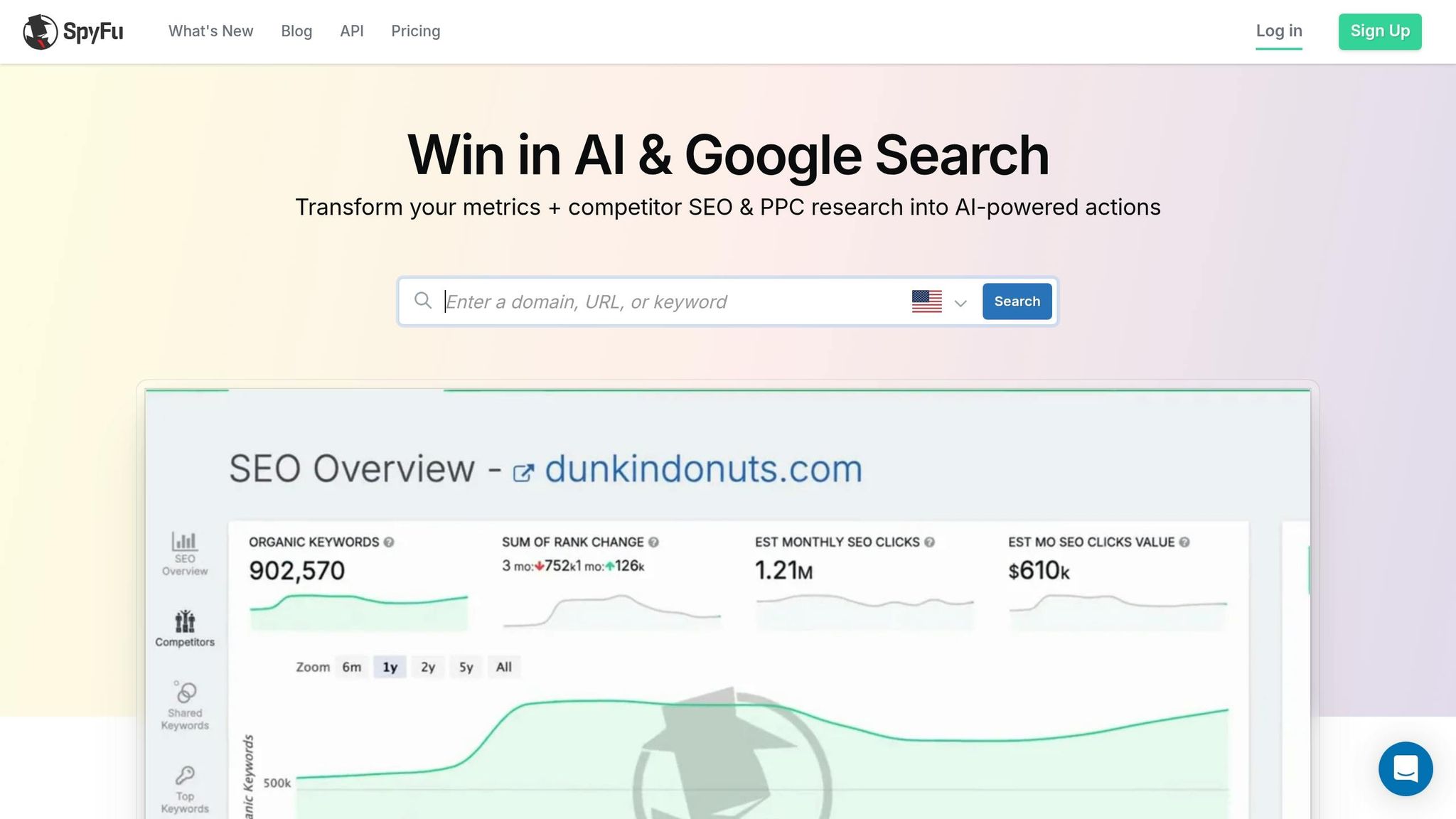
SpyFu focuses on competitor intelligence, offering an impressive 18 years of SEO and PPC data sourced from 152 million websites. This extensive historical tracking lets you analyze competitors’ ranking changes alongside Google algorithm updates and on-page optimizations. With an index covering 7.2 trillion search results and 13.1 billion keywords, SpyFu refreshes its data as often as every 15 seconds.
In addition to its historical insights, SpyFu provides advanced tools for content analysis. The RivalFlow AI tool conducts page-level gap analysis, comparing your content with that of higher-ranking competitors. It identifies missing questions, topics, or examples on your pages and offers suggestions to bridge those gaps. The Top Pages feature highlights competitor pages that drive the most organic traffic, giving you a blueprint for high-performing content. Meanwhile, SEO Kombat uses Venn diagrams to map keyword overlaps between domains, pinpointing "Weaknesses" – keywords your competitors rank for but you don’t.
"SpyFu has carved out a clear niche: competitor-focused keyword and PPC research with a depth of historical data that general-purpose SEO suites do not match." – AI-CMO Review
SpyFu also integrates with ChatGPT through SpyFu GPT, allowing you to pull live competitive data directly into the AI interface for strategic insights. It connects with Google Search Console to monitor ranking improvements after implementing RivalFlow recommendations. The platform is highly rated, with a 4.6/5 score on G2 (518 reviews) and 4.5/5 on Capterra (145 reviews). Users frequently praise its affordability and detailed PPC insights.
SpyFu offers flexible pricing plans to fit various needs. The Basic plan starts at $29 per month (billed annually), providing 10,000 row results, 5,000 weekly tracked keywords, and over 10 years of historical data. The Pro + AI plan is $89 per month (billed annually) and includes unlimited results, 15,000 tracked keywords, 18+ years of data, and API access. For larger teams, the Team plan costs $187 per month (billed annually), offering 50,000 tracked keywords and access for up to 5 users. All plans come with a 30-day money-back guarantee.
SpyFu’s combination of historical depth, real-time updates, and specialized tools makes it an essential resource for any SEO audit.
9. Mangools KWFinder
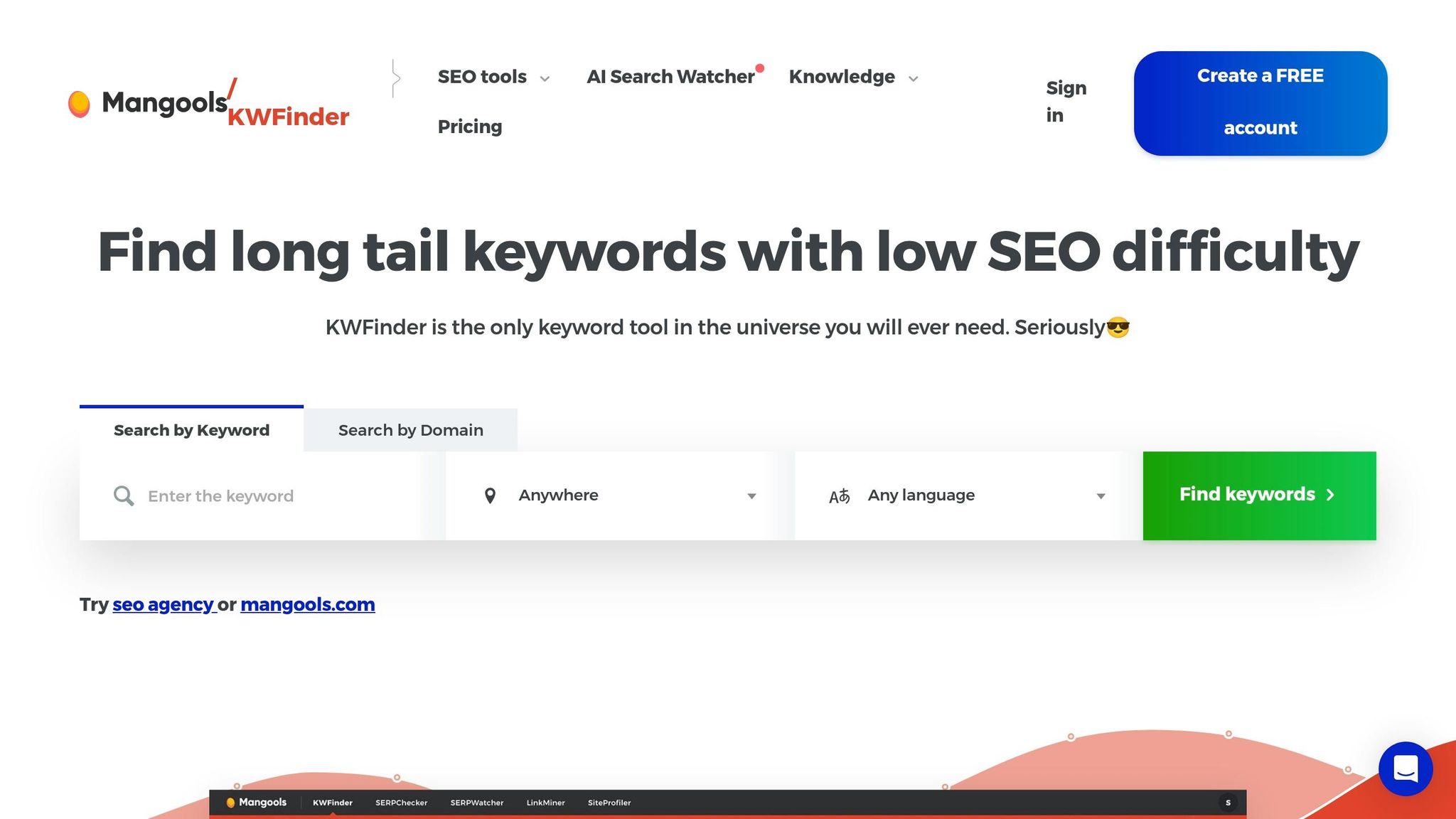
Mangools KWFinder stands out with its user-friendly design and affordable pricing, making it an excellent choice for competitor keyword research. One of its standout features, Search by Domain, allows you to input a competitor’s URL and instantly uncover the keywords driving their organic traffic. It provides data on search volume, keyword difficulty (KD), and estimated traffic metrics. Additionally, the Keyword Gap Analysis tool lets you compare your site with up to five competitors, identifying keywords they rank for that you don’t.
The tool’s SERPChecker feature dives into the top 10 ranking pages for any keyword, offering metrics like Domain Authority (DA), Page Authority (PA), backlink counts, and content length. This breakdown helps you gauge the effort required to outrank competitors. KWFinder uses a 0–100 scale for keyword difficulty, categorizing scores under 30 as easier targets and those above 50 as more competitive. It also highlights SERP features like "People Also Ask" boxes and featured snippets, giving you opportunities to gain visibility even without securing the top spot.
"At $29/month you really can’t go wrong with a Mangools subscription. Great value!" – Brian Dean, Backlinko.com
Mangools offers three subscription options:
- Basic Plan: $29/month (or $290 annually at $19.90/month), includes 100 keyword lookups per day and tracking for 200 keywords.
- Agency Plan: $99/month (or $990 annually at $44.90/month), offers 500 daily lookups and tracking for 700 keywords.
- Pro Plan: $199/month (or $1,990 annually at $89.90/month).
For those wanting to test the waters, a free version allows up to 5 lookups every 24 hours.
Mangools integrates seamlessly with Google Search Console for data verification and includes a Looker Studio connector for reporting. Its suite of tools – KWFinder, SERPChecker, SERPWatcher, LinkMiner, and SiteProfiler – works together to cover keyword research, rank tracking, and backlink analysis in one cohesive platform. With a database of over 2.5 billion keywords, support for 65,000 city-level locations, and a stellar 4.9/5 Trustpilot rating based on 130+ reviews, KWFinder combines powerful features with an intuitive interface. It’s a strong contender as we move toward the final tool in this SEO audit lineup.
10. Woorank
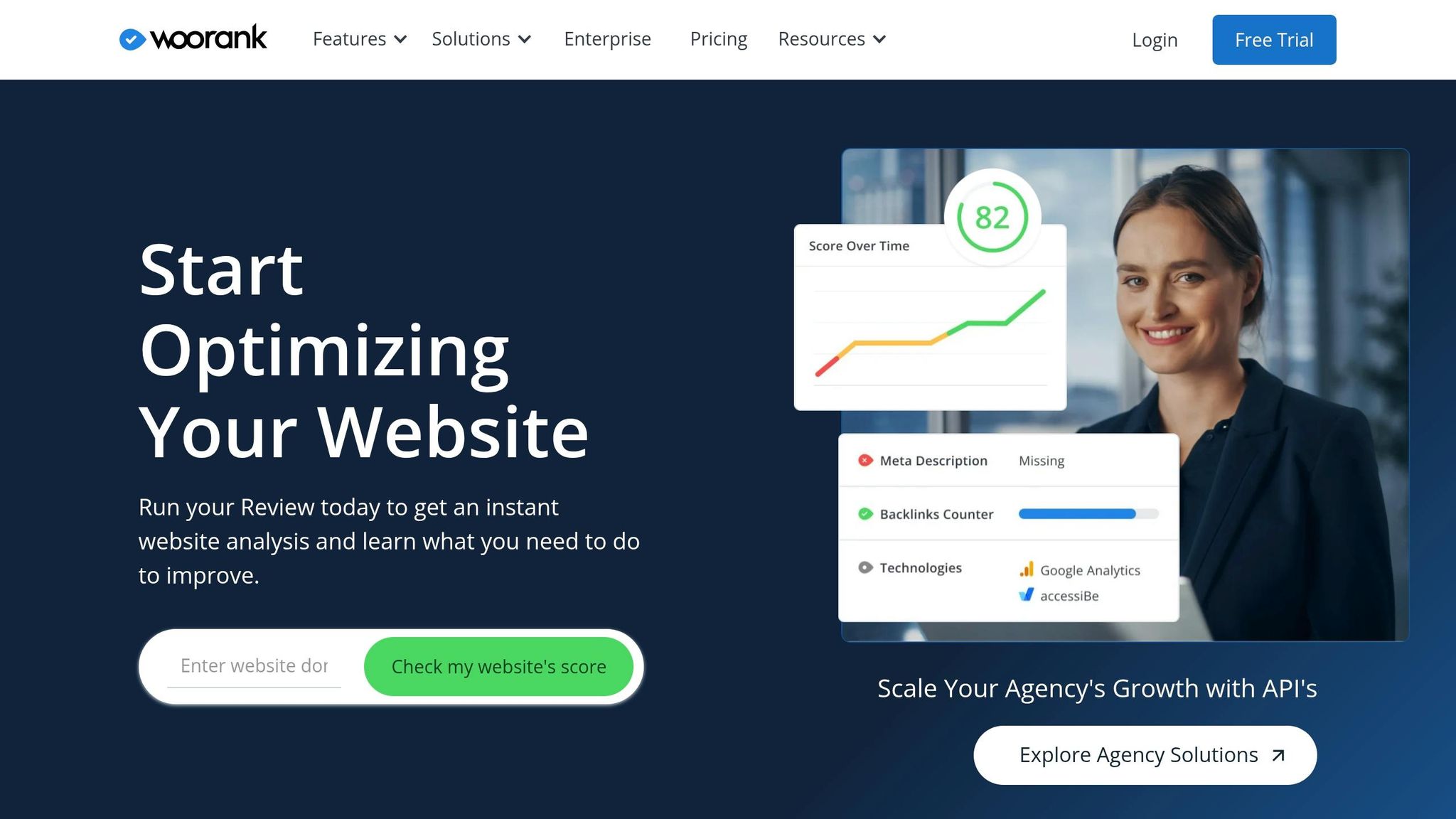
WooRank wraps up our list of SEO auditing tools with its easy-to-understand scoring system. It evaluates on-site SEO, usability, and technical factors, automatically identifying issues like duplicate content, broken links, and redirect errors. Plus, it offers instant insights into Core Web Vitals.
One standout feature is its competitor benchmarking, allowing you to compare your site against up to three competitors. This comparison highlights differences in SEO scores, technical performance, and keyword rankings. WooRank’s Keyword Tool is another useful addition, enabling daily tracking of ranking changes across more than 80 countries using a database of over 5.2 billion keywords. For added convenience, WooRank provides browser extensions for Chrome, Firefox, and Edge, offering unlimited instant reviews of any webpage. This is perfect for quick competitor analysis without setting up a full project.
"With Woorank we can see where we rank for specific keywords in relation to our competitors, helping us decide in which keywords to tackle first and what strategy implement." – Celso Prado
WooRank also integrates seamlessly with GA4, Google Search Console, and Facebook. For backlink analysis, it uses Majestic SEO, and its Premium plan includes white-label PDF reporting. With over 50 million websites analyzed and a 4.3/5 customer satisfaction rating, WooRank has proven its reliability over the years.
Pricing starts at $19.99/month for the Lite plan, which includes 100 page reviews. The Pro plan costs $89.99/month (or $53.25/month if billed annually), covering one website and tracking 50 keywords. For larger needs, the Premium plan is $199.99/month (or $133.25/month annually), supporting five websites and 250 keywords. Enterprise plans offer unlimited projects and full API access. A 3-day free trial lets you explore all core features, and non-profits benefit from a 30% lifetime discount.
With its range of features and flexible pricing, WooRank is a strong contender for anyone looking to sharpen their SEO strategy.
Conclusion
Analyzing competitor on-page SEO doesn’t have to feel like a guessing game. The ten tools highlighted in this guide give you the ability to break down what’s working for your competitors – whether it’s their keyword tactics, content depth, technical structure, or Core Web Vitals. These insights help uncover the elements that set top-performing pages apart.
The trick is choosing tools that match your goals and budget. Interestingly, 90% of SEO professionals rely on at least two tools to strike a balance between data accuracy, feature variety, and cost-effectiveness. If you’re a solo entrepreneur or run a small business, more affordable options might make sense. On the other hand, larger teams or agencies could benefit from platforms offering advanced features like in-depth backlink analysis and white-label reports.
Your role also plays a big part in determining the best tools. For example, content creators may find platforms like SurferSEO or Clearscope helpful for real-time content scoring. Meanwhile, technical SEO specialists might lean towards tools like Screaming Frog or Sitebulb for detailed crawl controls. As search algorithms continue to evolve – Google rolled out several major updates in 2024 – it’s wise to schedule regular audits and monitor rankings weekly.
Before committing to any tool, take advantage of free trials. Test them out over a 30-day period to see which one provides the most actionable insights. You can also set up automated alerts to track competitor keyword shifts and backlink activity, saving you from having to check manually every day.
Ultimately, the right mix of tools can turn competitor analysis into a proactive, results-driven process. Whether you’re identifying content gaps, comparing technical performance, or tracking how AI tools like ChatGPT and Google AI are influencing search visibility, these platforms help you focus on tasks that deliver the best return on investment.
As Jawwad from Contentpen says:
The most valuable tool is the one used consistently, not the one with the longest feature list.
FAQs
Which tools are best for technical vs. content on-page audits?
When it comes to technical on-page audits, tools like Screaming Frog and Ahrefs are excellent choices. They can help you pinpoint issues such as broken links, duplicate content, and page speed problems.
For audits that focus more on content, Clearscope and Moz Pro stand out. These tools are designed to fine-tune keyword usage and enhance content quality.
If you’re looking for platforms that handle both technical and content-specific audits, SEOptimer and RankYak are versatile options. They offer features like site speed analysis and ongoing content optimization.
The best tool for you will depend on what you need to focus on during your audit.
Can I audit competitor sites without verifying them in these tools?
Yes, there are plenty of tools that allow you to analyze competitor websites without needing verification. These tools work by examining publicly accessible data, such as keywords, backlinks, and content performance metrics. This means you can gather insights without having direct access to your competitor’s website.
How often should I run competitor on-page SEO audits?
Conducting competitor on-page SEO audits on a regular basis is crucial for staying ahead in the game. For most businesses, a quarterly schedule works well to keep up with changes and fine-tune strategies. However, if you’re in a fast-paced industry, monthly audits might be more appropriate to stay on top of rapid shifts. At the very least, aim to perform these audits twice a year to ensure your strategies remain relevant and to track your progress.
Ultimately, the right frequency will depend on factors like your industry, the size of your website, and how quickly your competitors are making changes.


