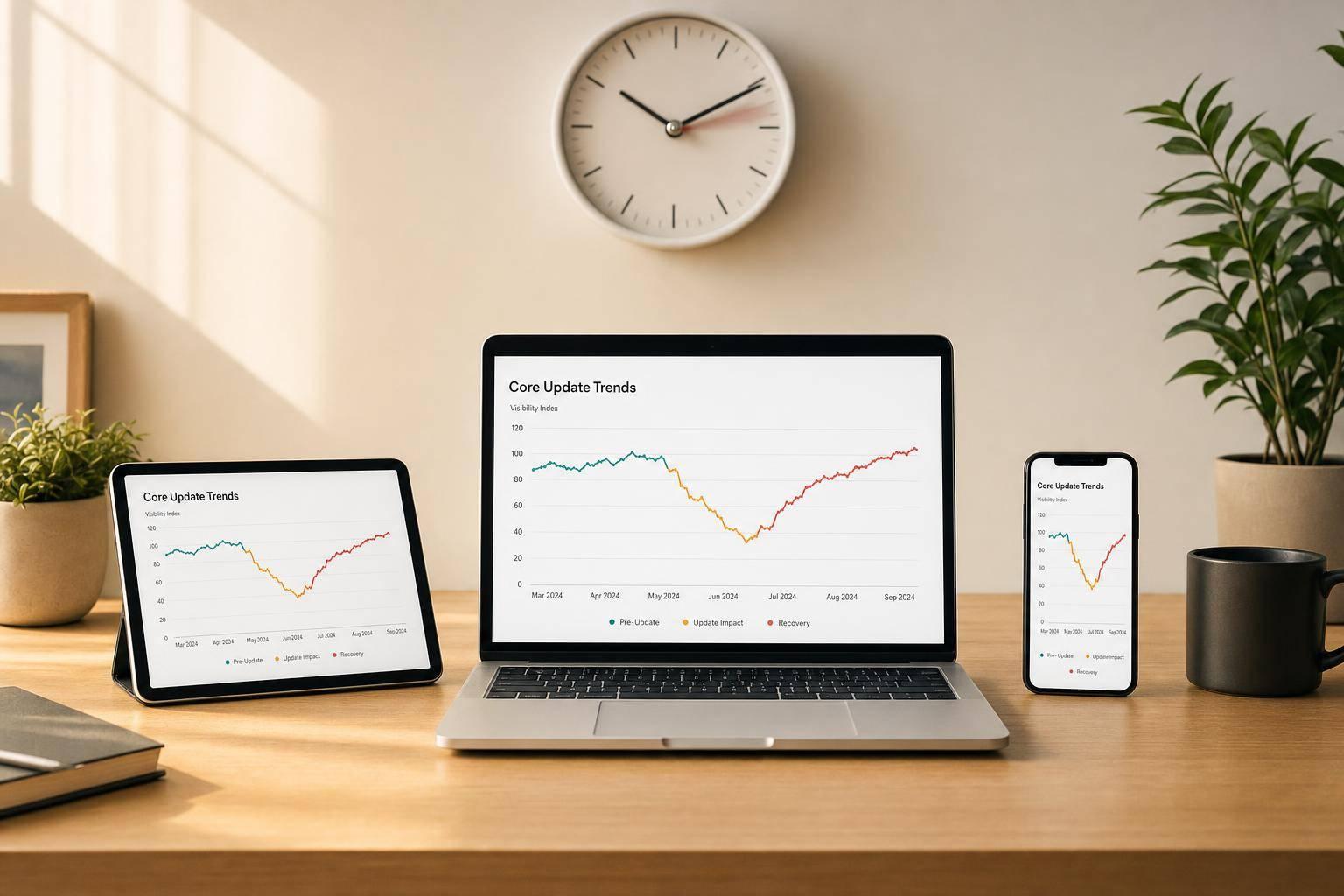
If your Google traffic drops during a core update, I’d wait, verify the dates, and look for patterns across updates before changing pages. Rankings often swing during rollout, and the cleaner read usually comes 60 to 90 days later.
Here’s the short version:
- I’d confirm the update first with Google’s official status sources
- I’d use GSC, GA4, and rank tracking together, not in isolation
- I’d check impact by page type, query intent, device, and search surface
- I’d separate short rollout noise from a lasting decline
- I’d focus fixes on content depth, clear authorship, site transparency, and technical cleanup
- I’d prioritize pages tied to leads, revenue, and ROI, not just traffic
A single drop is just one data point. But if the same page groups lose visibility after multiple rollouts, that usually points to a site quality issue instead of random movement. And if impressions return before clicks, that can be an early sign that changes are starting to work.
| What I’d check | Why it matters |
|---|---|
| Official rollout dates | To confirm it was a core update and not a site issue |
| Non-branded clicks and impressions | To see true SEO impact |
| Page groups and query intent | To find where losses are concentrated |
| Mobile vs. desktop | To spot device-specific problems |
| Conversions and lead flow | To tie traffic loss to business impact |
If I were reviewing this topic for a U.S. marketing team, I’d treat core update tracking as a repeat process: confirm, segment, compare, log, and only then decide what to fix.
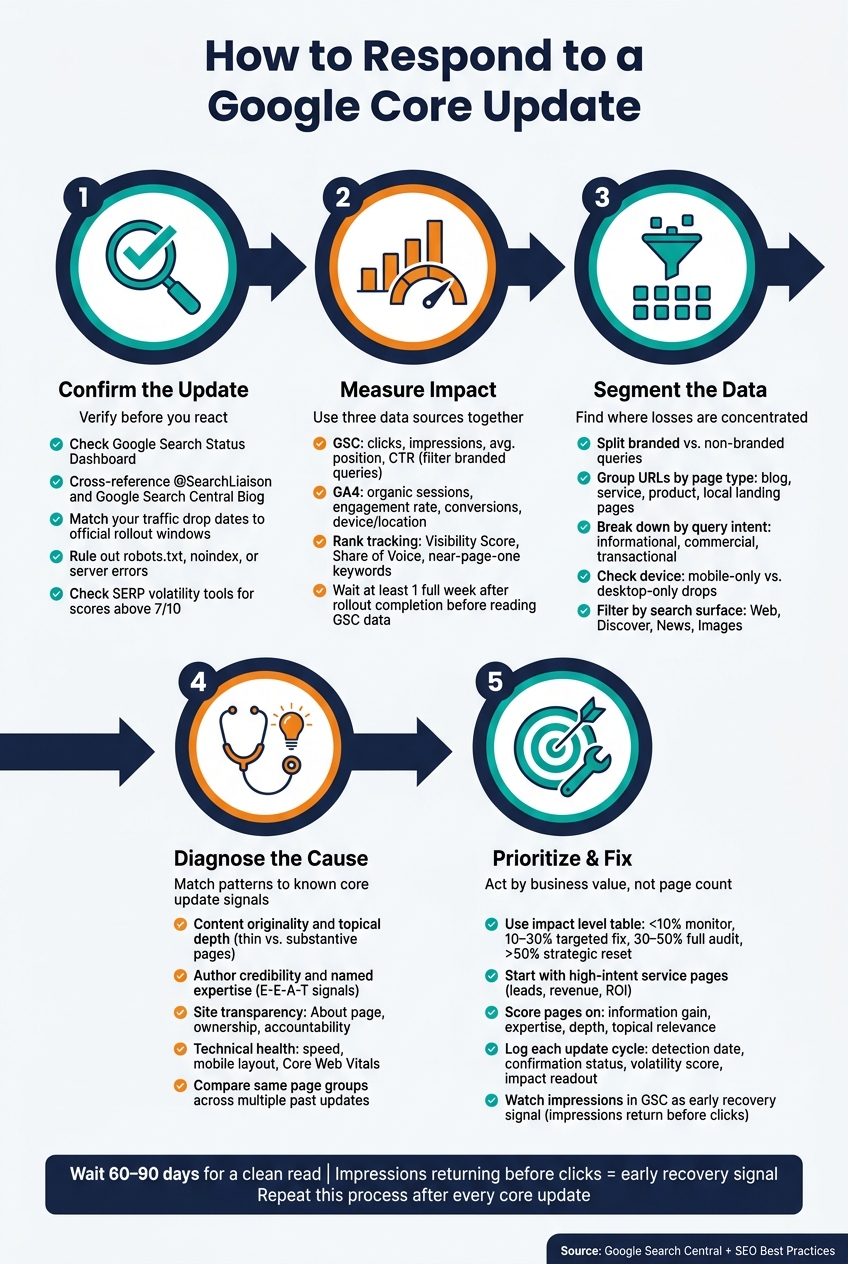
Google Core Update Response Process: Confirm, Segment, Fix, Repeat
How to Confirm and Track Google Core Updates
Confirm the cause before you change anything on your site. A rankings drop can look like a core update when it’s actually seasonality, search volatility, or a technical problem. That’s why confirmation comes first. Trend analysis only makes sense when the update itself is verified.
Use Official Rollout Dates and Trusted Monitoring Sources
Start with the Google Search Status Dashboard, @SearchLiaison, and the Google Search Central Blog. If your rankings moved on a date that doesn’t match a confirmed rollout window, the issue may be something else, like robots.txt, noindex, or server errors. Check those first.
If the dates do line up, use volatility tools to see whether the movement is part of a broader shift. When several tools show scores above 7/10 at the same time, a broad update is likely in progress.
Google recommends waiting at least one full week after completion before reading Search Console data. Google frames core updates as regular changes meant to surface more relevant, satisfying content. Once the rollout is confirmed, use GSC, GA4, and rank tracking to measure impact.
Build a Monitoring Stack with Search Console, GA4, and Rank Tracking
After you verify the update, measure impact from three angles: visibility, traffic, and ranking movement.
Google Search Console (GSC) is your main source for ranking and visibility data. Use the Compare feature to check clicks, impressions, average position, and CTR before and after the rollout. Filter out branded queries so you’re looking at non-branded SEO performance, not brand demand.
GA4 shows what that traffic change means for the business. Pull organic sessions, engagement rate, and conversion events from the Traffic Acquisition report to see whether a rankings drop led to fewer leads or lower revenue. It also helps you spot whether the impact is limited to certain devices or user locations. A year-over-year GA4 check can help rule out seasonality.
Rank tracking tools fill in the day-to-day movement that GSC can blur. Visibility Score and Share of Voice can show whether your site is slipping across the board or only on a small set of keywords. Pay close attention to near-page-one terms on pages 2 to 3. Short post-rollout windows are useful for an early read, but confirm the pattern with a longer baseline comparison.
Use the table below to match each source to the question it answers.
Comparison Table: Which Data Source Answers Which Core Update Question
Each source answers a different question, so it helps to use the right one first.
| Data Source | Primary Metrics | Best Use Case for Core Updates |
|---|---|---|
| Google Search Console | Clicks, Impressions, Avg. Position, CTR | Finding the exact queries and pages that lost visibility; checking whether the impact varies across Web, Images, Video, News, or Discover |
| Google Analytics 4 | Organic Sessions, Engagement Rate, Conversions | Measuring business impact and checking whether certain devices or user locations were hit harder |
| Rank Tracking Tools | Visibility Score, Share of Voice, Keyword Movement | Following daily ranking shifts during the rollout period and watching near-page-one keywords |
| Search Status Dashboard | Rollout Start/End Dates, Update Type | Confirming the official timeline so you can separate algorithm changes from site-specific problems |
| SERP Volatility Tools | Volatility Score (1–10), Weather Reports | Checking whether a rankings shift is site-specific or part of a broader update |
sbb-itb-7a4ada9
How to Analyze Core Update Impact by Page, Query, and Device
Use your GSC and GA4 data to pinpoint which pages, queries, and devices caused the shift. Sitewide traffic totals can blur the picture and make the hit look broader than it is.
Segment Performance by Query Intent, Page Type, and Content Category
Start by splitting branded and non-branded queries. Brand searches usually reflect demand, not how Google treated your pages in the update. So filter those out before you make any calls.
Next, dig into query intent. Informational searches like "how to", "what is", and "best way to" often lose more visibility to AI Overviews, while commercial and transactional queries tend to move less. That matters because the type of loss changes the meaning:
- Informational losses can point to content quality gaps
- Commercial losses can hit revenue more directly
Then group your URLs by page type: blog posts, service pages, product pages, and local landing pages. A basic spreadsheet is enough. Map each URL to a category and mark which pages lost impressions or clicks. This helps you see if the damage is clustered in one part of the site instead of spread across everything.
Check Mobile, Desktop, and Search Surface Differences
Once you’ve grouped the data by page and query, break it down again by device and search surface. Check device performance in both GA4 and GSC. A mobile-only drop often points to layout or Core Web Vitals problems. A desktop-only drop usually suggests something else is going on.
In GSC, use the Search Type filter to compare Web, Images, News, and Discover on their own. Don’t lump Discover in with Web search. If Discover impressions fell off a cliff but your web rankings stayed in place, that’s a surface-specific problem, not proof that the whole site lost favor.
| Segmentation Category | Recommended Tool | Diagnostic Goal |
|---|---|---|
| Page/Directory | GSC (Page Filter) | Determine if specific subdirectories (e.g., /blog/) were hit harder than others |
| Query Intent | GSC (Queries) | Identify if informational queries lost ground to AI Overviews or competitors |
| Device Type | GA4 / GSC | Check if mobile-specific layout or Core Web Vitals issues caused a device-specific drop |
| Search Surface | GSC (Search Type) | Isolate impact on Discover, News, or Image search versus standard Web results |
| Branded vs. Non-Branded | GSC (Query Filter) | Separate brand demand from algorithmic ranking changes |
Tell Apart Short-Term Rollout Drops from Lasting Performance Trends
After you know where the impact landed, the next step is telling rollout turbulence apart from a lasting drop. Don’t rush into big edits before the rollout ends. Put in a 72-hour hold after you first spot movement, then wait until the rollout is marked complete on the Google Search Status Dashboard.
After that, compare a clean 7-day period after the update with your pre-update baseline. Then zoom out to 30 days and use a moving average to see what the trend is doing: recovering, leveling off, or still slipping. Recovery can take weeks or even months, depending on how hard the site was hit.
Core Update Trends That Keep Appearing
Recent core updates keep rewarding the same broad signals. These patterns help explain why some pages stay steady while others drop. Once you know which pages and queries moved, use these trends to make sense of it. The page, query, and device patterns from the last section are the best place to test what changed.
Content Originality, Topical Depth, and Useful Information
Pages with original data, first-hand insight, or a new angle usually do better than rewrites. Substantive content keeps beating thin pages built mostly to chase keyword volume, as seen during the May 2026 Core Update. That’s the main point: original content earns more value. When you go back to your segmentation data, this often explains why some content fell behind.
Sites that stay focused on a narrower group of topics and cover them in depth usually do better than sites that spread out across loosely connected subjects. In plain English, it’s better to go deep than to try to rank for everything.
Trust Signals, Author Credibility, and Business Transparency
Once the content itself looks solid, the next step is the source. Can people tell who wrote it, why they’re worth listening to, and who runs the site? Core updates keep favoring official sources, named experts, and first-hand reporting over generic pages.
Named authors with verifiable credentials tend to do better than content with no clear owner. A strong About page that explains who runs the site and who is behind the work helps build credibility in line with E-E-A-T expectations. For business sites, make ownership, expertise, and accountability obvious. That often explains which source types lost ground in your query analysis.
Technical Health and Internal Site Quality
Start with speed and mobile issues. They won’t fix weak content on their own, but they can keep technical drag from getting in the way. Technical cleanup helps Google crawl, render, and evaluate the page cleanly. Those signals help you sort out what to fix first before the next review.
How to Adjust Your SEO Strategy After a Core Update
Build a Post-Update Review Process Your Team Can Repeat
After the rollout ends, run a structured post-update review. Hold off on big changes until Google says the rollout is finished. That matters because early swings can be noisy, and changing too much too soon can muddy the picture.
Start with Google Search Console Compare to spot which pages, queries, and devices moved the most. Then break performance down by page type, subdirectory, and traffic source so you can see where the change actually hit. It’s a lot easier to fix the right thing when you know whether the drop came from service pages, blog content, mobile traffic, or a specific folder.
It also helps to keep a dedicated algorithm update log. Track the detection date, official confirmation status, volatility scores, and your first impact readout. From there, use the log and performance data to figure out where cleanup work should happen first.
Use this decision table as a quick response guide:
| Impact Level | Traffic Change | Recommended Action |
|---|---|---|
| Minimal | <10% | Document and monitor for 30 days; no immediate remediation. |
| Moderate | 10–30% | Targeted remediation on identified weaknesses. |
| Significant | 30–50% | Comprehensive audit across affected page types and queries. |
| Severe | >50% | Strategic reset; evaluate site model viability. |
Use those patterns to rank fixes by business value, not by page count. A handful of money pages can matter far more than dozens of low-impact URLs.
Prioritize Improvements That Affect Visibility, Leads, and ROI
Not every page needs the same level of work. Start with high-intent service pages before lower-priority blog posts, since those pages often do the most for lead flow and ROI. If a service page slips, the effect can show up far beyond traffic charts.
A simple page score can help sort your next move. Look at:
- information gain
- expertise
- first-hand experience
- depth
- topical relevance
Use that score to decide whether a page should be improved, combined with another page, or removed.
If you need buy-in from leadership, connect organic lead losses to pipeline value in dollar terms. That makes the hit easier to understand and gives you a clearer case for the people, time, and budget needed for a recovery plan.
Watch Search Console impressions as an early recovery signal too. Impressions often come back before clicks, which can be a sign that your changes are starting to help.
Once priorities are clear, the aim is repeatable improvement, not a one-time cleanup.
Conclusion: Key Habits That Help Businesses Stay Resilient
The strongest sites usually do three things well: they confirm the update before reacting, they review impact by page and query type, and they document each cycle in a repeatable reporting system. Content quality and trust signals need steady work, not one-and-done fixes.
If your team needs extra support, a full-service agency like Upward Engine can help turn those insights into a practical SEO plan focused on visibility and ROI.
FAQs
How long should I wait before making SEO changes?
Wait 72 hours after you detect a core update before making major SEO changes. Rankings can bounce around during the rollout, so early moves can send you in the wrong direction.
After the rollout ends, give it at least one full week before you draw conclusions from Search Console or analytics. Recovery often takes 90+ days. In many cases, it takes 6–12 months, and you’ll usually see that confirmed at the next core update.
What signals show a core update drop is lasting?
Don’t react during the rollout. Give it at least one week after the rollout ends, then look at stable data.
A drop is more likely to stick if traffic stays flat at a lower level, keywords don’t bounce back, and crawl frequency doesn’t return to your baseline. Compare post-rollout performance against your pre-update baseline to see whether the decline affects the whole site or only certain page clusters.
Which pages should I fix first after a core update?
After a core update, wait at least 72 hours so the rollout can finish. Then check Google Search Console and compare your post-update numbers with your pre-update baseline. The goal is simple: spot patterns across pages that lost ground.
Start with pages you should update or consolidate. Put extra focus on pages with thin content, unclear authorship, mixed search intent, low engagement, or little that sets them apart. Save deletion for last.