

May 2026 was a significant month for Google Search. In the span of a few weeks, Google released its first official documentation on AI Optimization, announced AI Mode as the new default experience at Google I/O, declared that Search has officially entered the “agentic Gemini era,” deprecated FAQ rich results from SERPs, and began rolling out a core algorithm update that completed on June 2.
The headlines have ranged from measured to hyperbolic. We have read the primary sources, looked at the data, and here is what we actually think is happening, what it means for you, and what you should and should not be doing about it.
1. Google Officially Calls It What It Is: SEO = AIO
Google released its Guide to Optimizing for Generative AI Features in Search on May 16, 2026, and the headline takeaway is something we have been telling clients for months: optimizing for AI-powered Search is still SEO.
“From Google Search’s perspective, optimizing for generative AI search is optimizing for the search experience, and thus still SEO.” — Google Search Central, May 2026
Google explicitly addresses the terms AEO (Answer Engine Optimization) and GEO (Generative Engine Optimization) in the documentation and calls them different names for SEO. This is the backbone of what we do at Upward Engine with our AI SEO services: the same fundamentals that drive traditional search rankings, authoritative content, strong technical structure, and genuine expertise are what drive visibility inside AI Overviews and AI Mode.
What Google Says to Stop Doing
Google specifically calls out several tactics circulating online as “AI SEO hacks” and instructs site owners to ignore them:
- Creating llms.txt files or other machine-readable AI markup
- “Chunking” content into smaller pieces for AI consumption
- Rewriting content with specific AI-friendly phrasing or heavy long-tail keyword targeting
- Pursuing inauthentic brand mentions across third-party sites (this is different from legitimate link building, which remains a core authority signal)
According to Google, these approaches are not supported by how their systems actually work. Now, Google will often state one thing and, in practice, reward another – so take these points with a grain of salt.
What Actually Moves the Needle
Google’s documentation leans on one core principle: create non-commodity content. Content that contributes a unique perspective, first-hand experience, and expert depth that a generative AI model cannot replicate. Organized, crawlable, technically sound pages that serve the reader remain the foundation. For a deeper look at how we approach this for clients, see our SEO services overview.
2. Google Has Officially Entered the Agentic Era of Search
At Google I/O on May 19, 2026, Google announced AI Mode, powered by Gemini 3.5 Flash, as the new default search experience globally. On June 5, Google’s official recap of May confirmed the framing: May 2026 marks the launch of the “agentic Gemini era,” defined by AI systems that do not just answer questions but take actions on your behalf.
AI Mode hit one billion monthly users just one year after launch, with query volume more than doubling every quarter. The new intelligent search box, the biggest redesign in over 25 years, expands dynamically to accept text, images, files, videos, and Chrome tabs as inputs.
The broader product suite announced alongside this includes information agents that monitor the web 24/7 on specific tasks, agentic coding capabilities that build custom generative UI in real time, and Universal Cart for cross-merchant shopping. Google also announced Gemini Omni, a model capable of creating high-quality video from any combination of inputs.
New: Content Transparency Tools Are Coming to Search
One announcement from the June 5 Google recap deserves specific attention for anyone thinking about content strategy: Google is expanding content transparency and verification tools across Search, Gemini, Chrome, and Pixel to help users identify how content was created and whether it was AI-generated.
This matters because it reinforces what the algorithm data is already showing: AI-generated content without meaningful human authorship and editing is under increasing pressure, while content with identifiable expert voices is holding ground or gaining. This is a signal, not just a product feature.
What the Industry Data Is Actually Showing
The announcement sent some corners of the SEO world into panic. The reality is more nuanced, and the data is instructive.
38-61% drop in click-through rate on queries where an AI Overview appears (SEJ / SISTRIX, 2026)
35% more clicks earned by brands cited inside AI Overviews vs. non-cited competitors (QuickSEO research, 2026)
66% of SEO professionals do not expect full replacement of traditional search (Search Engine Roundtable survey, May 2026)
The zero-click concern is real for certain query types, particularly simple informational queries where AI can answer without a click. But the citation benefit tells the more important story for businesses investing in content authority: being the source Google’s AI cites generates more traffic than a traditional position-one without a citation.
Post-rollout analysis from practitioners confirms that thin informational content and AI-generated content without meaningful human editing took the heaviest losses. Sites with strong topical authority and named expert voices held or gained ground. This is exactly the positioning our SEO programs and Enterprise SEO work are built to create.
Our Honest Take: Wait and See on the Product Announcements
We have seen significant coverage of these announcements, but the specific new features described are not yet visible in practice for most users.
Information agents are launching first for paid Google AI Pro and Ultra subscribers this summer. Agentic coding and generative UI features have no firm date beyond “this summer” and “coming months.” The rollout is staggered, and the experienced reality for the average searcher is still evolving.
What we are watching: whether AI Mode changes click-through patterns by vertical, how source attribution evolves as agents become more prominent, and whether the citation opportunity creates a measurable traffic floor for high-authority sites. These are signals to track over the next two to three quarters, not reasons to pivot strategy today.
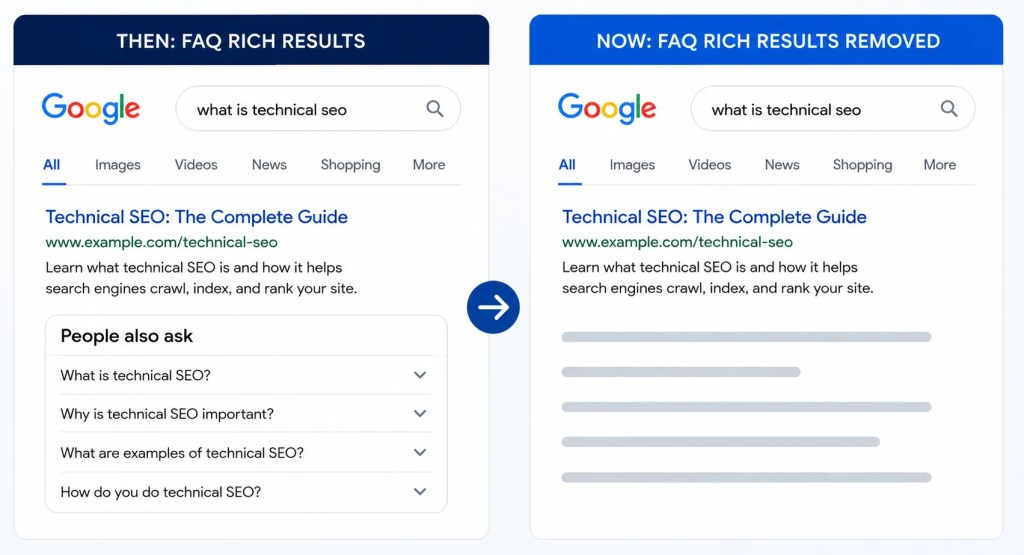
3. FAQ Rich Results Are Gone from SERPs. FAQ Schema Is Not.
As of May 7, 2026, Google stopped displaying FAQ rich results in Search. The visual enhancement, the expandable question-and-answer block that appeared directly in SERPs, is being fully removed. The rich result report in Search Console and support in the Rich Results Test drop in June 2026; the Search Console API removes support in August 2026. This was confirmed by Barry Schwartz at Search Engine Roundtable and covered in depth by Search Engine Land.
Important Context Most Coverage Is Missing
First, FAQ rich results in SERPs were already restricted to government-focused and health-focused websites. For the majority of businesses, that visual enhancement was never generating impressions to begin with. The broader impact of this change is smaller than most coverage suggests.
Second, and critically, the FAQPage structured data type itself is not deprecated. Google confirmed this explicitly. The deprecation applies only to the SERP enhancement, not the schema markup or its underlying value to how machines read your content.
Why FAQ Schema Still Belongs in Your Strategy
Google’s AI features, including AI Overviews and AI Mode, use retrieval-augmented generation: a process where the model pulls specific content from indexed pages to build its responses. Well-structured, machine-readable content, including content organized with FAQ Schema, gives Google’s systems a cleaner signal about what questions your page answers and how it answers them.
Our strategy of enriching pages with FAQ Schema to improve LLM visibility is unchanged. The goal was never the SERP visual enhancement. The goal is to ensure AI systems can accurately represent your content when responding to queries relevant to your business.
4. May 2026 Core Update: Complete as of June 2
Google began rolling out the May 2026 core update on May 21, 2026, and Search Engine Land confirmed it completed on June 2, 2026. The rollout took approximately two weeks, which is typical for a broad core update.
Post-rollout analysis from GSQI and others indicates this was a meaningful update, not a minor shuffle. The pattern holds with what we have seen in prior core updates: sites with strong topical depth and quality signals recovered or improved, while thin content took measurable losses.
What to Do With Your Data
If you have Search Console access, compare your performance from the week of May 21 forward against the prior 28-day period. Focus on page-level data, not just site-wide totals. If specific pages lost visibility, look for patterns: Are they your thinnest pages? Pages built primarily around a single keyword? Pages without clear authorship signals?

We track core updates as a standard part of monthly performance reporting for all clients. If something looks unusual in your data from the past few weeks, bring it to your account manager, and we will review it in context. You can also see examples of how we approach this in our case studies.
The Bottom Line
May 2026 was a confirmation month more than a change month for how we approach SEO. Google put in writing what strong SEO practices have always required. The agentic era framing is real, and the product direction is significant, but the features are still rolling out, and the data shows that citation authority, not panic-driven pivots, is the right response. The FAQ rich result deprecation is a surface-level SERP change, not a strategy change. And the core update is complete, with the patterns we expected.
For clients with programs built on content authority, technical health, and genuine expertise positioning, none of these announcements requires a pivot. They require continued, disciplined execution.
Want to talk through what any of this means for your specific program? Reach out to our team, and we will walk through it in the context of your industry and goals. You can also find more SEO analysis and strategy on the Upward Engine blog.
Sources
Google Search Central: Optimizing for Generative AI Features in Search
Google Blog: A New Era for AI Search (Google I/O 2026)
Google Blog: The Latest AI News We Announced in May 2026
Google Search Central: FAQ Structured Data (Deprecation Notice)
Search Engine Land: Google May 2026 Core Update Rollout Is Now Complete
Search Engine Journal: Study Confirms Google AI Overviews Cut Organic Clicks 38%
Search Engine Roundtable: June 2026 Google Webmaster Report
Google Search Status Dashboard: May 2026 Core Update


