Multi-channel shopping has become the norm, but it’s not without its challenges. Customers expect smooth transitions across platforms – whether they’re browsing Instagram, researching on Google, or buying in-store. Yet, many brands struggle with inconsistent messaging, fragmented data, and poor coordination between channels. These issues lead to customer frustration, lost trust, and wasted marketing budgets.
Here’s what you need to know to fix it:
- Inconsistent Messaging: Ensure promotions, pricing, and branding are aligned across all platforms.
- Fragmented Data: Centralize customer data for a complete view of interactions and preferences.
- Poor Coordination: Automate workflows and improve communication between teams to create a unified experience.
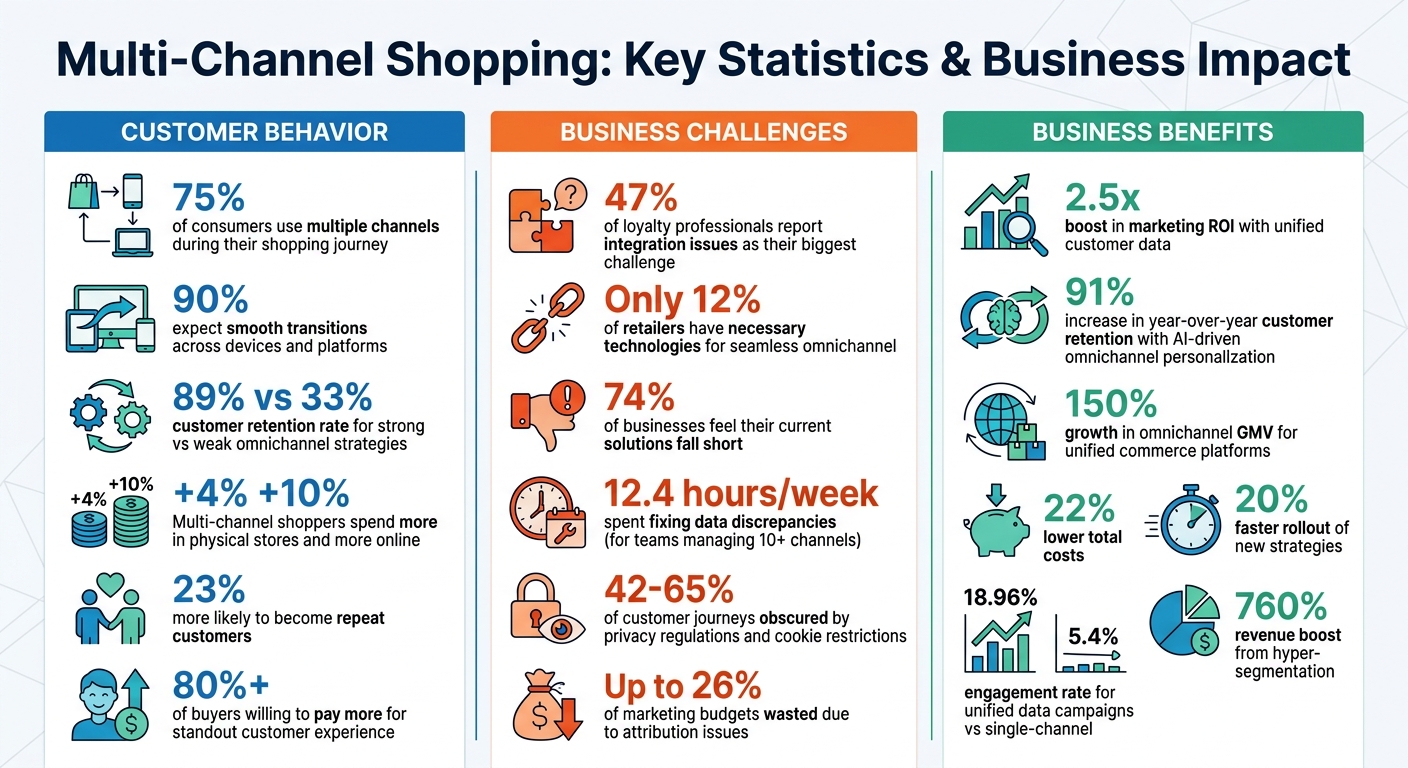
Multi-Channel Customer Journey Statistics and ROI Impact
Mastering Cross-Channel Marketing For A Seamless Customer Journey
sbb-itb-7a4ada9
Common Pain Points in Multi-Channel Journeys
When platforms don’t work together seamlessly, businesses often face three major challenges: inconsistent messaging, fragmented data, and poor coordination between channels. These issues frustrate customers and waste valuable marketing resources.
Inconsistent Messaging Across Channels
One of the biggest hurdles is when customers encounter conflicting brand messages. Promotions, pricing, or even design elements can vary across platforms. Why? Each platform comes with its own set of constraints – such as technical limitations on fonts, layouts, and color palettes. These restrictions often make it difficult to maintain consistent brand guidelines, especially on third-party platforms.
Payment options can also add to the confusion. For instance, a customer might find one payment method available on a brand’s website but not on their app. This lack of consistency erodes trust. The solution? Establish strict brand standards and ensure clear communication about any unavoidable differences, such as pricing variations due to platform-specific costs.
But inconsistent messaging is just the tip of the iceberg. The next challenge lies in how scattered data worsens these issues.
Fragmented Customer Data
When customer data is scattered across systems, teams lose the ability to see the full picture. In fact, 47% of loyalty professionals report that integration issues are their biggest challenge. This lack of integration slows processes like onboarding, which can stretch from days to weeks. Worse, it can cause different teams to send conflicting offers to the same customer.
This problem is even more pronounced in B2B settings. For example, a distributor might receive a 15% discount from one regional team, only to get a 20% discount from another. These discrepancies, often referred to as lost revenue opportunities, highlight how fragmented data can directly impact the bottom line. Without a unified view, delivering personalized and timely experiences becomes nearly impossible.
And when data is fragmented, teamwork suffers, leading to the next major challenge: poor coordination across channels.
Poor Channel Coordination
Channel silos often result in clunky, disconnected customer experiences. Teams working in isolation struggle to provide the seamless interactions customers now expect across platforms.
"Running an omnichannel program is about meeting different audiences where they are and investing accordingly."
– Madison Sternberg, Sr. Account Director, Fashion at Power Digital
This lack of coordination also complicates measurement. Traditional last-click attribution models often fail to reflect how different channels contribute to the buyer’s journey. As a result, brands may undervalue critical touchpoints. On the flip side, businesses that align their efforts across platforms often see significant cost efficiencies and stronger performance. Coordinated messaging not only improves customer experience but also ensures marketing dollars are spent wisely.
Solutions to Fix Multi-Channel Pain Points
Now that the main challenges are clear, let’s dive into how businesses can address them. The best part? Companies are already putting these strategies into action and seeing real results.
Creating Consistent Messaging Across Platforms
Unified commerce solves the problem of inconsistent messaging by operating from a single source of truth. Instead of relying on complicated integrations between different systems, a unified platform ensures that product details, pricing, and promotions match across every channel – whether it’s social media, your website, or a physical store.
Take Tomlinson’s Pet Supply, for example. In 2025, they used Shopify Functions to apply their Pet Club pricing both online and in-store instantly. This cut checkout times by 56% and built customer trust.
"It used to require multiple steps to apply a percentage off products that were part of a promotion. But with Shopify, the right discounts populate automatically when you add items to the cart. It’s a thing of beauty."
– Kate Knecht, Owner and Operator, Tomlinson’s Pet Supply
Catalina Crunch also streamlined its messaging between Amazon, Instacart, and retail stores by partnering with Power Digital between 2025 and 2026. This unified strategy led to a 47% year-over-year increase in Amazon revenue and a 144% jump in Instacart revenue.
To start, audit your tech stack with professional SEO services to identify any tools creating data silos. Transform your website by mapping out all customer touchpoints to see where messaging breaks down, and implement centralized systems that apply consistent promotion rules across all channels.
Once messaging is aligned, the next hurdle is tackling fragmented customer data.
Unifying Customer Data for Better Insights
Consistent messaging is only part of the equation. To truly understand your customers, you need to integrate data from every interaction into a single, comprehensive profile. This 360-degree view should include transaction history, behavior patterns, and preferences, accessible across all touchpoints.
Astrid & Miyu, a jewelry retailer, achieved impressive results in 2025 by unifying customer profiles across 23 stores and their ecommerce platform. Store teams could access real-time data on customers’ online activity, enabling them to deliver personalized experiences. The result? A fivefold increase in customers who made more than four purchases, with omnichannel shoppers showing a 40% higher customer lifetime value compared to online-only buyers.
"When a customer walks into our store, our team can quickly access their purchase history, loyalty status, and preferences. That unified view helps create the personalized experience our Gen Z customers expect."
– Alex Collis, Director of Operations and Customer Experience, Princess Polly
Data integration also powers targeted messaging. For example, campaigns using unified data achieved an 18.96% engagement rate, compared to just 5.4% for single-channel efforts. Hyper-segmentation based on this data has been shown to boost revenue by 760%.
To address fragmented data, consider implementing a Customer Data Platform (CDP) or a unified commerce system that syncs data from your CRM, email tools, and web analytics in real time. This ensures that inventory, pricing, and promotions stay consistent across all channels.
With a unified view of your customers, the next step is optimizing how channels work together.
Improving Channel Coordination
Once messaging and data are unified, it’s time to ensure smooth coordination between channels. Poor channel coordination often forces customers to repeat themselves, creating a frustrating experience. The solution? Design workflows where actions in one channel automatically trigger responses in another.
For instance, Princess Polly introduced Shopify POS to seven U.S. stores in 2024, connecting physical tills with the same live inventory and customer profiles used on their website. This setup allowed for unified gift card balances and instant exchanges, reducing out-of-stock incidents by 55% and keeping checkout times under a minute.
Ruggable took this a step further during its Canada launch by using a multi-entity management system to consolidate orders and payments on one dashboard. This approach saved 330 hours of initial setup time, cut annual maintenance by nearly 6,000 hours, and reduced third-party fees by $55,000.
To improve coordination, adopt multi-touch attribution models that show how channels work together to drive conversions, rather than relying on outdated last-click metrics. Focus on a balanced mix of channels – such as email for primary communication, social ads for retargeting, and personalized website experiences for conversions. Automate handoffs between channels, like sending an SMS reminder if an email goes unopened or launching a social ad after a product view.
Brands leveraging unified commerce platforms report up to 150% growth in omnichannel gross merchandise value (GMV), 22% lower total costs, and 20% faster rollout of new strategies.
Building Infrastructure for Multi-Channel Success
Once you’ve tackled challenges with messaging, data, and coordination, the next step is creating a solid infrastructure to support multi-channel customer journeys. The reality is, only 12% of retailers have the necessary technologies in place for a seamless omnichannel approach. Meanwhile, 74% of businesses feel their current solutions fall short. For marketing teams managing 10 or more channels, an average of 12.4 hours each week is spent fixing data discrepancies. Add to that privacy regulations and cookie restrictions, which obscure 42–65% of customer journeys, and you’re left with major attribution issues leading to up to 26% of wasted marketing budgets. By addressing these gaps with better technology and streamlined processes, you can lay the groundwork for sustainable multi-channel success.
Implementing Scalable Technology Solutions
The backbone of a strong infrastructure is a unified data foundation. Centralized ETL (Extract, Transform, Load) pipelines bring together data from platforms like Google Ads, Salesforce, and email systems into one analytics environment. This eliminates the need for manual reconciliation and ensures consistency.
Identity resolution engines are another key piece. They connect fragmented customer interactions across channels using deterministic methods (like email or login IDs) and probabilistic techniques (like device fingerprinting). These tools address cross-device tracking gaps, which currently obscure about 35% of customer journeys. Closing these gaps enables more precise personalization.
As third-party cookies become less effective, server-side tracking has become indispensable. With iOS privacy updates and similar changes, brands need solutions that bypass browser-level tracking restrictions. Server-side tracking ensures consistent data collection, even when customers switch devices or browsers.
AI-driven analytics platforms are also transforming the game. These systems analyze customer actions in real time to recommend the "next best action." They also allow marketers to query cross-channel data using natural language, making insights more accessible. Companies utilizing AI for omnichannel personalization report a 91% increase in year-over-year customer retention.
To ensure your infrastructure is effective, start by creating a data dictionary – a centralized document that defines all metrics clearly. This helps marketing, sales, and support teams stay on the same page. Before introducing new tools, conduct a thorough tag audit using platforms like Google Tag Manager to avoid conflicts between old and new tracking scripts. If your business generates fewer than 1,000 conversions per month, stick to rule-based attribution models (like position-based or time-decay) instead of algorithmic ones, which require larger data sets.
Encouraging Cross-Functional Collaboration
While technology is crucial, aligning your teams is just as important for delivering a seamless customer experience. One effective way to achieve this is through customer journey mapping, which brings together marketing, sales, customer service, and product development to visualize shared customer experiences.
"Journey mapping is a collaborative effort that helps align different teams across an organization… By visualizing shared customer experiences, journey maps can connect organizational silos, clarifying responsibilities and fostering a common understanding of customer needs."
– Isabel Grillmayr, Marketing Perspective Contributor, Smaply
Journey maps make it clear who is responsible for each phase of the customer experience. This reduces redundant efforts and highlights opportunities for collaboration. Use journey performance indicators (JPIs) with a "traffic light" system – red, yellow, green – to give teams a quick overview of how customer interactions are performing.
Another useful tool is an opportunity portfolio, which organizes pain points and improvement opportunities into a shared backlog. Prioritize initiatives based on their potential impact, feasibility, and financial value. This ensures teams focus on solutions that benefit the overall customer journey rather than isolated channels.
Shift your focus from channel-specific KPIs to customer-centric outcomes. Reward teams based on metrics like customer retention and lifetime value instead of isolated stats like email open rates or social media engagement. This approach fosters collaboration rather than competition between departments.
Finally, conduct cross-functional mapping workshops with stakeholders from all departments. This ensures journey maps are based on real customer behavior rather than internal assumptions. These workshops help teams identify where the customer experience is thriving and where it needs improvement.
Brands with unified customer data see a 2.5x boost in marketing ROI, and those with strong omnichannel engagement retain 89% of their customers, compared to just 33% for weaker strategies. By integrating customer data and fostering collaboration, you can significantly improve both ROI and retention rates.
Conclusion: Delivering Better Multi-Channel Experiences
These days, multi-channel shopping is the norm. Around 75% of consumers use multiple channels during their shopping journey, and 90% expect smooth transitions across devices and platforms. To meet these expectations, businesses must tackle issues like inconsistent messaging, fragmented data, and poor coordination. The goal? To ensure that whether a customer is on your website, social media, email, or in-store, they experience one cohesive brand.
And here’s the payoff: addressing these challenges isn’t just good for customers – it’s great for business. Shoppers who engage across multiple channels spend 4% more in physical stores and 10% more online. They’re also 23% more likely to become repeat customers. Plus, over 80% of buyers say they’re willing to pay more for a standout customer experience.
Key Takeaways for Multi-Channel Strategies
To strengthen your multi-channel efforts, consider these actionable steps:
- Ensure every touchpoint works together as part of a single, seamless customer journey. This means customers shouldn’t feel like they’re starting over when they move from Instagram to your website or from your app to your store. Keep messaging, pricing, and details consistent across all platforms to build trust.
- Use data-driven personalization to create tailored experiences based on customer behavior. Integrated CRM systems can help refine these journeys continuously. Regularly audit your touchpoints – both online and offline – to identify areas where customers face friction. Feedback tools, like surveys, can help pinpoint specific issues such as slow checkouts or confusing navigation.
- Align your teams – marketing, sales, support, and product development – around shared, customer-focused KPIs. Metrics like retention and lifetime value should guide your efforts to consistently deliver smooth, enjoyable experiences. When teams work toward the same goals, the customer journey improves across the board.
FAQs
Where should I start if my channels don’t match?
To create a smooth and connected experience for your customers, start by mapping their journeys across every touchpoint. This process helps you uncover any inconsistencies that might disrupt their experience.
Dive into feedback from all your channels – whether it’s social media, email, or in-store interactions. By analyzing this data collectively, you can gain a clearer picture of where things might be out of sync.
Pay attention to red flags like mismatched branding or isolated data systems that prevent a unified approach. Leveraging cross-channel analytics can help you align your efforts, ensuring every interaction feels cohesive and consistent for your customers.
Do I need a CDP or a unified commerce platform?
Choosing the right tool for your business – whether it’s a Customer Data Platform (CDP) or a unified commerce platform – comes down to your specific goals. A CDP focuses on bringing together customer data to enable personalized, real-time interactions. By eliminating silos, it helps improve marketing efficiency and drive better ROI. On the other hand, a unified commerce platform connects sales, inventory, and engagement systems, ensuring smooth and consistent experiences across all customer touchpoints.
For businesses aiming for the most seamless customer experience, combining a CDP with journey management tools can often deliver the best results. This pairing allows you to not only understand your customers better but also guide them through their interactions with your brand effortlessly.
How can I measure ROI without last-click attribution?
To evaluate ROI without relying on last-click attribution, consider using multi-channel attribution models. These models distribute credit across all the touchpoints in a customer’s journey, offering a clearer picture of how each channel influences conversions. By adopting this method, you can gain deeper insights into the performance of your marketing efforts and make more informed adjustments to your strategies.