Social media lead personalization is all about tailoring your content and interactions to match individual preferences, behaviors, and demographics. By leveraging data from social media activity, browsing habits, and CRMs, businesses can create targeted messages that resonate with their audience. Here’s why it matters and how to get started:
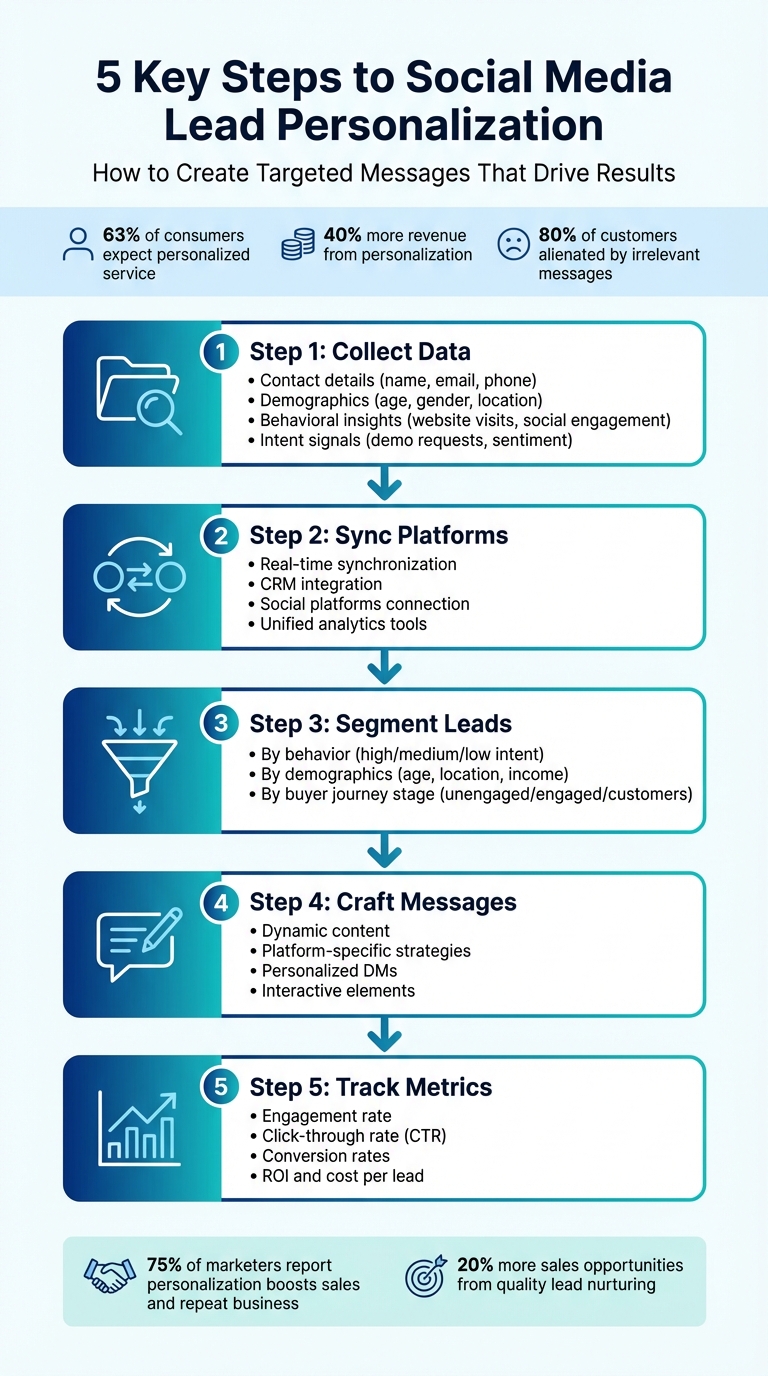
- Why Personalization Matters: 63% of consumers expect personalized service, and businesses using this approach see up to 40% more revenue. Irrelevant messages, on the other hand, can alienate 80% of potential customers.
- Key Steps:
- Collect Data: Gather contact details, demographics, behavioral insights, and intent signals.
- Sync Platforms: Integrate data across CRMs, social platforms, and analytics tools for a unified view.
- Segment Leads: Divide your audience by behavior, demographics, and buyer journey stage.
- Craft Messages: Use dynamic content, platform-specific strategies, and personalized DMs.
- Track Metrics: Monitor engagement, CTR, conversion rates, and ROI to refine your efforts.
Personalization cuts through the noise of generic messaging, helping businesses connect with leads on a deeper level and drive better results. Ready to make it work for you? Start by analyzing your audience data and tailoring your approach today.
5-Step Social Media Lead Personalization Process
Setting Up Your Social Media Lead Personalization System
What Data You Need to Collect
To get started with personalization, you’ll need to gather the right data. Begin with basic contact details like name, email, phone number, and address. From there, layer in demographic information such as age, gender, location, income, and education – this helps you craft more targeted messages.
Behavioral data is equally important. Pay attention to actions like website visits, social media engagement, and, for B2B leads, include firmographics (e.g., company name, job title, and industry). Don’t forget psychographics – understanding your leads’ values, goals, and pain points allows you to align your messaging with what matters most to them. Finally, track intent signals like demo requests or sentiment data (whether reactions to your brand are positive, neutral, or negative). These insights help you time your outreach for maximum impact.
Here’s why this matters: 75% of marketers report that personalization based on detailed lead data boosts sales and repeat business. Additionally, businesses that nurture leads with quality data generate 20% more sales opportunities. Tools like native lead forms on platforms such as Facebook, LinkedIn, and TikTok make it easy to collect pre-filled user data without redirecting users off the app. To track which posts drive traffic to your site, use UTM parameters on your social media links.
Once you’ve defined your data collection process, it’s time to integrate these insights across your platforms.
Combining Data Across Platforms
Collecting data is just the first step – merging it into one cohesive system is where the magic happens. Surprisingly, many marketers don’t fully sync their social data with their CRM, which means they miss out on real-time insights. By enabling real-time synchronization, you can instantly transfer lead data from social media ad forms into your CRM or email marketing software.
Jason Bahnak, Founder of Abstrakt Marketing Group, highlights the benefits:
When your lead data flows in real time across your systems, you can immediately see what’s working and where to adjust your campaigns. That level of visibility shortens the feedback loop and drives smarter marketing decisions.
Social CRM platforms take this a step further by blending traditional CRM features with data from social networks. This gives you a complete view of your prospects, including their engagement and nurturing history. For businesses juggling multiple platforms, third-party APIs simplify the process by providing a single interface to access data from TikTok, Instagram, YouTube, and X. Tools like SocialPilot and Hootsuite also offer unified dashboards that consolidate metrics like engagement, reach, and follower growth into one easy-to-read report.
To build a full picture of your leads, connect their social profiles to website behavior using UTM parameters. Additionally, monitoring social listening for mentions of your brand, hashtags, or competitors can help you spot warm leads who are actively seeking recommendations or voicing concerns.
With your data synced and organized, the next step is choosing the right tools to turn that information into actionable insights.
Tools for Managing Your Data
The right tools can transform scattered data into a powerful personalization system. CRMs like Salesforce and HubSpot are excellent for creating detailed lead profiles and segmentation. For platform-specific insights, dashboards such as Meta Business Suite, LinkedIn Analytics, and TikTok Insights deliver valuable metrics. If you need a cross-platform view, tools like SocialPilot, Hootsuite, and Sprout Social provide a complete picture of all your social channels.
To fill in data gaps, consider lead enrichment tools like Clay, Apollo.io, and Clearbit. These tools can match social usernames to professional emails, job titles, and even company details like revenue or tech stacks. For seamless integration between your social platforms and CRM, tools like LeadsBridge are invaluable.
When selecting tools, think about your business size and budget. SocialPilot is often praised for being budget-friendly for small businesses and agencies, while Sprout Social caters to larger enterprises needing advanced features. Some tools, like Pipedrive, offer free trials (e.g., a 14-day trial for its social CRM features), and others, like SociaVault, provide free data extraction credits to get you started.
Lastly, ensure compliance with regulations like GDPR, CCPA, and TCPA, as well as platform-specific rules. With the right tools in place, you’ll be ready to create personalized messages that resonate with your leads and support your overall goals. Once your system is set, you can move on to segmenting your leads for even greater precision.
sbb-itb-7a4ada9
90% Open Rate: This AI Monitors Socials and Creates Custom Lead Magnets
How to Segment Your Social Media Leads
Once your data system is ready, it’s time to divide your audience into meaningful groups. This process, known as segmentation, allows you to deliver messages that resonate with specific subsets of your audience. Why does this matter? Because personalization works – 80% of consumers prefer tailored experiences, and 56% are more likely to become repeat buyers because of it. Here’s how you can effectively segment your leads.
Segmenting by Behavior
Behavioral segmentation focuses on your audience’s actions – things like clicking links, sharing posts, commenting, downloading resources, or visiting specific pages. For example, someone who visits your pricing page or downloads a gated report shows high intent, while a simple "like" suggests lower engagement.
Take BambooHR in 2024 as an example. They used LinkedIn Lead Gen Forms to offer early access to a new feature, targeting users who had previously interacted with their content. This approach resulted in a 53% higher submission rate compared to traditional website lead forms. Similarly, Alida ran a LinkedIn campaign aimed at senior decision-makers, leveraging behavioral data like job titles and content engagement. The results? A 5X increase in sales leads and a 122% improvement in conversion rates.
Start by categorizing actions into intent levels. For instance:
- Visits to your pricing page = High Intent
- Downloads of case studies = Medium Intent
- General social interactions = Low Intent
Use retargeting data to create segments based on these actions. For example, you can target users who abandoned a lead form or watched a specific video. Sequential retargeting is another option – serve follow-up ads only to those who engaged with earlier content. Social listening tools can also help you find leads discussing your brand or related topics.
"Lead gen isn’t outreach anymore. It’s positioning. It’s timing. It’s trust at scale." – Vikash Soni, CTO & Co-Founder, DianApps
Segmenting by Demographics and Interests
Demographics and interests provide another layer of segmentation. For B2C businesses, this might include age, gender, location, income, or education. In B2B contexts, factors like company size, industry, revenue, and job titles become more relevant. Adding psychographics – such as values, lifestyle, and personality traits – can further refine your messaging.
In 2024, Maserati took its traditional TV ads and reformatted them into Instagram and Facebook Reels, targeting mobile users with visually impactful videos. This strategy boosted lead volume by 25% while cutting the cost per lead by 20%.
Social platforms make this type of segmentation fairly straightforward. For instance:
- Facebook allows targeting by demographics and interests.
- LinkedIn offers filters for industry, company size, and job title.
Interactive quizzes are another way to segment leads naturally based on their responses. You can also schedule posts to align with different time zones, ensuring your content reaches users when they’re most active. Creating dedicated groups – like private Facebook or LinkedIn communities – can provide deeper insights into what specific segments need.
Segmenting by Buyer Journey Stage
Not all leads are at the same point in the buying process. By segmenting based on their position in the buyer journey, you can align your messaging with their needs. Leads typically fall into three categories:
- Unengaged: Leads who are disconnected or have churned.
- Engaged: Those showing interest but still in the evaluation phase.
- Customers: People who have already converted.
For unengaged leads, focus on rekindling interest with educational content, lead magnets, or reminders of past interactions. Engaged leads may respond better to free trials, product demos, or content that addresses their specific challenges. For existing customers, tailor your efforts toward retention through upselling, cross-selling, or offering exclusive content. It’s worth noting that upselling accounts for 21% of revenue, with cross-selling contributing another 21%.
To manage these segments, tools like Twitter/X lists can help you track followers based on their position in the funnel. Social management platforms can also filter conversations by stage. You might even maintain separate social accounts – one for educational content and another for customer support – to better serve each group. Keep in mind that segmentation is a continuous process, and as leads evolve or market conditions shift, you’ll need to adjust accordingly.
| Lead Segment | Primary Goal | Recommended Social Content/Action |
|---|---|---|
| Unengaged Leads | Recapture Interest | Lead magnets, competitive offers, educational content |
| Engaged Leads | Build Trust/Convert | Free trials, live demos, pain-point-specific content |
| Existing Customers | Retention/Expansion | Upsell offers, exclusive webinars, dedicated support |
Creating Personalized Messages for Social Media
When you’ve segmented your audience, the next step is crafting messages that resonate personally. Why does this matter? Because 80% of people are more likely to buy when they feel the experience is tailored to them, and 91% of customers prefer brands that remember their preferences and offer relevant promotions.
Creating Dynamic Content
Dynamic content adapts automatically based on what you know about each person. This could mean showing different images, text, or offers depending on their browsing habits, purchase history, or social media activity. The magic lies in using data to make these changes happen in real-time.
Take Sephora SEA’s "Ang Pao" campaign during Lunar New Year in Malaysia in early 2025. By using action-triggered notifications and segmenting their audience, they created a festive, interactive experience tailored to individual preferences. The payoff? A 132% jump in purchases from participating customers. Similarly, Luxury Escapes introduced its LuxPlus+ rewards program in 2024, dynamically customizing emails based on a member’s tier, location, and eligibility. Within two weeks, they hit 142% of their membership signup goal and doubled click-through rates compared to their usual mass emails.
Start small: use merge fields to include personal details like names, locations, or past actions in your messages. For an extra layer of customization, tools with "Liquid" logic let you display different content blocks based on specific conditions. For example, you could send a discount code to someone who abandoned their cart while showing product recommendations to someone who recently browsed your site.
Interactive tools, like quizzes, are another way to personalize. A "Find Your Perfect Product" quiz invites people to share their preferences willingly. You can use this data to suggest tailored products through Messenger bots or other channels. This approach feels helpful rather than intrusive and gives you insights to fine-tune future messages.
"Personalized marketing meets people where they are, with content that feels relevant, timely, and built for them." – Team Braze, Braze
From here, it’s time to adjust your strategy for each social media platform.
Personalizing for Each Platform
Dynamic content is just the beginning. To make the most of it, you need to tailor your approach to the unique style of each social platform. Instagram thrives on visuals, Twitter (X) is all about short, real-time updates, TikTok focuses on quick, engaging videos, and LinkedIn revolves around professional expertise. Adapting your content to these environments is key.
For instance, in 2024, Nike launched a personalized Instagram campaign using data from its Nike Training Club app. They provided tailored product recommendations and workout plans directly on Instagram, based on individual fitness goals. Runners got suggestions for specific shoes and training programs, creating a custom experience that felt seamless and relevant.
Here are some tips for platform-specific personalization:
- Instagram: Use dynamic ads tied to browsing history or try interactive tools like quizzes.
- Twitter (X): Keep it concise and focus on timely responses to mentions or trending topics.
- TikTok: Partner with micro-creators and lean into authentic, unpolished videos.
- LinkedIn: Share expertise and build professional connections by focusing on community and thought leadership.
The 5-3-2 rule offers a good content balance: for every 10 posts, share 5 curated pieces, 3 original expert insights, and 2 posts that add a personal or human touch.
AI tools are making this process easier. They can generate customized ad copy, analyze audience trends, and even create virtual characters to engage users emotionally. Social listening tools also help – by monitoring brand mentions, you can respond with personalized visuals or timely comments that show you’re paying attention.
| Platform | Personalization Focus | Best Practice |
|---|---|---|
| Visual & Interactive | Use dynamic ads and quizzes | |
| Twitter (X) | Brevity & Real-time | Respond quickly with concise messages |
| TikTok | Short-form Video | Work with micro-creators for authentic content |
| Professional Community | Share expertise and build connections | |
| Behavioral Targeting | Show complementary product ads based on past purchases |
Using Direct Messages and Automated Responses
Public posts and ads are important, but personalized direct messages take engagement to another level by offering one-on-one interactions. The trick is balancing automation with a personal touch. Automated DMs can handle repetitive tasks like answering FAQs, providing resources, or qualifying leads – but they should still feel timely and relevant.
Automation works best when it’s triggered by specific actions, like a comment on a post, a reply to a Story, or the use of a keyword (e.g., "GUIDE" or "PRICING"). For instance, a comment-to-DM funnel might invite users to comment a keyword on a post, and in return, they receive a link or resource via private message.
AI tools can analyze profiles and engagement patterns to craft tailored messages. And the results speak for themselves: personalized messages see 50-85% higher response rates than generic templates, and those referencing recent activity on social media can boost responses by 30%. Even small touches, like including one or two personal details, can lead to 2.5x more replies.
Keep your automated messages short and focused. Ask just one question at a time to encourage responses, and always use official APIs (like Meta Graph API) to ensure compliance and account safety.
While automation can handle initial interactions, more complex queries or high-priority leads should be handed off to a human representative. Timing is crucial – on Instagram, for example, promotional automated responses are limited to a 24-hour window after a user’s first message. Using CRM tags to track user behavior (e.g., "intent: pricing" or "outcome: booked") can help refine future follow-ups.
Avoid generic greetings. Instead, reference the specific trigger, such as a comment on a particular post or a shared connection. On LinkedIn, try weaving the recipient’s name into the middle of a sentence (e.g., "That was a great point, Sarah, about…") instead of just placing it at the start. These small adjustments make your messages feel more conversational and less robotic.
Tracking and Improving Your Personalization Results
With your personalization framework in place, the next step is to track your results and make adjustments based on key performance metrics. This ensures you’re not relying on guesswork but instead refining your strategy with data-driven insights.
Metrics to Monitor
Start by keeping an eye on your engagement rate, which measures how actively people interact with your content – likes, comments, shares, and saves. You can calculate it using this formula: (Total Interactions / Total Followers or Impressions) x 100. On platforms like Instagram and TikTok, saves are particularly important. When someone bookmarks your content, it signals they found it valuable enough to revisit.
Other critical metrics include:
- Click-through rate (CTR): Indicates how well your personalized calls-to-action (CTAs) drive traffic to your site.
- Conversion rate: Tracks the percentage of those clicks that lead to actions like signups, purchases, or registrations.
- Cost per lead (CPL): Helps you measure how much you’re spending to acquire new leads through social media.
- Return on ad spend (ROAS): Shows how much revenue you’re generating for every dollar spent on personalized campaigns.
Don’t forget dark social traffic – the 84% of shares happening through private channels like DMs, WhatsApp, or Slack. Use UTM codes on your links to track these hidden interactions. Additionally, monitor brand sentiment by leveraging social listening tools to understand how your audience feels about your personalized messaging.
"Keeping engagement rate in mind means I constantly assess visuals and copy and ask ‘why would anyone care?’" – Rebecca Broad, Freelance Social Media Marketer
| Metric Category | Key Metric | Purpose for Personalization |
|---|---|---|
| Engagement | Saves & Shares | Indicates high-value, relevant content |
| Visibility | Unique Reach | Measures how many new leads see your content |
| Conversion | Form Completions | Tracks lead generation success |
| Efficiency | Cost Per Lead (CPL) | Evaluates cost-effectiveness of efforts |
| Retention | Video Watch Time | Gauges if video content resonates |
Testing Different Personalization Approaches
A/B testing is your go-to method for figuring out what resonates most with your audience. The process is simple: create two versions of your content, tweak one specific element, and run both versions simultaneously with similar audience segments. Then, compare their performance.
Experiment with elements like:
- Caption tone (casual vs. professional)
- Visual styles (bright vs. muted colors)
- CTA wording
- Emoji usage
- Audience segments based on demographics or interests
For example, testing different caption tones or lengths can boost engagement rates by 15% to 30%, while experimenting with visuals like color palettes or text overlays might lead to a 20% to 40% increase in engagement. Tools like Facebook Ads Manager, LinkedIn Campaign Manager, and Instagram Insights can automate audience segmentation for these tests.
To get accurate results:
- Run tests for at least 7 days to account for algorithm fluctuations.
- For smaller accounts (under 10,000 followers), extend tests to 2–4 weeks.
- Larger accounts (over 100,000 followers) may see meaningful results within 3–7 days.
"A/B testing is your shortcut to data-driven decisions. It’s like having a cheat code to learn what your audience actually loves so you can stop relying on hunches and start scaling what works." – Ritika Tiwari, Content Writer and Strategist, Socialinsider
Before running a test, define a clear hypothesis: "If I [change this element], then [expected result] because [reasoning]". Once you identify a clear winner, use it as your new baseline and test another variation against it. This continuous refinement will keep your strategy evolving.
Using Data to Refine Your Strategy
Your data should guide every decision. Use metrics and test outcomes to adjust your messaging and ensure your personalization efforts remain effective. Each metric aligns with a stage in the customer journey: reach and impressions for awareness, engagement and saves for consideration, and conversion rate and CTR for action.
Look for recurring patterns across multiple tests rather than focusing on isolated results. Aim to dedicate around 20% of your monthly social media posts to experimentation. This approach helps you stay ahead of algorithm changes. When a specific variation – whether it’s a tone, visual, or CTA – proves successful, apply those insights consistently while continuing to test smaller changes.
Benchmark your performance against control posts or competitors to confirm whether your personalization strategy is delivering results. Review your social media KPIs quarterly to ensure they align with your evolving business goals and platform updates. Avoid testing during major holidays or unusual events unless the test directly relates to those circumstances, as audience behavior can be unpredictable.
Finally, use platform-specific analytics to refine your audience profiles. Dig into demographics, interests, and behaviors to update your buyer personas. And remember: brands that engage with comments on social media see up to 4x higher ongoing engagement. Use your data not just to decide what to post, but also how to interact with your audience.
Conclusion
After exploring the steps of data collection, audience segmentation, and dynamic messaging, it’s evident that effective lead personalization is a continuous, data-driven effort.
Social media lead personalization isn’t something you set and forget – it’s a strategy that evolves with real-time insights. Successful brands focus less on vanity metrics and more on key performance indicators like conversions, cost per lead, and ROI. With 80% of consumers more likely to buy from brands that deliver personalized experiences, relying on generic messaging is no longer viable.
The way forward is straightforward: gather relevant data, segment your audience carefully, tailor dynamic content for each platform, and consistently test and refine your approach. For example, 66% of marketers report generating new leads by dedicating just six hours a week to social media engagement. This shows that working smarter, not harder, can yield impressive results. Use A/B testing to fine-tune headlines, visuals, and CTAs, while letting behavioral data guide your decisions. This combination of data analysis and creative experimentation can enhance your campaigns significantly.
"Outbound done right isn’t about volume – it’s about velocity and value."
- Tom Arduino, Chief Marketing Officer
Leverage AI tools for predictive targeting, conversational lead qualification, and automated content optimization to stay ahead. Companies adopting these strategies have reported ROI increases of 200% to 400% compared to static targeting methods. Whether you’re targeting B2B or B2C audiences, the goal remains the same: prioritize delivering value, and the leads will naturally follow.
Start small – focus on one platform, test a specific tactic, measure the outcomes, and scale what works. As the digital world continues to shift, the key to staying ahead lies in understanding your audience deeply and refining your strategy continuously.
Ready to take your strategy to the next level? Partner with Upward Engine for customized digital marketing solutions that can transform your social media lead personalization.
FAQs
What data should I collect first to personalize social media leads?
To make social media leads more personal, focus on gathering essential data points like browsing habits, purchase history, and how users interact with your content. Pay attention to social signals, such as recent activity or changes in roles, as these can offer valuable context. It’s also important to have verified contact details, like email addresses and social media profiles. With this information, you can craft messages that align with individual behaviors and preferences, making your outreach more meaningful and effective.
How can I connect social lead data to my CRM without violating privacy rules?
To integrate social lead data into your CRM while adhering to privacy regulations, it’s crucial to use secure methods like official APIs and compliant automation tools. For instance, the Conversions API is a great option for transferring data securely. Equally important is being transparent with users – always obtain the required consents and follow privacy laws such as GDPR or CCPA. These steps help protect user data and ensure your business stays compliant.
How can I tell if personalization is actually increasing leads and revenue?
To determine if personalization is effectively driving leads and revenue, focus on tracking key metrics such as conversion rates, engagement levels, and ROI. Pay close attention to how these numbers change after introducing personalized strategies. Research shows that personalization can greatly improve marketing ROI, positioning it as a powerful approach for boosting business growth.