

Consistent branding ensures your marketing channels work together effectively, creating a unified experience for customers. When your visuals, messaging, and tone are aligned, your brand becomes recognizable and trustworthy, driving better results. Here’s why it matters:
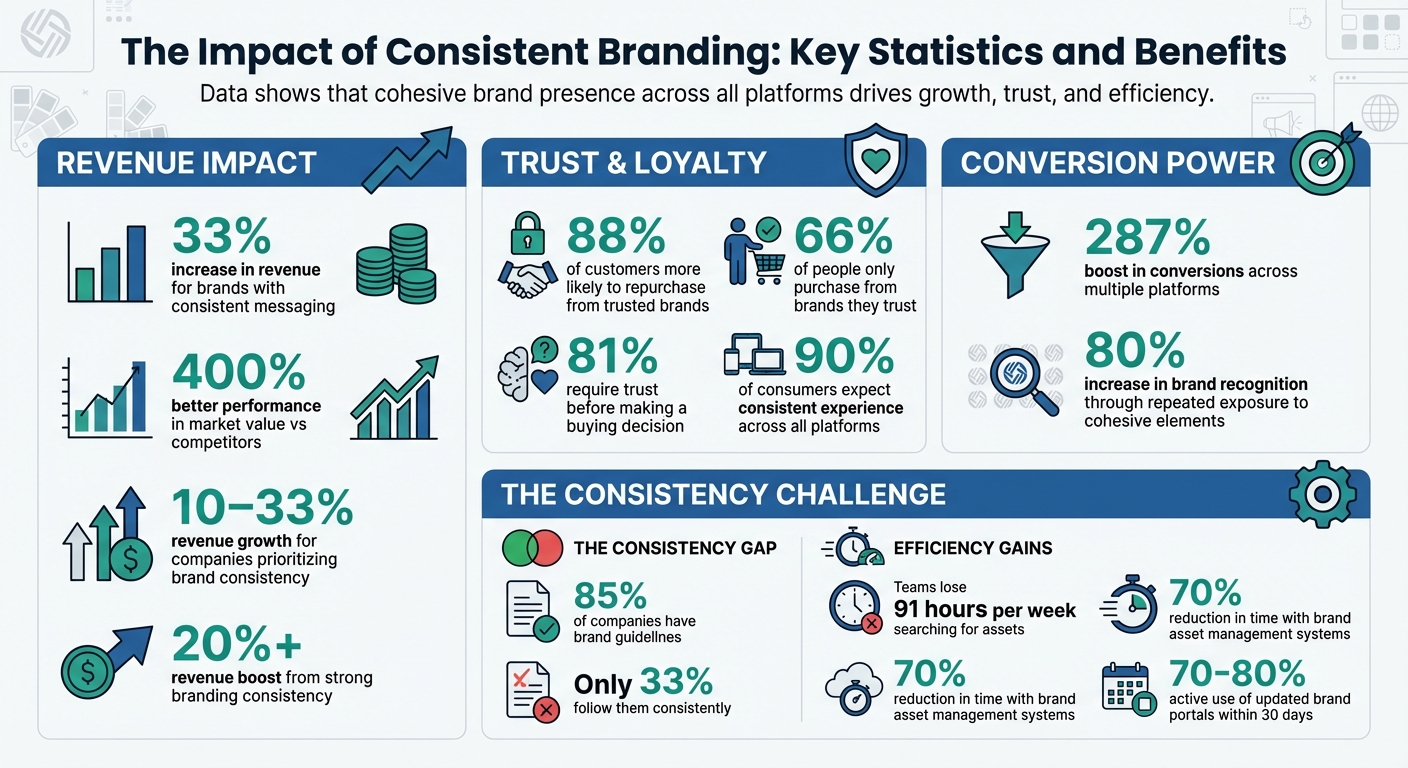
- Revenue Impact: Brands with consistent messaging see a 33% increase in revenue and outperform competitors by up to 400% in market value.
- Customer Trust: 88% of customers are more likely to purchase again from brands they trust, and trust grows through consistency.
- Conversion Rates: Consistency across multiple platforms can drive a 287% boost in conversions.
Despite 85% of companies having brand guidelines, fewer than 33% follow them consistently, often due to decentralized teams or lack of coordination. Fixing this requires clear guidelines, centralized assets, and regular audits to ensure alignment across channels. to ensure alignment across channels.
Key Takeaways:
- Consistency builds trust, recognition, and loyalty.
- It improves marketing efficiency, saving time and money.
- Repetition strengthens emotional connections with customers.
The Impact of Consistent Branding: Key Statistics and Benefits
The Power of Consistency in Branding: How to Stay Memorable
sbb-itb-7a4ada9
Why Consistent Branding Improves Channel Synergy
Consistent branding plays a key role in creating synergy across your marketing channels. By presenting a unified look and feel across platforms, it strengthens your digital presence and enhances the customer experience. This alignment ensures that no matter where customers interact with your brand, they encounter the same personality and message, making your business instantly recognizable.
Building Trust and Recognition Across Platforms
When your branding remains consistent, it sends a message of professionalism and dependability. Seeing the same visual elements, tone, and messaging across different platforms gives customers confidence in your organization. On the flip side, inconsistent branding can feel disjointed and may push potential customers away.
Studies show that trust is a critical factor for consumers, with 66% of people only purchasing from brands they trust, and 81% requiring trust before making a buying decision. Familiarity, which grows through repeated exposure to consistent branding, plays a huge role in shaping consumer preferences and improving brand recall.
"When customers encounter the same branding over time, they develop a positive perception, which can build trust in the brand and contribute to the brand’s long-term success." – Erik Rudolph, Marketing Assistant, West Virginia University
Additionally, brands that maintain consistency across three or more marketing channels can see a 287% increase in conversion rates compared to those with fragmented branding strategies. By reducing confusion and creating a cohesive experience, consistent branding allows customers to connect with your business more easily.
Improving Marketing Efficiency and ROI
Consistency doesn’t just build trust – it also makes your marketing efforts more efficient. Clear brand guidelines and centralized asset libraries cut down on the time and resources needed to create marketing materials. Instead of starting from scratch, teams can quickly pull from a library of approved assets, ensuring alignment across campaigns.
Companies that prioritize brand consistency often see revenue growth of 10% or more, with some reporting up to a 33% increase compared to competitors with inconsistent branding. By eliminating redundant work, avoiding outdated assets, and streamlining collaboration, businesses save time and money while maintaining a polished image.
A unified branding strategy also enhances your ability to track and measure ROI. With consistent messaging and data infrastructure, you can better understand the customer journey and identify which touchpoints drive conversions.
"Consistency signals professionalism and reliability. When your brand elements remain consistent across all digital touchpoints, customers develop deeper trust in your offerings." – Eran Regev, Founder & CEO, Growth Engines
While efficient processes improve your bottom line, consistent branding also strengthens emotional ties with your audience.
Creating Stronger Emotional Connections Through Repetition
Repetition is a powerful tool in branding. By consistently delivering the same message and visuals across platforms, you reinforce your brand story and values, building an emotional bond with your audience. This familiarity positions your brand as a reliable choice when customers are ready to make a decision.
In fact, 90% of consumers expect a consistent experience with a brand across all platforms. Repeated exposure to cohesive elements like logos and color schemes can boost brand recognition by up to 80%. Over time, this familiarity fosters loyalty, turning casual customers into repeat buyers and, eventually, brand advocates.
Maintaining a unified presence not only keeps your business top of mind but also builds long-term relationships that drive growth.
How to Align Branding Across Marketing Channels
Keeping your branding consistent across various marketing channels takes careful planning and execution. It’s about creating a unified experience for your audience without losing the unique touch of each platform. Start by evaluating your current brand presence, setting clear guidelines, and customizing those guidelines for each platform – all while staying true to your brand’s core identity.
Step 1: Conduct a Branding Audit
Begin by taking stock of all your brand touchpoints – this includes your social media profiles, website, email campaigns, paid ads, and any other customer-facing materials. Use a spreadsheet to track key branding elements like your logo, color palette, and tone of voice for each channel. This makes it easier to spot inconsistencies.
One common issue to look out for is brand drift – those unintended differences that can pop up when different teams or regions create content independently. For example, one team might use an outdated logo while another uses the latest version. To address this, audit your assets and set a firm "go-live" deadline for retiring old materials. This approach can result in 70–80% active use of updated brand portals within just 30 days.
"Cohesive branding isn’t a one-time project but a dynamic, ongoing process."
– Louise Bautista, Content Writer, Thrive Internet Marketing Agency
Use the findings from your audit to develop thorough brand guidelines.
Step 2: Create Brand Guidelines
After identifying inconsistencies, establish detailed brand guidelines that cover both fixed elements (like your logo, core values, and tone) and flexible elements (such as localized visuals or platform-specific formats). Store all approved assets and templates in a centralized digital asset system to ensure everyone has access to the most up-to-date materials.
To maintain consistency, consider assigning regional brand leads or team members to review content before it goes live. This extra layer of oversight helps ensure that any adaptations still align with your brand’s overall guidelines.
Step 3: Adapt Messaging and Visuals for Each Channel
With your guidelines in place, customize your messaging and visuals for each platform while keeping your brand identity intact. For example, adjust your tone based on the platform – use a professional, data-driven voice on LinkedIn, but opt for a more casual, visual style on Instagram. At the same time, ensure that core elements like your logo and color palette remain consistent across channels.
For email marketing, standardized templates for headers, footers, and typography help make your brand instantly recognizable. When creating video content, set clear standards for elements like intro/outro sequences, motion graphics, and background music to maintain a cohesive look and feel. In digital advertising, design frameworks that allow your visuals to scale seamlessly from large desktop banners to smaller mobile ads.
"The central tension in global brand management is this: consistency builds recognition, but relevance drives connection."
– Eran Regev, Founder & CEO, Growth Engines
Striking the right balance between consistency and relevance ensures your brand stays recognizable while connecting with diverse audiences across all channels.
Tools and Services to Maintain Branding Consistency
Centralizing Branding Assets with Tools
After defining your brand guidelines, the next step is ensuring everyone sticks to them. Digital Asset Management (DAM) platforms make this easier by acting as a central hub for all your brand materials – logos, fonts, color palettes, imagery, and templates. Tools like Canto, Brandfolder, and Frontify serve as your go-to source, ensuring only up-to-date, approved assets are used.
Did you know teams lose about 91 hours each week just searching for assets? By adopting a brand asset management system, large enterprises can cut that time by up to 70%. Many modern platforms now combine brand guidelines with assets, so when users download materials, they also see clear instructions for usage – like color codes or logo specifications. This removes confusion and reduces back-and-forth emails about which version to use.
These platforms often include content automation and templating tools, allowing non-designers to easily customize approved templates while preserving key brand elements.
"Brandfolder has increased our efficiency because of the usability and ease of use. With a quick and simple search, our international partners can find exactly what they need, when they want it." – Anthony Nguyen, Director of Global Marketing
For businesses aiming to align their brand strategy from the start, professional branding services can provide additional support.
Working with Upward Engine‘s Branding Services
While tools simplify asset management, professional services ensure those assets align with your overall strategy. Upward Engine’s branding and graphic design services help businesses define and document six core elements of a strong brand: logo, color palette, typography, tone of voice, imagery style, and content themes. This framework becomes the foundation for all future branding efforts.
These services also help transition businesses from scattered, disorganized assets to a centralized and accessible system. Beyond branding, Upward Engine’s custom web design and WordPress hosting services ensure your brand identity remains consistent across your digital presence. For WordPress users, this can even include customizing the back-end to reflect your brand, creating a cohesive experience for both internal teams and clients. Companies that maintain strong branding consistency have been shown to boost revenue by 20% or more.
Measuring and Improving the Impact of Branding on Channel Synergy
Tracking Key Metrics for Branding Success
To gauge the effectiveness of consistent branding, focus on three types of metrics. Outcome metrics reveal how your audience perceives your brand. These include tracking brand awareness, customer sentiment, message retention, and loyalty rates. Then there are performance metrics, which measure direct business results like conversion rates, click-through rates (CTR), return on investment (ROI), and cost per acquisition (CPA). Research shows that consistent branding across channels can significantly boost revenue, with trust playing a major role in purchasing decisions.
Don’t forget about operational metrics, which assess how smoothly your branding process runs. These metrics include review turnaround times, deviations from brand guidelines, and production efficiency. They help identify internal issues before they impact your brand externally. For example, if teams frequently create materials from scratch instead of using approved templates, it could point to compliance or resource access problems.
"What gets measured gets managed. Implementing metrics for brand consistency helps you identify issues and make improvements." – Eran Regev, Founder & CEO, Growth Engines
Combining all three types of metrics delivers the best results. For instance, Petco used unified customer data to track engagement across channels, which led to a 15% increase in won-back customers. Similarly, Nike saw a 110% revenue growth in their first year of personalized, automated marketing campaigns. These successes stemmed from simultaneously measuring brand perception and channel performance, allowing for proactive adjustments to their strategies.
Using Data to Refine Branding Strategies
Once you’ve gathered data, it’s time to act on it. Look for gaps between outcome metrics (like brand sentiment) and operational metrics (such as production efficiency). For example, if customers love your brand but your team struggles to produce on-brand materials quickly, you’ve pinpointed a process issue. Tools that automatically scan your website and social media for inconsistencies in tone, typography, and logo usage can help catch problems before they affect your brand’s image.
Multi-touch attribution can also provide insights into which early branding efforts – like a social media video – contribute to final conversions. This helps identify which channels are most effective in building brand equity. For example, BrandAlley used AI-driven predictive analytics to identify customers at risk of leaving, recovering 24% of their defecting customer base within 90 days. By combining these insights with audit results, you can refine both creative and operational strategies. Mapping the customer journey from the first interaction to purchase, and using sentiment analysis on chat logs or call transcripts, can highlight where your messaging may become unclear or inconsistent.
Testing and refining your approach is an ongoing process. Use A/B testing to experiment with different combinations of visuals and copy across channels, ensuring they align with your core brand identity while driving performance. Conduct quarterly brand audits to review visuals, messaging, and digital assets, prioritizing the most impactful updates. This data-driven approach will reveal whether your brand guidelines are being consistently enforced or if adjustments are needed.
Conclusion
When your messaging, visuals, and tone align across all platforms, you create a seamless experience that amplifies the impact of your marketing efforts. Consistency across every touchpoint – whether it’s social media, your website, or paid ads – eliminates confusion and builds trust. And trust, as studies show, drives results: consistent branding can boost revenue by up to 33% while enhancing channel synergy.
To maintain this consistency, revisit your audit findings and refine your brand guidelines and asset management processes. These steps not only help build trust but also deliver measurable results across your digital presence. After all, 88% of customers are more likely to repurchase from a brand they trust. That trust stems from a professional and cohesive presentation.
Scaling consistent branding might feel challenging, especially with distributed teams, but professional support can simplify the process. Services like Upward Engine’s branding solutions offer the expertise and tools to align your team and protect your brand’s integrity. This ensures your brand delivers a unified message across all platforms, maximizing efficiency and ROI.
Consistent branding is more than just aesthetics – it’s about creating a seamless customer experience that fuels growth. By implementing the right strategy, tools, and support, you can turn channel synergy into a true competitive edge, transforming your marketing channels into a well-oiled engine for growth.
FAQs
What counts as “consistent branding” across channels?
Consistent branding across all channels ensures your business presents a unified identity, whether through messaging, visuals, or tone. By maintaining this alignment across digital platforms like websites, social media, email, and apps, you create a seamless experience. This not only strengthens trust but also reinforces recognition, allowing your audience to connect with the same brand personality and values at every touchpoint.
How do I adapt my brand to each platform without losing consistency?
To keep your brand consistent across different platforms, stick to the essentials: messaging, tone, and visual identity. While it’s important to adjust content and visuals to match each platform’s format and audience, make sure they always reflect your brand’s voice and core values. This approach creates a cohesive and recognizable presence, fostering trust and familiarity, while still embracing the unique features of each platform.
Which metrics best prove branding consistency is improving ROI?
Metrics that showcase how consistent branding can boost ROI include customer loyalty, sales volume, price premium, and brand reputation. These factors highlight the benefits of consistent messaging and visuals, which enhance customer trust and the overall perceived value of the brand.


