
Google’s Helpful Content Update is a system designed to prioritize content made for people, not search engines. Integrated into Google’s core ranking algorithm in March 2024, it continuously evaluates entire websites, penalizing domains with unhelpful, low-quality content. Key takeaways:
- Focus on People-First Content: Content should address user needs, demonstrate expertise, and provide original insights.
- Site-Wide Impact: Even a small amount of poor content can harm a domain’s rankings.
- E-E-A-T Framework: Google values Experience, Expertise, Authoritativeness, and Trustworthiness in content.
- Metrics Matter: Track organic traffic, engagement time, bounce rate, and impressions to monitor performance.
- Recovery Takes Time: Removing or improving unhelpful content can take 2-6 months to reflect in rankings.
To comply, conduct thorough content audits, remove or revise low-quality material, and focus on delivering value to users. Avoid keyword stuffing, shallow summaries, and irrelevant topics. Regular updates and monitoring are essential to maintaining compliance and improving rankings.
Understanding Google’s Helpful Content Update
sbb-itb-7a4ada9
What the Helpful Content Update Is Designed to Do
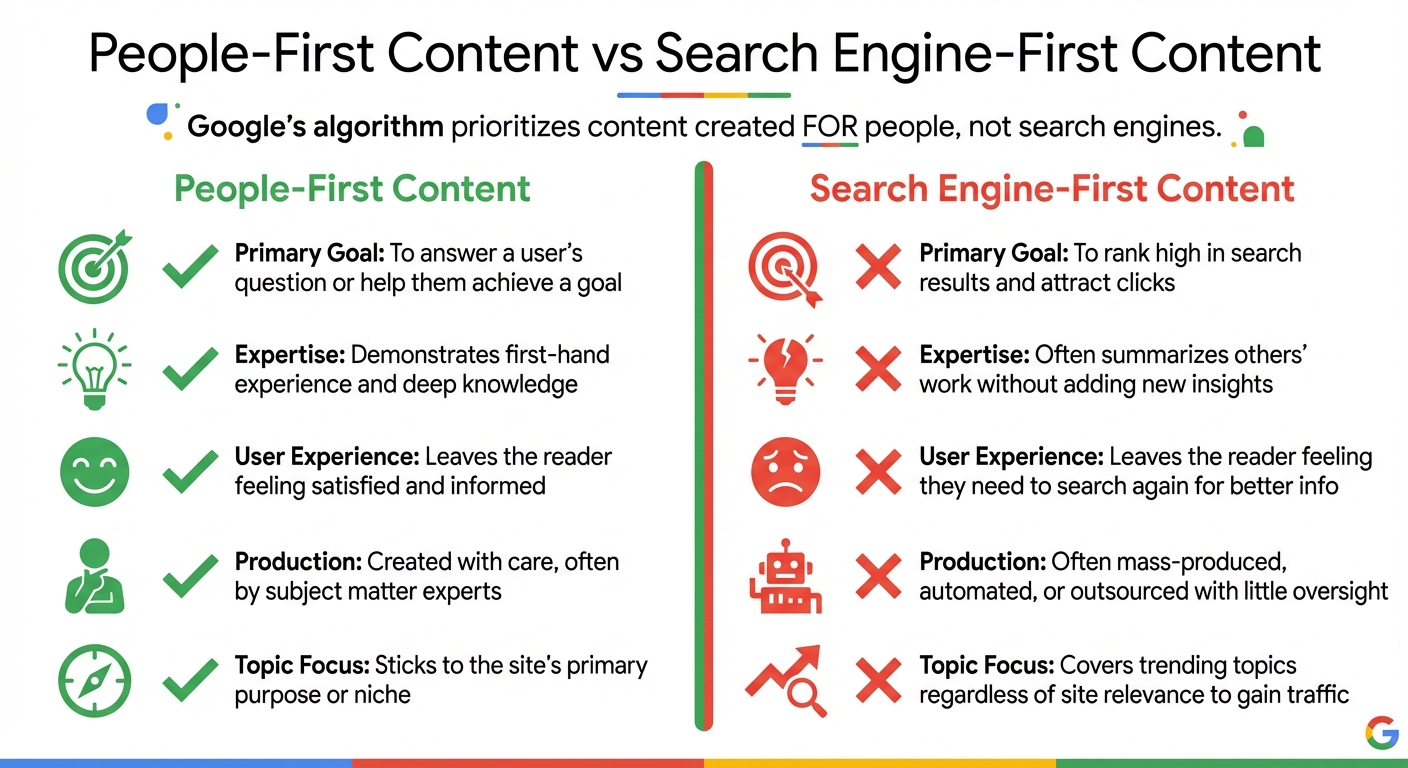
People-First vs Search Engine-First Content: Key Differences for Google’s Helpful Content Update
Google’s Helpful Content Update has one primary purpose: to reward content that prioritizes people over search engines. It aims to identify and downgrade "search engine-first" content – material crafted solely to boost rankings – while promoting pages that genuinely serve the needs of readers. This aligns with Google’s mission to deliver the most useful, relevant, and original information to its users.
In March 2024, Google fully integrated this site-wide signal into its core ranking algorithm. This means the evaluation of content is now a continuous, automated process. If a significant portion of your site contains unhelpful material, even your high-quality pages could see ranking declines. As stated on the Google Search Central Blog:
Any content – not just unhelpful content – on sites determined to have relatively high amounts of unhelpful content overall is less likely to do well in Search.
Danny Sullivan, Google’s Search Liaison, elaborated:
the system is now "part of a core ranking algorithm that’s judging helpfulness on many types of aspects".
This system works as an automated machine-learning classifier, constantly assessing whether your content genuinely helps users or is simply an attempt to game the system.
What People-First Content Means
People-first content is created with the primary goal of benefiting human readers, rather than manipulating search rankings. According to Google, this type of content should satisfy its intended audience, demonstrate first-hand expertise, and leave readers feeling they’ve gained enough knowledge to meet their goals.
Content designed to help users aligns with these principles. On the other hand, material created mainly to attract search engine traffic is likely to be downgraded. This underscores the importance of focusing on the "why" behind creating content: to genuinely serve users.
Google also emphasizes the principles of Experience, Expertise, Authoritativeness, and Trustworthiness (E-E-A-T), with trust being the most critical element. The addition of "Experience" highlights the value of content that shows real, first-hand interaction with products or services. This could include original photos, specific test results, or personal insights that prove genuine engagement with the topic. In September 2023, Google updated its guidance, shifting from content "written by people" to content "created for people", acknowledging that AI-generated material can be helpful when it provides original value and isn’t used for large-scale content manipulation.
| Feature | People-First Content | Search Engine-First Content |
|---|---|---|
| Primary Goal | To answer a user’s question or help them achieve a goal | To rank high in search results and attract clicks |
| Expertise | Demonstrates first-hand experience and deep knowledge | Often summarizes others’ work without adding new insights |
| User Experience | Leaves the reader feeling satisfied and informed | Leaves the reader feeling they need to search again for better info |
| Production | Created with care, often by subject matter experts | Often mass-produced, automated, or outsourced with little oversight |
| Topic Focus | Sticks to the site’s primary purpose or niche | Covers trending topics regardless of site relevance to gain traffic |
This approach prioritizes real value and stands in direct opposition to practices that result in penalties, as outlined below.
Content That Gets Penalized by This Update
Content that strays from these principles risks penalties under Google’s system. Specifically, Google targets "search engine-first" content – material crafted to manipulate rankings. Examples include thin content that lacks depth, offers no original insights, or merely summarizes existing sources without adding meaningful value.
Mass-produced content created solely for ranking purposes is also penalized, whether it’s generated by AI, human writers, or a mix of both. Additionally, sites that abuse their reputation by hosting irrelevant third-party content without proper oversight can face ranking drops.
Other practices that trigger penalties include:
- Deceptive freshness: Updating publication dates without making significant content changes.
- Lack of expertise: Covering niche topics without demonstrating knowledge or authority.
- Misleading promises: Creating content that claims to answer unconfirmed questions, such as speculative movie release dates.
- Keyword stuffing: Awkwardly forcing keywords into content for ranking purposes.
For instance, writing product reviews without actually using the product violates Google’s standards. Similarly, sites attempting to capture traffic by covering trending topics outside their expertise signal a focus on search engines rather than users, leading to penalties.
How the Update Affects Your Website Rankings
Google’s Helpful Content Update evaluates entire websites rather than just individual pages. This means if a large portion of your site contains content that doesn’t meet user expectations, it can negatively impact the rankings of your entire domain – even the well-written pages. In short, low-quality content has the potential to drag down your site’s overall visibility.
Unlike before, rankings now fluctuate continuously as Google reassesses content in real time. This change makes it essential for businesses to improve their search rankings and monitor site performance, as traffic spikes or dips can happen at any moment. The shift also highlights the importance of maintaining high-quality, user-focused content to stay competitive.
Small and medium-sized businesses are particularly vulnerable, especially those relying on "commodity content" – articles created just to match high-volume keywords. For instance, websites in niches like education, affiliate marketing, and recipes saw traffic declines of 20% to 60% after the update. Google also reported a 45% reduction in low-quality, unoriginal content appearing in search results following the update.
Recovery from these penalties isn’t quick. Even after cleaning up or improving content, it can take two to six months for Google’s automated systems to confirm that the low-quality material has been removed and hasn’t returned.
How Google Adjusts Rankings After This Update
The algorithm now prioritizes content that delivers a "satisfying experience" for users. If your content leaves visitors searching for better information elsewhere, your rankings will drop. This is determined by a machine-learning classifier that evaluates whether your content genuinely serves users or is designed primarily to manipulate search rankings. As Chris Nelson from Google’s Search Quality team explained:
"The helpful content update aims to better reward content where visitors feel they’ve had a satisfying experience, while content that doesn’t meet a visitor’s expectations won’t perform as well."
As of Q1 2025, consistently satisfying content makes up about 23% of Google’s ranking factors, a notable shift from the past when backlinks carried more weight. User engagement metrics, like bounce rate and time on page, now account for roughly 12% of the algorithm’s influence. This means Google increasingly values how users interact with your content.
Interestingly, word count doesn’t play a significant role in recovery. A study examining 847 pages affected by the update found that pages with successful recoveries averaged 1,400 words, while those that didn’t recover averaged 1,650 words. The key takeaway? It’s not about length but about delivering dense, useful information that directly addresses user intent.
Metrics You Should Track
Tracking the right metrics is essential for understanding how the update impacts your site and whether your efforts to comply are working. Start by monitoring organic traffic – a sudden drop often signals that Google’s site-wide classifier has flagged your domain. Use tools like Google Search Console to identify these changes and compare them with update timelines.
Average position is another critical metric. If rankings drop across your entire domain rather than specific pages, it’s a clear sign of site-wide quality issues.
Engagement time can reveal whether your content meets user needs. High engagement suggests readers find value, while low engagement indicates they might be leaving to find better information elsewhere. Similarly, a high bounce rate points to unmet user expectations.
Also, keep an eye on impressions in Google Search Console. A decline here could mean your site is no longer appearing for terms it previously ranked for. Lastly, monitor direct traffic trends. Growth in this area shows that users find your site valuable enough to bookmark or revisit, which is a positive signal for Google.
| Metric to Track | What It Reveals | Data Source |
|---|---|---|
| Organic Traffic | Sudden drops often indicate a site-wide classifier hit | Google Analytics, Google Search Console |
| Average Position | Indicates if the entire domain is being suppressed | Google Search Console, Semrush |
| Engagement Time | High engagement suggests user intent is satisfied | Google Analytics 4 |
| Bounce Rate | High rates signal unmet user expectations | Google Analytics 4 |
| Impressions | Drops indicate the site is losing visibility | Google Search Console |
| Direct Traffic | Growth shows users value the site enough to return | Google Analytics 4 |
Paying attention to these metrics will help you assess your site’s performance and ensure it aligns with Google’s focus on user satisfaction.
How to Make Your Content Compliant
To align with Google’s Helpful Content Update, the focus should be on genuinely serving your audience. Since this system became part of Google’s core algorithm in March 2024, content quality is evaluated continuously rather than during periodic updates.
A balanced strategy that combines creating new content with auditing your existing material can help you stay on track. The key? Information gain – offering unique perspectives, original data, or firsthand insights that users can’t find elsewhere. According to Google’s guidelines, trust remains a cornerstone of E-E-A-T (Experience, Expertise, Authoritativeness, and Trustworthiness).
Interestingly, updating your existing content can yield better results than creating new material. On average, refreshed content generates 106% more traffic compared to publishing new articles on the same topic.
How to Create Content That Serves Your Audience
Creating content that resonates with your audience starts with understanding their needs. Before diving into writing, identify the search intent behind the query. Are users looking for information, comparing options, finding a specific site, or making a purchase?
The E-E-A-T framework is a valuable guide. Google now places a premium on firsthand experiences, rewarding content that provides unique, real-world insights over generic advice. For instance:
- Chewy improved rankings by collaborating with board-certified veterinarians and animal behaviorists to ensure accurate, expert-backed content.
- The National Council on Aging (NCOA) enhanced transparency by detailing testing data, including research hours and expert consultations, in their articles.
To demonstrate firsthand experience, include original photos, videos, case studies, or personal anecdotes. Stick to your niche – Google penalizes sites that chase trending topics unrelated to their expertise. Always address the user’s primary question early in the article. As Kevin Smith from Mighty Roar explains:
The goal is to fully answer the searcher’s question. Sometimes that takes 500 words. Sometimes it takes 3,000.
Avoid overloading your content with unnecessary words. Data shows that pages recovering from the update averaged 1,400 words, whereas those that didn’t averaged 1,650 words.
| Search Intent Type | User Goal | Content Best Practice |
|---|---|---|
| Informational | Seeking knowledge | Step-by-step guides or clear definitions |
| Navigational | Finding a specific site | Clear branding and intuitive site structure |
| Commercial | Researching options | Comparison tables and expert reviews |
| Transactional | Ready to buy | Direct calls to action and detailed product information |
Be transparent about the creators of your content and how it was produced, including any use of AI. Detailed author bios with credentials, social links, and references to authoritative works help establish trust.
How to Audit Your Existing Content
A thorough content audit can be your guide to recovery. Start by categorizing every URL on your site into one of four buckets: Keep, Update, Consolidate, or Remove.
Evaluate each page using a 100-point scoring system across five dimensions:
| Quality Dimension | Max Points | Evaluation Criteria |
|---|---|---|
| E-E-A-T Signals | 30 | Author credentials, firsthand experience, editorial reviews |
| Content Depth | 25 | Comprehensive coverage, original data, unique insights |
| Content Freshness | 15 | Updated stats (2025–2026), no broken links |
| User Engagement | 15 | Bounce rate, time on page, scroll depth, internal clicks |
| Technical Health | 15 | Core Web Vitals (LCP < 2.5s), mobile usability, structured data |
Pages with low engagement (under 30 seconds) are often flagged as unhelpful. Use tools like Google Analytics to identify these pages for improvement or removal. Research shows that 25% to 35% of a website’s content drives no organic traffic after a year. If a page isn’t contributing to your site’s authority or has no backlinks, consider rewriting or consolidating it instead of deleting it.
Address keyword cannibalization by locating pages targeting the same query. Merge the unique value from weaker pages into the strongest URL and use 301 redirects to consolidate authority.
A 4-week sprint can help you systematically improve content quality:
- Week 1: Enhance author bios and add source citations.
- Week 2: Expand thin sections with original data or case studies.
- Week 3: Resolve Core Web Vitals issues and improve internal linking.
- Week 4: Organize content with clear headings and formatting to aid AI analysis.
Seeking help from experts can make these tasks more manageable.
Working with SEO Professionals
After auditing and optimizing your content, partnering with SEO professionals can further improve compliance and performance. Google’s Helpful Content Update can pose challenges, but experienced SEO teams can guide you through it.
At Upward Engine, we specialize in crafting content strategies that align with Google’s evolving standards. By developing content clusters around your core expertise, we ensure every piece serves a clear user need. Our audits use the same scoring rubrics and prioritization methods outlined above to identify which pages need updates, consolidation, or removal.
We emphasize E-E-A-T by incorporating firsthand experiences, original research, and expert credentials into your content. To make your material AI-ready, we structure it with clear headings and information hierarchies, enabling AI systems to parse and cite it accurately.
Our services go beyond content creation. We monitor key metrics – such as organic traffic, rankings, engagement time, and bounce rate – to address issues quickly. We also maintain your site’s technical health through ongoing Core Web Vitals optimization, mobile usability improvements, and structured data updates.
While recovery often takes 2 to 4 months due to Google’s recrawl and update cycles, a well-executed strategy can help you not only recover but also build a stronger, more resilient online presence. Our ultimate goal is to help you create content that users genuinely find helpful – content that would stand out even without search engines.
Mistakes That Hurt Your Compliance Efforts
Even businesses with the best intentions can make missteps when responding to Google’s Helpful Content Update. These mistakes often arise from outdated practices or hasty decisions that end up doing more harm than good.
One of the most common issues is panicked content pruning. When rankings drop, some site owners delete large numbers of non-ranking pages in one go. This can undermine your site’s topical authority and erase valuable backlinks. Instead of rushing to delete, take a thoughtful approach by asking three key questions about each page: Does it answer a real question? Does it offer a unique perspective? Would you confidently put your name on it? Pages that fail all three can be removed, but others might benefit from a rewrite or consolidation. This careful evaluation helps preserve your site’s credibility and authority.
Another frequent error is chasing trends outside your expertise. Jumping on viral topics that don’t align with your brand’s core focus can signal to Google that your site lacks genuine expertise. This behavior is now flagged as a site-wide issue, potentially dragging down your entire domain’s rankings. Since March 2024, Google’s Helpful Content system has been integrated into its core algorithm, meaning evaluations happen continuously rather than during periodic updates.
A third mistake involves prioritizing word count over information density. Research examining 847 pages affected by the update showed no link between word count and recovery. Interestingly, pages that recovered averaged 1,400 words, while those that didn’t averaged 1,650 words. Adding unnecessary filler to make content seem more "complete" often backfires. Google prioritizes whether readers feel they’ve gained enough information to meet their needs, not how long the content is.
Finally, many sites fall into the trap of summarizing existing search results without adding anything original. This approach is flagged as unhelpful because it doesn’t provide readers with new insights or expertise. Following the March 2024 update, Google reported a 45% reduction in low-quality, unoriginal content in search results.
Avoiding these mistakes is critical for maintaining compliance and ensuring your content aligns with Google’s expectations.
Why Keyword Stuffing Backfires
Keyword stuffing is one of the quickest ways to get penalized under the Helpful Content Update. Repeating keywords excessively signals to Google that you’re more focused on manipulating search rankings than helping your audience.
Thanks to advanced algorithms like BERT and neural matching, Google now understands context and synonyms, making repetitive keyword use both unnecessary and easy to detect as spam. In fact, neural matching influences about 30% of all search queries, connecting words to concepts rather than relying solely on exact matches. As John Mueller, Google’s Search Advocate, has explained:
Google does not have a notion of optimal keyword density.
The consequences of keyword stuffing go beyond individual pages. Since Google’s Helpful Content system evaluates site-wide signals, a cluster of over-optimized pages can harm your entire domain’s rankings. This is especially problematic because most users – about 79% – scan web pages rather than reading them word for word. Overstuffed content is harder to scan, driving users away and increasing bounce rates.
So, what works instead? Strategic placement over repetition. Use your primary keyword naturally in key areas like the title tag, H1 heading, URL, and the first 100 words of your content. Then incorporate synonyms and related terms throughout. For example, instead of repeating "best running shoes" dozens of times, you could use phrases like "top-rated sneakers" or "high-performance athletic footwear".
The data backs this up. Pages that rank number one on Google often rank in the top 10 for hundreds of related keywords, proving that broad topical relevance outperforms single-keyword repetition. Additionally, 91.8% of search queries are long-tail phrases (three or more words), so creating comprehensive, naturally written content captures more traffic than keyword-stuffed pages.
A simple way to check for over-optimization? Read your content aloud. If it sounds awkward or forced, it’s likely over-optimized and needs rewriting for better flow. Focusing on natural language and reader experience is a proven strategy for long-term success.
Publishing Content That Doesn’t Match User Intent
One of the most expensive mistakes businesses make is creating content that doesn’t align with user intent. When your content fails to meet what searchers are looking for, Google’s algorithms notice – and your rankings take a hit.
For example, blending different user intents in one piece of content can confuse search engines. If someone searches for "how to change a tire" (informational intent), they want clear, step-by-step instructions – not a sales pitch for tire brands. Pages that don’t meet the user’s immediate goal are unlikely to rank well.
Google’s continuous evaluations now focus on what it calls the "search again" signal – content that leaves users feeling the need to conduct another search to find better information. This highlights the importance of fully addressing user needs.
A great example of getting it right comes from Jobber, a home service software company. In 2023, they optimized their resource on "How to get an Electrician License" by answering key reader questions – such as what it is, the categories, and the requirements – early in the article. This approach quickly satisfied user intent without requiring excessive scrolling, resulting in better rankings and engagement.
In contrast, sites that published large amounts of shallow, AI-generated content across unrelated topics – like gaming sites featuring recipes – experienced massive ranking drops after the March 2024 core update integration. Some even lost all their indexed pages. To avoid these pitfalls, take time to analyze the top-ranking pages for your target keyword. Understand what Google considers helpful for that query and aim to provide even more value. If the top results are how-to guides, your content should be instructional. If they’re product pages, focus on transactional intent.
How Upward Engine Helps You Meet Google’s Standards
Keeping up with Google’s Helpful Content Update can feel like a moving target. That’s where Upward Engine comes in. Their full-service digital marketing approach combines SEO know-how with ongoing content management, helping your site stay in sync with Google’s ever-changing standards.
At the core of their strategy is the E-E-A-T framework: Experience, Expertise, Authoritativeness, and Trustworthiness. This is the foundation of how Google evaluates quality. Instead of relying on outdated shortcuts, Upward Engine focuses on creating content that genuinely serves your audience while adhering to SEO best practices. This balanced approach ensures your site attracts traffic without risking penalties from search engines.
Since Google rolled out this system in March 2024, there’s been a 45% drop in low-quality content. Staying compliant has never been more important. Upward Engine’s team keeps up with these ongoing evaluations, tweaking strategies as Google refines its algorithms. From custom web design to paid search ads and social media marketing, they offer a suite of services that establish your site’s authority across multiple channels. This sets the stage for the targeted strategies outlined below.
SEO Strategies Built for Compliance
Upward Engine’s SEO services focus on creating content for people – not just algorithms. They craft material tailored to specific audience personas, ensuring it provides real value. This aligns perfectly with Google’s core principle:
People-first content creators focus first on creating satisfying content, while also utilizing SEO best practices to bring searchers additional value.
- Google Search Central
Their approach includes intent-based content mapping, which matches the depth and length of content to the searcher’s goals. For instance, someone searching "how to change a tire" doesn’t need a 3,000-word history of tires – they need clear, actionable steps. By delivering exactly what users want, Upward Engine helps you avoid the dreaded “search again” signal that flags unhelpful pages. This focus on people-first content ensures your rankings aren’t just strong – they’re sustainable.
To further protect your site, Upward Engine conducts site-wide audits to identify and fix low-value pages efficiently. This proactive approach helps avoid penalties from Google’s domain-level evaluations, which can take months to recover from. They also ensure keywords are used naturally, steering clear of over-optimization, while tailoring strategies to your unique needs.
Continuous Content Updates and Monitoring
Staying compliant with Google isn’t a one-and-done task – it’s an ongoing process. Upward Engine offers quarterly content audits, categorizing pages into three actions: “Keep” (high-performing), “Update” (underperforming but fixable), and “Remove” (thin or unhelpful content). This ensures your content library consistently meets Google’s quality standards.
They also monitor performance through tools like Google Search Console. Sudden drops in clicks, impressions, or rankings are flagged and analyzed, especially following algorithm updates. When issues arise, the team quickly diagnoses and corrects them. Sites that make meaningful improvements often see rankings recover within two to six months, minimizing potential revenue losses.
Additionally, Upward Engine tracks algorithm changes, such as the March 2026 Core and Spam Updates, and adjusts strategies in real time. As Carlos Silva, Content Marketer at Semrush, explains:
The principles of helpful content are now applied continuously. Not through periodic updates.
- Carlos Silva, Content Marketer, Semrush
This means your content is never “done” – it needs regular fine-tuning to maintain its performance. For sites using AI-generated content, Upward Engine provides human oversight to add unique insights, verify facts, and ensure the material delivers value beyond what’s already available. This is especially important as Google tightens its scrutiny on mass-produced AI content lacking originality.
When AI is used, Upward Engine is upfront about it, explaining the “Who, How, and Why” behind the content’s creation. This transparency builds trust with both your audience and Google’s algorithms, strengthening your site’s credibility over time.
Conclusion
Google’s Helpful Content Update has become a continuous part of its core ranking algorithm since March 2024. This means your content is constantly being evaluated to ensure it meets user-focused standards.
Websites overloaded with unhelpful content have seen traffic plummet by 20% to 60%, with recovery taking anywhere from two to six months of consistent effort. On the flip side, Google has reported a 45% drop in low-quality content since the update’s integration. These statistics highlight the importance of refining your content strategy.
To stay ahead, focus on the basics: conduct regular content audits, remove or merge thin pages, and ensure every piece of content reflects Experience, Expertise, Authoritativeness, and Trustworthiness (E-E-A-T). Rather than chasing arbitrary word counts, tailor your content length to match the needs of your audience and their search intent.
Feeling overwhelmed? Companies like Upward Engine can handle quarterly audits and real-time monitoring for you. Their support can help keep your site aligned with Google’s standards, allowing you to concentrate on running your business. Whether you’re strategizing from scratch or bouncing back from a ranking drop, staying consistent and prioritizing your audience’s needs is essential.
Google rewards sustained quality. Start improving your content now, and over time, Google’s algorithms will take notice of your dedication to delivering value.
FAQs
How can I tell if my site was hit by the Helpful Content system?
If your website has seen a noticeable dip in traffic or rankings, the culprit might be Google’s Helpful Content Update. This update tends to penalize sites filled with low-value, SEO-focused content that doesn’t prioritize user experience. Signs of this include drops in organic traffic, reduced keyword visibility, or ranking declines across multiple pages.
To bounce back, shift your focus to producing high-quality, audience-centered content. Also, take the time to identify and remove any unhelpful or irrelevant material from your site.
Should I delete, rewrite, or merge low-quality pages?
It’s a smart move to delete, rewrite, or merge low-quality pages. With Google’s Helpful Content Update, user-focused, high-quality content takes center stage, while sites with thin, outdated, or low-value pages might face penalties. Regular audits to identify and improve underperforming content can help keep your site in good standing and even recover from ranking dips. By consolidating or removing these weaker pages, you can boost your site’s credibility and potentially improve its search rankings.
How can I demonstrate E-E-A-T and real experience in my content?
To emphasize first-hand experience, include specific details that only someone with direct involvement could provide. Share original outcomes or results that can be verified, and back them up with solid credentials. This could mean showcasing degrees, certifications, or professional achievements.
Structured author bios are another great way to build credibility. Make sure they include consistent bylines and any relevant industry affiliations. These elements signal to Google – and your audience – that your content is backed by knowledgeable and trustworthy individuals.
Incorporating real-world examples, case studies, or personal insights is another way to underline authenticity. These details not only make your content more relatable but also align with Google’s focus on ranking content that demonstrates trust and authority.