
- Why SEO matters: Organic search drives 53% of website traffic, with 75% of users never scrolling past the first page. SEO helps your business reach these users while lowering acquisition costs compared to paid ads.
- Keyword research: Focus on high-value, intent-driven keywords. Tools like Google Keyword Planner, Semrush, and Ahrefs can help refine your strategy. Group keywords into clusters to establish topical authority and avoid competition between your pages.
- On-page optimization: Use keywords effectively in title tags, headers, URLs, and meta descriptions. Ensure your content is easy to read with short paragraphs, clear headers, and optimized images.
- Fix technical SEO: Improve site speed, mobile usability, and Core Web Vitals (LCP ≤ 2.5s, INP ≤ 200ms, CLS ≤ 0.1). Add schema markup to qualify for rich results and boost click-through rates.
- Site structure and links: Organize your content logically with a hub-and-spoke model. Use internal links to distribute authority and external backlinks to build credibility.
- Monitor progress: Regularly track performance using tools like Google Search Console and Google Analytics. Update outdated content, fix technical issues, and focus on improving rankings for underperforming keywords.
SEO is a long-term effort, but consistent improvements can significantly boost your visibility, traffic, and revenue. Start optimizing today to stay ahead of your competitors.
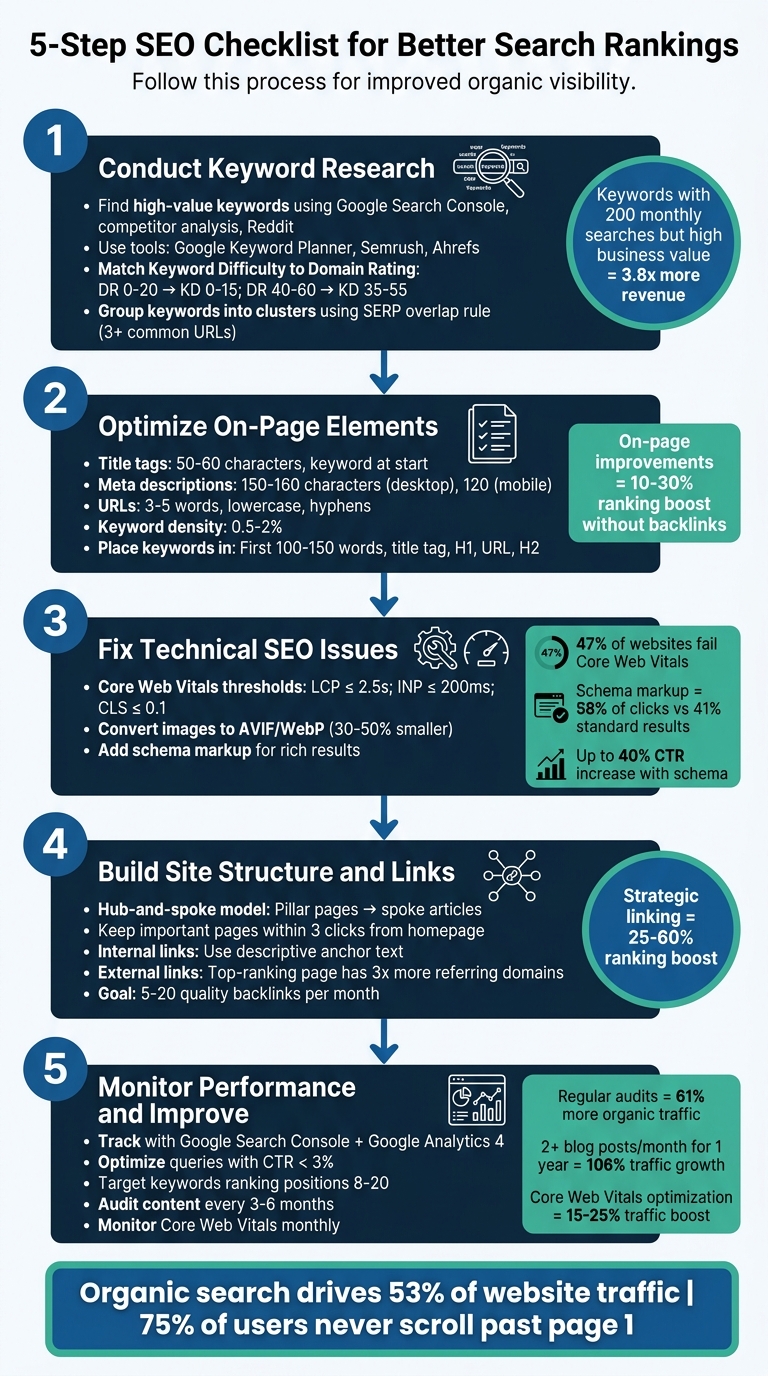
5-Step SEO Checklist for Better Search Rankings
Step 1: Conduct Keyword Research
Find High-Value Keywords
Start by identifying seed keywords – broad terms that are directly related to your business or niche. To expand on these, use four key resources: Google Search Console, customer support transcripts, competitor sitemaps, and discussion platforms like Reddit. These sources can help uncover terms that resonate with your audience.
Here’s something to keep in mind: A keyword with just 200 monthly searches but a high business value score can generate 3.8 times more revenue than a more frequently searched, low-value keyword.
"96.55% of published content gets zero organic traffic. The difference between the 3.45% that works and everything else almost always traces back to the keyword research phase." – The SEO Engine
When you’ve identified potential keywords, classify them by intent: informational, navigational, commercial, or transactional. This helps you understand how users interact with your content. Long-tail keywords, which are more specific, tend to convert 1.8 times higher than broader terms.
Once you’ve narrowed down your list, use advanced tools to refine your keyword strategy.
Use Tools for Keyword Analysis
A great starting point is Google Keyword Planner (GKP). It’s free and provides search volume data straight from Google. Want a pro tip? Use the "Start with a website" feature in GKP to input a competitor’s URL. This reveals keywords they’re targeting that other tools might overlook.
For more detailed insights, tools like Semrush and Ahrefs are invaluable. They offer features like Keyword Difficulty (KD) scores and competitor gap analysis. match your target KD to your domain’s authority:
- If your site has a Domain Rating (DR) of 0-20, focus on keywords with a KD of 0-15.
- For DR 40-60, aim for KD 35-55.
Another tactic? Mine "People Also Ask" (PAA) boxes on Google. Enter your primary keyword, then expand PAA boxes three levels deep to uncover 15-25 specific questions reflecting user intent. These questions can serve as excellent H2 headings or FAQ sections. Also, check the "Top of Page Bid" in GKP – higher bids often indicate traffic with stronger conversion potential.
Group Keywords into Clusters
Once you’ve analyzed your keywords, group them into clusters to enhance your site’s topical authority.
Why cluster? It prevents keyword cannibalization, where multiple pages compete for the same search query. Plus, search engines favor sites that provide comprehensive coverage of a topic. Clustering signals depth and expertise.
Here’s how: Apply the SERP overlap rule by grouping keywords that share at least three common top 10 URLs. Assign the broadest, highest-volume keyword as your pillar page (a detailed guide) and use more specific sub-queries as spoke articles (individual subtopics). Link each spoke article back to the pillar page, and vice versa, to create a strong internal linking structure.
Here’s a real-world example: In 2024, NextGrowth.ai revamped its content strategy by organizing 340 seed keywords into 28 topic clusters. For their "SEO Automation" cluster, they created a pillar page titled Best SEO Automation Tools and linked it to five spoke articles, such as DataForSEO Review and Can SEO Be Automated?. This shift from publishing random topics to a structured cluster approach led to a measurable increase in organic sessions.
sbb-itb-7a4ada9
SEO Checklist – How to Get More Organic Traffic (Fast!)
Step 2: Optimize On-Page Elements
Once you’ve identified your high-value keywords, the next step is to fine-tune your on-page elements. This ensures that your keywords work as effectively as possible to boost your visibility and engagement.
### Optimize Meta Tags and Headers
Your title tags are some of the most powerful tools in your SEO arsenal. Aim for titles that are 50–60 characters long, place your primary keyword near the beginning, and add numbers or brackets to increase click-through rates by 36%–38%.
"Title tags are the highest-ROI optimization in all of SEO. I have seen sites double their organic click-through rate by simply rewriting title tags with a number, a year, and a clear value proposition." – Atilla Kuruk, SEO & AI Search Specialist
For meta descriptions, stick to 150–160 characters for desktop and around 120 for mobile. Use action-oriented language, include your primary keyword, and finish with a call-to-action to entice clicks.
When it comes to headers, use one H1 per page, and organize the rest of your content with H2s and H3s in a logical, hierarchical order. Avoid skipping heading levels to maintain clarity.
Create SEO-Friendly URLs
Your URL structure matters. Keep slugs short – ideally 3–5 words – written in lowercase, and separate words with hyphens (not underscores). Be sure to include your primary keyword in the URL for added SEO value. If you need to change an existing URL, always set up a 301 redirect to retain any link equity from the original URL.
Place Keywords and Format Content
To make your content keyword-friendly, incorporate your primary keyword in the following areas:
- The first 100–150 words
- Title tag
- H1 heading
- URL
- At least one H2 heading
Keep keyword density between 0.5% and 2%, and sprinkle in related terms to enhance relevance.
For readability, break your content into short paragraphs, use clear header hierarchies, and add bulleted lists where appropriate. When using images, optimize them by including keywords naturally in file names and alt text. These on-page SEO improvements can boost your rankings by 10%–30%, even without adding new backlinks.
Step 3: Fix Technical SEO Issues
Once you’ve worked on your on-page optimizations, it’s time to address technical SEO issues. These fixes ensure your site is easy for search engines to crawl and index, which is critical for ranking. Here’s a startling fact: 47% of websites fail Google’s Core Web Vitals thresholds. This gives you a chance to outperform nearly half of your competitors.
Improve Website Speed and Performance
Site speed isn’t just about convenience – it directly affects rankings and how users interact with your site. Pages that meet Core Web Vitals standards experience an average 24% boost in organic click-through rates. The three key metrics to focus on are:
- Largest Contentful Paint (LCP): Should load in 2.5 seconds or less.
- Interaction to Next Paint (INP): Should stay under 200 milliseconds.
- Cumulative Layout Shift (CLS): Should remain below 0.1.
To improve these metrics:
- Identify the LCP element (often the hero image) and use a preload hint in the
<head>to reduce delays. Avoid lazy loading above-the-fold images. - Convert images to AVIF or WebP formats to shrink file sizes by 30–50% without sacrificing quality.
- Reduce Time to First Byte (TTFB) to under 600ms by implementing full-page caching or edge hosting solutions like Cloudflare Workers.
- Break long JavaScript tasks into smaller chunks using tools like
scheduler.yield()to maintain responsiveness.
Keep in mind, speed improvements can take 28–30 days to show up in Google Search Console.
| Metric | Good Threshold | Focus Area |
|---|---|---|
| LCP | ≤ 2.5 seconds | Loading Performance |
| INP | ≤ 200 milliseconds | Interactivity/Responsiveness |
| CLS | ≤ 0.1 | Visual Stability |
Make Your Site Mobile-Friendly
Google now uses your mobile site exclusively for crawling, indexing, and ranking. This means any content missing from your mobile version might as well not exist in Google’s eyes.
"The mobile version of your website is the version that gets crawled, indexed, and ranked – not the desktop version you spent three weeks perfecting."
– Mobile Viewer
To ensure your site is mobile-friendly:
- Add the viewport meta tag:
<meta name="viewport" content="width=device-width, initial-scale=1.0">. - Test screen widths from 360px to 430px to catch horizontal scrolling issues.
- Make sure tap targets are at least 48×48 pixels and text is no smaller than 16px.
- Avoid using full-screen popups that cover your main content, as Google penalizes these intrusive interstitials.
Add Schema Markup
Schema markup makes it easier for search engines to understand your content and qualifies your site for rich results. These rich results capture 58% of user clicks, compared to just 41% for standard results. Sites with schema markup have reported up to a 40% increase in click-through rates.
Google recommends using JSON-LD format for schema, as it’s straightforward to implement and maintain. Focus on high-impact pages like product pages, reviews, articles, and local business listings. You can use Google’s Structured Data Markup Helper to generate the code.
Here’s an example of schema’s potential: In 2024, SAP saw a 400% growth in clicks from rich results after implementing schema strategically. Similarly, Sharp Healthcare experienced an 843% increase in clicks over nine months by using semantic schema. To monitor your schema’s performance, use the "Enhancements" report in Google Search Console and fix any issues promptly.
Step 4: Build Site Structure and Links
Once you’ve tackled technical optimizations, it’s time to focus on structuring your site and building a solid linking strategy. These steps are essential for helping search engines understand the relationships between your content and ensuring authority flows effectively across your pages. A well-organized site with strategic internal and external links can boost rankings by 25% to 60% without even adding new content. This complements earlier optimizations by making it easier for search engines to navigate and rank your site efficiently.
Organize Your Site Structure
Your site’s structure should be logical and user-friendly. Group related content into clear directories, and make sure important pages are no more than three clicks away from your homepage. Pages buried deeper than three clicks are less likely to rank or even be indexed by search engines.
A hub-and-spoke model works particularly well. In this setup, pillar pages (which cover broad topics) link to more detailed subtopic pages, and those subtopic pages link back to the pillar. For businesses with multiple locations, using subfolders (e.g., /locations/chicago/) instead of subdomains is better for consolidating domain authority. Additionally, every page on your site should have at least one internal link pointing to it. Pages without internal links – often called "orphan pages" – are rarely discovered by crawlers.
Use Internal Links Effectively
Internal links are powerful tools for redistributing ranking power across your site. By linking high-authority pages to newer or underperforming ones, you can help those weaker pages gain traction. Place these links naturally within the body of your content, as contextual links hold more SEO value than those placed in headers or footers.
Anchor text is another critical factor. Use descriptive phrases that clearly indicate the content of the destination page. For example, instead of generic terms like "click here", opt for something like "guide to local SEO". Jason Roy from SEOSiteCheckup emphasizes the importance of internal links:
"Internal links are the levers you fully control".
Regular maintenance is key. Conduct quarterly audits to identify broken links and orphan pages with no incoming links. This ensures that your internal linking strategy stays effective and up-to-date.
Build Quality External Links
External backlinks remain one of the strongest signals for establishing authority. In fact, the top-ranking page on Google often has about three times more referring domains than pages ranked two through ten. To compete, focus on earning links from reputable sources like niche industry blogs, associations, and partners.
Creating "linkable assets" is a smart way to attract backlinks naturally. Examples include original research, data studies, or free tools. You can also use backlink gap analysis to find websites that link to your competitors but not to you – these are prime opportunities for outreach. A realistic goal for manual link building is 5 to 20 quality placements per month, as higher volumes often indicate low-quality links.
As OutreachZ puts it:
"Manual link building = strategic, human-led outreach to earn quality backlinks. It’s slower than automation, but it’s what Google rewards and what keeps your site penalty-free long-term."
– OutreachZ
To diversify your backlink profile, use a mix of branded anchor text, naked URLs, partial-match phrases, and topical keywords. Platforms like HARO (Help a Reporter Out) can help you pitch newsworthy data to journalists, earning high-authority media mentions. Additionally, reclaim unlinked brand mentions by politely requesting authors to include hyperlinks.
With a solid internal and external linking strategy in place, you’re ready to move on to monitoring performance and making ongoing improvements.
Step 5: Monitor Performance and Make Improvements
This step ties everything together by focusing on consistent monitoring and refining your SEO efforts. To maintain and improve your keyword strategy, technical health, and content quality, you need to track performance regularly. SEO isn’t a one-and-done task – it requires ongoing attention. Keep an eye on organic revenue and lead generation to assess overall success, while other metrics can act as early warning signs.
Track Metrics with Analytics Tools
Leverage tools like Google Search Console (GSC) to track search visibility and Google Analytics 4 (GA4) to analyze on-site user behavior. Pay close attention to queries with high impressions but a click-through rate (CTR) below 3%, as well as keywords ranking between positions 8–20 – these areas often present the best opportunities for optimization.
One of the most impactful tasks you can tackle is rewriting titles and meta descriptions for queries with low CTRs. This simple adjustment can yield significant results. Additionally, focus on optimizing keywords in the 8–20 ranking range to push them onto the first page of search results. Comparing year-over-year data can help you identify trends and areas for improvement.
"Rankings alone tell you almost nothing. The businesses that win at SEO measure what happens after the click, not just the click itself."
– The Seo Engine Editorial Team
Beyond tracking metrics, it’s essential to keep your content relevant and up-to-date.
Audit and Update Content Regularly
Conduct site audits every 3–6 months to address technical issues and refresh outdated content. For high-traffic or e-commerce sites, quarterly audits are recommended due to the revenue risks associated with outdated content. Smaller, static websites can get by with twice-yearly reviews. Regular audits can lead to up to 61% more organic traffic compared to sites that neglect this step.
Updating your content doesn’t just protect your rankings – it builds on earlier optimizations. Look for pages where traffic has declined over the past 12–24 months and revitalize them with updated data, fresh examples, and titles like “Updated for 2026.” Research shows that the average age of content in the top 10 search results is about two years, so regular updates are crucial to staying competitive. Also, remove or consolidate thin content (under 300 words) to improve your site’s domain quality score.
Monitor Core Web Vitals and Technical Problems
Use tools like GSC and PageSpeed Insights to track Core Web Vitals, ensuring your site meets these benchmarks: LCP under 2.5 seconds, INP under 200 milliseconds, and CLS under 0.1. Fixing technical issues can result in a 30–45% increase in organic traffic within six months.
Monthly audits can catch 89% of indexing issues before they affect your rankings. Always start by checking the "Manual Actions" tab in GSC – if your site has been penalized by a human reviewer, no other improvements will matter until the penalty is resolved. For larger sites publishing more than 20 pages a month, consider weekly crawls or monthly technical audits to prevent issues from piling up.
Conclusion: Put Your SEO Checklist into Action
SEO is not a one-and-done task; it’s an ongoing effort that requires regular attention and refinement. The checklist provided covers everything from keyword research to technical optimizations and monitoring. Now it’s time to put it into action. Start with the essentials – crawlability, mobile experience, and site speed. Once you’ve nailed those, you can focus on more advanced strategies like schema markup and link building. These steps will help you turn insights into measurable results.
"SEO isn’t complicated – it’s just comprehensive."
– SerpNap Team
Consistent execution is where the magic happens. Research shows that websites publishing at least two blog posts monthly over a year can see organic traffic grow by 106%. Even small improvements, such as optimizing Core Web Vitals, can boost traffic by 15% to 25%. Setting up your SEO strategy initially takes about 15 to 25 hours, with 3 to 5 hours of weekly upkeep to maintain progress.
If this feels overwhelming or if you’d rather focus on other aspects of your business, teaming up with an agency like Upward Engine can make a world of difference. They handle everything from prioritizing tasks to performing technical audits, ensuring your content stays fresh and your site avoids regressions. Plus, they offer access to enterprise-grade tools and AI-driven analytics that are hard to replicate in-house.
Whether you manage SEO yourself or bring in professionals, the most important thing is to start now and stay consistent. SEO takes time, but the results build on themselves. The sooner you begin, the sooner you’ll see improvements in traffic, leads, and revenue.
FAQs
Which SEO tasks should I prioritize first?
To lay the groundwork for improving your website’s visibility, begin with tasks that address the essentials. Start by identifying target keywords – these will guide your content strategy and ensure it aligns with what your audience is searching for. Next, tackle any crawlability and indexability issues. For instance, double-check that your robots.txt file isn’t blocking search engines from accessing important pages. Fixing these technical hurdles ensures search engines can properly navigate and index your site.
Once the basics are covered, focus on refining on-page elements like titles and headings. Then, shift your attention to developing a solid content plan and building a strategy for acquiring backlinks. These steps work together to strengthen your site’s presence in search results.
How do I choose keywords my site can actually rank for?
To pick keywords your site can realistically rank for, leverage tools to assess keyword difficulty, search volume, and relevance. Aim for terms that strike a balance between competition and your site’s authority, while also aligning with what your audience is searching for. Focus on keywords that show commercial intent – these are the ones likely to drive conversions.
Keep an eye on performance data and adjust your strategy as needed. This way, you can zero in on high-value terms that are within reach. Regularly revisiting your keyword choices helps you stay in tune with opportunities to improve your rankings.
How long does SEO take to show results?
SEO efforts usually start showing results within 3 to 6 months, with more noticeable improvements often appearing during this timeframe. For highly competitive industries, it could take anywhere from 6 to 12 months to experience meaningful changes in rankings and revenue.
The timeline largely depends on factors like your website’s authority, how quickly SEO strategies are implemented, and the pace at which search engines update their indexes. While some early wins – like resolving technical issues – might be visible within weeks, achieving consistent, long-term growth requires patience and time.