You’re probably here because someone asked a simple question that SEO teams hear all the time.
How much traffic will this bring us?
For a small business owner, that question usually means something more specific. How many leads will come in. Whether the budget is justified. Whether SEO will produce steady growth or become another channel that feels hard to measure.
That’s why forecasting seo traffic matters. A forecast turns SEO from a vague promise into a working model. It gives you a way to estimate what can happen, what assumptions sit behind the estimate, and how that traffic could translate into real business outcomes.
The difference is credibility. A weak forecast is just optimism in spreadsheet form. A reliable one is built from first-party data, realistic ranking assumptions, seasonal context, and a reporting format that a business owner can use.
Why Forecasting SEO Traffic Is a Game Changer
A small business owner approves an SEO budget in Q1, then asks the hard question in Q2. How much pipeline should this produce, and when?
That question changes the standard SEO conversation. Rankings and traffic still matter, but they are not the decision point. The key decision is whether projected organic growth can support lead goals, sales targets, and cash flow expectations.
For SMBs, that shift matters because resources are limited. A local service business may need 15 more qualified leads a month, not 5,000 extra visits. An e-commerce brand may care less about raw sessions than projected revenue by category. A forecast gives both teams a way to test whether the plan is likely to produce enough business value before months of work are already sunk.
Forecasting improves planning quality
Without a forecast, SEO often gets managed as a set of activities. Content gets published. Technical fixes get logged. Links get pursued. Those tasks can be valid, but they do not tell an owner whether the current plan supports the company’s growth target.
A useful forecast changes that. It sets expected ranges, ties those ranges to assumptions, and gives stakeholders a model they can pressure-test. If projected traffic growth only supports six extra leads per month, but the business needs twenty, the gap is visible early. That makes it easier to adjust scope, target higher-intent queries, improve conversion paths, or shift budget across channels.
At Upward Engine, that is usually the point where SEO becomes easier to defend internally. The model does not remove uncertainty. It makes the uncertainty visible and manageable.
It turns SEO from reporting into operating math
Traffic by itself is an incomplete success metric.
A forecast becomes more useful when it connects search demand to business outcomes. That means estimating not just possible visits, but also conversion rate, lead volume, close rate, and revenue per sale. Small businesses need that chain because budget decisions are rarely made on traffic alone.
For example, a projected increase of 1,000 monthly organic visits sounds promising. If those visits land on low-intent blog content and convert poorly, the business result may be modest. If 300 of those visits come from service pages with strong commercial intent, the revenue impact can be much higher. Good forecasting forces that distinction early.
Teams also need clean visibility into baseline performance before making those projections. If reporting is inconsistent, forecasts become fragile. A clear process for tracking pageviews and sessions in GA4 helps establish whether current organic traffic trends are stable enough to model with confidence.
Forecasting exposes trade-offs earlier
Every forecast carries trade-offs. Higher-volume keywords can produce larger traffic upside, but they often require more time, stronger authority, and broader content support. Lower-volume terms may deliver faster wins and better lead quality, but the ceiling is lower.
That trade-off should be explicit.
Forecasting also helps teams decide where tooling matters. The right SEO tools can speed up keyword grouping, rank tracking, and opportunity analysis, but software does not fix weak assumptions. If the forecast is built on inflated search volume, unrealistic CTR expectations, or pages that cannot realistically rank, the spreadsheet will still be wrong.
Credibility comes from transparency
Stakeholders trust SEO more when they can see how the estimate was built.
That means showing the expected range, the main assumptions, the downside case, and the conditions that would cause the plan to miss. It also means being direct about timing. Some pages can gain traction quickly. Competitive commercial terms often take longer, especially for smaller sites without strong authority.
A credible forecast does not promise certainty. It gives business owners a practical planning tool they can use to set targets, compare scenarios, and judge whether SEO is on track to contribute measurable growth.
Gathering and Cleaning Your Forecasting Data
A small business owner approves an SEO plan because the traffic upside looks strong. Three months later, the campaign is producing visits, but the sales team is still short on qualified leads. That gap usually starts here, in the input data.
A reliable SEO traffic forecast needs clean search data, clean analytics data, and a clear connection between traffic and business outcomes. If one of those pieces is weak, the forecast can still look polished while giving the wrong answer.
Reliable forecasting seo traffic usually starts with two sources you already control. Google Search Console shows search visibility, queries, clicks, and page-level demand. GA4 shows what those visitors did after they arrived, including engagement, conversions, and revenue events when tracking is set up correctly.

Start with two forecasting lenses
SEO forecasts usually rely on two methods: a keyword-based approach and a historical statistical approach.
The keyword-based method estimates potential traffic from target terms, expected rankings, and realistic click-through assumptions. The historical method looks at your existing organic performance over time to find recurring patterns such as growth, flat periods, and seasonality.
Each method answers a different planning question.
- Keyword-based forecasting: What traffic could this content or ranking plan produce?
- Historical forecasting: What growth pattern has the site already shown?
- Blended use: How much upside is realistic given current performance?
For SMBs, that blended view matters. Search volume alone does not pay the bills. The pages most worth forecasting are the ones that can produce inquiries, booked calls, purchases, or store visits.
Pull clean search data from Google Search Console
Export queries, pages, clicks, impressions, CTR, and average position from Search Console.
Then sort for patterns that can support a forecast, not just big numbers:
- Pages with high impressions and weak CTR: These may be title tag, meta description, or intent-match opportunities.
- Queries sitting just off page one: These often produce faster gains than brand-new keyword targets.
- Branded and non-branded searches: Separate them early. A forecast built on brand demand can overstate SEO-driven growth.
- Page groups by topic or service: This helps tie projected traffic to service lines and revenue categories later.
Year-over-year comparisons are usually more useful than short month-to-month changes. A seasonal business can look like it is losing momentum when demand returns to its normal pattern.
Pull matching behavior and conversion data from GA4
In GA4, isolate organic search traffic and review landing pages, sessions, engaged sessions, conversions, and purchase or lead events where available.
If reporting needs cleanup before you trust the numbers, use this guide on how to track pageviews and sessions in GA4 to verify the basics.
The goal is not just to estimate visits. The goal is to estimate what those visits are worth.
Review organic landing pages with questions like these:
- Which pages attract visitors who stay, browse, and convert?
- Which entry pages drive form fills, calls, purchases, or quote requests?
- Which pages bring traffic that looks healthy in Search Console but weak in GA4?
- Which conversions are missing because of tracking gaps, duplicate events, or poor attribution setup?
I usually treat conversion data with more skepticism than traffic data until the setup is confirmed. Inflated conversions can make a forecast look profitable on paper while setting the wrong budget expectations.
Clean the data before building the model
Many forecast errors start before any formulas are written.
Run a cleanup pass across both platforms:
- Remove anomalies: Exclude periods affected by bot traffic, tracking outages, accidental noindex tags, or major reporting issues.
- Mark one-time events: PR spikes, flash sales, viral social exposure, and unusual referral surges can distort organic patterns.
- Align dates and definitions: Search Console clicks and GA4 sessions will not match perfectly, but the date ranges and channel filters should.
- Tag major site changes: Migrations, redesigns, large content launches, and technical fixes can change the trend line for valid reasons.
- Check page-level consistency: Make sure the URLs in Search Console line up with the landing page structure used in GA4 exports.
Some months should not carry the same weight as others. A clean forecast reflects normal demand and normal site performance, not temporary noise.
Use outside tools carefully
Third-party platforms help fill the gaps in first-party data, especially for keyword discovery, competitor comparisons, and estimating opportunity beyond your current footprint. If you are evaluating platforms for that work, this roundup of SEO tools is a useful reference.
Use those tools as directional inputs. Do not let them override what your own site has already proven. Search volume estimates, keyword difficulty scores, and competitor traffic ranges are helpful, but they are still estimates. Search Console and GA4 usually provide the stronger base for forecasting what an SMB can turn into leads or revenue.
Organize the output into forecast-ready buckets
Before any modeling starts, structure the dataset so it can support business planning, not just rank projections.
| Data bucket | What to collect | Why it matters |
|---|---|---|
| Historical traffic | Organic sessions, clicks, landing pages | Shows trend direction and baseline performance |
| Search opportunity | Queries, impressions, rankings, search volume | Estimates upside by topic, service, or page |
| Conversion context | Leads, purchases, key events | Connects projected traffic to business outcomes |
| Business events | Launches, outages, promotions, updates | Explains irregular performance periods |
That final step is where a traffic forecast becomes useful to decision-makers. Instead of reporting a top-line visit estimate, you can show expected traffic by page group, projected lead volume by service, and the assumptions behind each number. For small businesses, that is the difference between an SEO forecast that sounds interesting and one that can support hiring, budgeting, and revenue planning.
Choosing the Right SEO Forecasting Model
Not every business needs an advanced forecasting stack. In fact, a lot of bad forecasts come from using a complex model on weak data.
The right model depends on what kind of site you have, how much history exists, and how the forecast will be used. A local business with limited data shouldn’t use the same framework as a mature e-commerce store with years of performance and hundreds of revenue-driving pages.
The model choice starts with a simple question
Ask what you need the forecast to do.
- Support a budget discussion
- Estimate traffic upside from a content plan
- Predict lead volume for sales planning
- Benchmark a new site against competitors
- Set realistic targets for an existing campaign
If the answer is basic, your model should be basic. If the answer affects staffing, revenue planning, or inventory, your model needs more rigor.
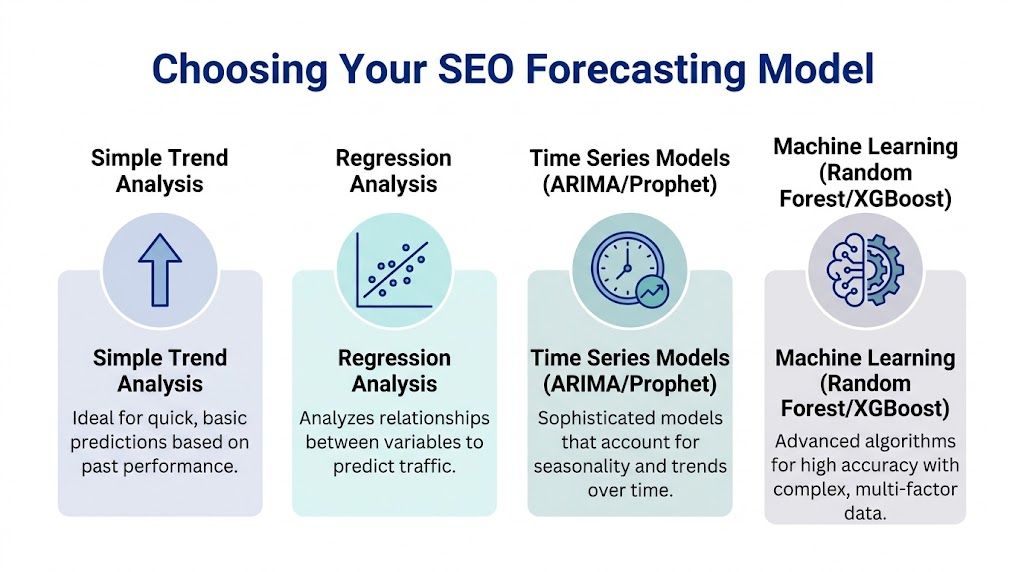
Model one, simple trend analysis
This is the fastest option. You take historical organic traffic and extend the trend line forward.
It works best when the site has consistent momentum and no major disruptions in the recent period. A simple spreadsheet with moving averages or basic growth assumptions can be enough for directional planning.
This model is useful for:
- Established sites with stable trends
- Quick executive planning
- Creating a baseline scenario
It breaks down when seasonality is strong or when the business has changed its SEO investment level.
Model two, keyword-based opportunity forecasting
This model starts from target keywords rather than site history. It uses search volume and expected CTR by ranking position to estimate potential traffic.
The logic is clear. If a keyword gets monthly searches and you expect to reach a certain ranking, you estimate clicks from there. Earlier, we covered the CTR benchmarks commonly used in that method. The value here is not precision to the decimal. It’s directional opportunity sizing.
This model works well for:
- New site sections
- Content roadmap planning
- Keyword cluster prioritization
Its weakness is optimism. Ranking assumptions are easy to inflate, especially if you assume top positions too early or ignore SERP features.
Model three, seasonal time-series forecasting
When a site has enough historical data, a time-series model can do a much better job of handling recurring patterns.
Here, moving averages and tools like FORECAST.ETS become practical. They’re useful when your traffic follows repeating demand cycles and you need a model that respects those cycles instead of flattening them into one long upward line.
Use this when:
- The business is seasonal
- You have enough clean historical data
- Your stakeholders care about month-by-month planning
For many SMBs, this is the highest level of complexity they need.
Model four, regression-based forecasting
Regression is useful when traffic is affected by more than time alone.
If a business publishes content on a structured cadence, expands service pages, or pairs SEO with technical cleanup and paid search insights, regression can help model the relationship between those inputs and organic outcomes. This approach is stronger when you can clearly define explanatory variables and trust the underlying data.
It’s often a better planning tool than a boardroom storytelling tool because it takes more explanation.
Model five, machine learning and advanced forecasting
Tools and frameworks like Prophet, ARIMA, or more advanced machine learning methods can be useful when the site is large, the data is deep, and the team has the ability to maintain the model.
For many SMBs, that’s more than necessary. These methods can improve sensitivity to changing patterns, but they also increase the risk of false confidence if no one on the team can explain why the model is producing a given number.
A forecast should be defensible. If the team can’t explain the assumptions, the sophistication doesn’t help.
Why hybrid models usually win
For small businesses, a hybrid model is often the most reliable choice because it combines what your site has already done with what your target keyword set could still produce.
Agency benchmarks cited by Aira note that a hybrid approach uses Search Volume × CTR × Ranking Probability, with ranking expectations informed by competitor benchmarking, and that these models achieve 65-80% accuracy within 15% of actual traffic, compared with 45% for single-method models (Aira).
That matters because most SMBs sit in the middle. They have some historical data, but not perfect data. They have growth opportunities, but not unlimited ranking power. Hybrid forecasting handles that reality better than a one-track model.
The best forecast usually isn’t the fanciest one. It’s the one that combines enough realism with enough opportunity to support a decision.
Comparison of SEO Forecasting Models
| Model | Best For | Complexity | Data Required |
|---|---|---|---|
| Simple trend analysis | Stable sites needing a quick baseline | Low | Historical traffic |
| Keyword-based model | Content planning and opportunity sizing | Low to medium | Search volume, rankings, CTR assumptions |
| Seasonal time-series | Businesses with recurring demand patterns | Medium | Clean historical traffic over time |
| Regression analysis | Teams modeling multiple growth drivers | Medium to high | Historical traffic plus explanatory variables |
| Machine learning models | Large sites with advanced analytics support | High | Deep historical data and model oversight |
| Hybrid model | SMBs balancing realism and upside | Medium | Historical data, keyword opportunity data, competitor context |
How to choose without overcomplicating it
A practical decision framework looks like this:
- Limited history, but clear keyword targets: Start with a keyword model and temper it with competitor reality.
- Strong history, recurring seasonal swings: Use a time-series method.
- Mature site with multiple growth levers: Add regression.
- Need the most usable SMB forecast: Blend historical and opportunity models.
If you’re using a platform to operationalize this, options range from spreadsheets and BI dashboards to purpose-built agency systems. Upward Engine also offers forecasting and ROI dashboard workflows that connect traffic assumptions with business reporting, which is useful when the forecast needs to be reviewed regularly rather than built once and forgotten.
The key is consistency. Pick one methodology, document your assumptions, and refine it over time. Frequent model switching creates confusion faster than it improves accuracy.
Validating Your Model and Measuring Accuracy
A forecast isn’t useful because it looks reasonable. It’s useful because it can survive scrutiny.
That means validating the model before you present it. If you can’t show how it would have performed against historical data, you’re asking stakeholders to trust an output they can’t test.
Backtest before you publish
Backtesting is the simplest validation method. You take an earlier slice of historical data, build the forecast from that point, and compare the projection against what happened later.
A practical version looks like this:
- Choose a cutoff date: Use older data as your training period.
- Build the model: Apply the same assumptions you plan to use now.
- Hold out later data: Don’t let the model “see” it in advance.
- Compare forecast versus actual: Review the gap month by month.
- Adjust assumptions: Tighten ranking probability, seasonality handling, or conversion logic where needed.
This process doesn’t guarantee future precision. It does tell you whether the model behaves sensibly.
Use error metrics as a sanity check
You don’t need a data science team to use basic error metrics.
Two common options are MAE and RMSE. In plain English, they both measure how far off your forecast was. MAE gives you the average size of the miss. RMSE gives more weight to bigger misses, so it’s useful when large errors would create serious business problems.
The exact formula matters less than the habit. Measure forecast error consistently and use it to improve the next round.
Evaluate the assumptions, not just the result
A model can miss for good reasons or bad ones.
Bad reasons usually include poor inputs, unrealistic ranking expectations, or conversion assumptions that never matched actual site behavior. Good reasons tend to be external changes you couldn’t fully control, such as shifts in SERP layout, competitor movement, or changes in demand.
That distinction matters when you review performance with stakeholders.
A forecast that misses for understandable reasons can still be credible. A forecast built on weak assumptions was never credible to begin with.
Keep validation operational
The teams that improve forecasting seo traffic treat validation as part of routine reporting.
Build a simple review rhythm:
- Compare actual versus forecast regularly
- Log why major deviations happened
- Refine one assumption at a time
- Keep prior versions for context
If you want a broader planning perspective on methods to improve forecasting accuracy, it’s useful to look beyond SEO-specific workflows and borrow the discipline that forecasting teams use in adjacent fields.
A reliable forecast isn’t static. It gets better because you keep testing it.
From Traffic Projections to Predictable Revenue
A business owner approves an SEO budget because they expect more booked jobs, more qualified leads, or more online sales. A traffic forecast only becomes useful when it shows that path clearly.
Start with the revenue target, then work backward
Traffic is an input. Revenue is the outcome the business cares about.
For small and midsize businesses, that distinction changes how the whole forecast gets built. Instead of asking, “How many visits can SEO drive?” ask, “How many leads or sales does the business need, and what level of organic traffic is required to support that?” That approach keeps forecasting tied to planning decisions such as budget, hiring, sales coverage, and cash flow.
Use first-party data wherever possible. Google Search Console, CRM data, closed-won rates, and actual order values usually produce a more credible model than one built mainly on third-party volume estimates. As noted earlier, outside search volume tools can be directionally useful, but they are not precise enough to carry the revenue model on their own.
Use simple formulas stakeholders can verify
The math does not need to be complicated. It needs to be honest.
Start with the core chain:
- Projected leads = projected organic traffic × lead conversion rate
- Projected sales = leads × lead-to-sale rate
- Projected revenue = sales × average order value or customer value
For example, if a site is projected to generate 500 monthly organic visits and the relevant landing pages convert at 10%, the forecast points to 50 leads. From there, the business can apply its own close rate and deal value to estimate revenue.
That is the step many SEO forecasts skip. Once traffic is translated into pipeline impact, owners can compare SEO against paid search, outbound, referrals, or local partnerships using the same business lens.
Build revenue scenarios, not a single forecast number
A single number creates false certainty. Scenario planning creates a usable range.
For SMB reporting, I usually recommend three cases:
- Conservative: Slower ranking gains, lower click-through realization, softer conversion performance
- Expected: The most likely outcome based on current execution and historical site behavior
- Aggressive: Faster visibility gains, stronger page performance, and above-baseline conversion rates
Keep the model structure identical across all three. Only change the assumptions. That makes it easier for stakeholders to see what is driving the spread between outcomes.
It also improves conversations about risk. If the aggressive case depends on new pages ranking faster than the site has historically ranked, say that plainly. If the conservative case assumes weaker close rates because the sales team is already at capacity, include that too. Transparent trade-offs make the forecast more credible.
Match the revenue model to the business
The same traffic number can mean very different things depending on how the business makes money.
Local service businesses
For a plumber, attorney, dentist, med spa, or roofer, the forecast should focus on qualified inquiries, not broad traffic growth. Service-page visits, local intent, call rates, form-fill rates, and booking capacity matter more than total sessions.
A local business can hit a traffic goal and still miss the business goal if that traffic lands on informational pages that do not produce calls or appointments.
E-commerce and DTC brands
E-commerce forecasts usually have a cleaner line to revenue because the transaction is easier to observe. The model should separate category traffic, product-page traffic, branded demand, non-branded demand, conversion rate by landing page type, and average order value.
That gives the business a forecast they can use for merchandising, promotion timing, and inventory planning. It also helps avoid a common mistake, which is treating low-intent blog traffic as if it will convert like product traffic.
B2B lead generation and high-consideration services
For B2B companies and service businesses with longer sales cycles, forecasting straight to revenue can create false precision. Forecast qualified leads first. Then connect those leads to CRM stages, opportunity rates, and closed revenue with an expected time lag.
That structure is usually more defensible than forcing same-month traffic into same-month revenue attribution.
Build a worksheet people can actually use
A readable model gets used. A complicated one gets ignored.
A practical worksheet for SMBs should show the full chain from traffic to business outcome:
| Input | Example use |
|---|---|
| Target revenue | What the business wants SEO to contribute |
| Historical conversion rate | What organic traffic has actually done |
| Required traffic | What volume is needed to support the target |
| Traffic source assumptions | Historical trend, keyword opportunity, or both |
| Scenario ranges | Conservative, expected, aggressive |
| Review cadence | When assumptions will be checked and updated |
At Upward Engine, the useful version of this worksheet is rarely the most complex one. It is the one a business owner, marketing lead, and sales manager can all read in the same meeting and challenge line by line. If a forecast cannot survive that conversation, it is not ready to guide budget decisions.
A visual explainer can help if the team needs a quick primer before discussing assumptions:
Keep the revenue model grounded in real constraints
Revenue-first forecasting can still go wrong. The usual failure is not the formula. It is the assumption stack.
Teams often start with a revenue target, then force the traffic projection high enough to make the spreadsheet work. That is how forecasts become fiction. A better approach is to pressure-test each input. Are the ranking gains realistic for the authority of the site? Does the conversion rate reflect organic traffic specifically, or was it borrowed from paid traffic? Can the business handle the extra lead volume without slower response times hurting close rates?
Use historical conversion rates when possible. Separate page types with different intent. Revisit close rates with the sales team, not just marketing. Blend historical performance with realistic opportunity estimates instead of relying on one or the other in isolation, as noted earlier.
A revenue forecast should help a small business decide where to place its next dollar. If it cannot show the path from rankings to leads to revenue with clear assumptions, it is not finished.
Presenting Forecasts and Avoiding Common Pitfalls
A solid forecast can still fail if you present it badly.
Most stakeholders don’t want to inspect formulas. They want to know what outcome is likely, what assumptions matter most, and what could cause the result to shift. If your reporting can’t answer those three questions quickly, the forecast will feel fragile even when the math is sound.
Use a reporting format people can scan
A practical forecast report for SMBs usually fits on one page or dashboard view.
Include these elements:
- Business goal: The lead or revenue target the forecast supports
- Forecast range: Conservative, expected, and aggressive outcomes
- Key assumptions: Ranking pace, conversion behavior, scope of work, and timing
- Primary risks: Seasonality, SERP changes, site issues, competitive pressure
- Current status: Forecast versus actual, with commentary on major variance
That structure works because it balances confidence with honesty. It doesn’t hide uncertainty. It manages it.
Forecasts should sound like informed planning, not guaranteed delivery.
Show assumptions in plain English
A common presentation mistake is burying assumptions in tabs no one will open.
Put them in the report itself. For example:
- Ranking assumptions: Are projections based on improving existing pages, publishing new pages, or both?
- Traffic assumptions: Is the model driven by historical trend, keyword opportunity, or a hybrid approach?
- Conversion assumptions: Are you using actual organic conversion behavior or a blended sitewide rate?
- Timing assumptions: When should implementation begin to influence traffic?
When stakeholders can see the assumptions, they can challenge them early. That’s good. Forecast reviews should surface disagreement before budget is committed.
The mistakes that undermine credibility
Most SEO forecasting failures come from a small set of repeat issues.
Ignoring seasonality
If demand changes during the year, a flat growth line will mislead people. Use year-over-year context and don’t mistake normal fluctuations for strategy wins or losses.
Using static CTR assumptions everywhere
CTR changes based on query type, device, and SERP layout. A fixed assumption may be useful inside a model, but it should never be treated like a universal truth.
Assuming top rankings too quickly
This is one of the biggest sources of inflated forecasts. Ranking probability should reflect site authority, page quality, competition, and implementation lag.
Treating a forecast like a one-time deliverable
Forecasting is a discipline, not a kickoff artifact. If you don’t revisit it, it gets stale fast.
A simple communication checklist
Before sharing the forecast, ask:
- Can a non-SEO stakeholder explain the main conclusion back to you?
- Are the assumptions visible without opening a hidden tab?
- Does the model show a range instead of a single hard promise?
- Have you explained the biggest reasons actual results may differ?
- Is there a review date attached to the forecast?
If the answer to any of those is no, the presentation still needs work.
What reliable forecasting really does
Forecasting seo traffic isn’t about pretending search is perfectly predictable. It isn’t.
What it does is give a business a more disciplined way to invest. It turns keywords, pages, and rankings into a planning framework that can support staffing, budgeting, and revenue expectations. It also forces better conversations. Which pages matter most. Which assumptions are weakest. Which outcomes justify more investment.
For small businesses, that transparency matters as much as the forecast itself. It’s how SEO earns trust month after month.
If you want a practical forecast tied to leads and revenue, not just traffic charts, Upward Engine can help you build one. The team works with small businesses, local providers, e-commerce brands, and agency partners to connect SEO planning with measurable growth through transparent reporting and flexible engagement. Learn more at Upward Engine.