Want more clicks on your CTAs? The words you use can make all the difference. Specific terms like "Get", "Now", and "Free" tap into psychological triggers like urgency, curiosity, and trust, driving users to take action. For instance, swapping "Submit" for "Get My Free Guide" can increase conversions by over 60%. Here’s a quick overview of the 10 most effective words for CTAs:
- Get: Focuses on the reward, not the effort.
- Now: Creates urgency, boosting conversions by up to 90%.
- Free: Eliminates risk and encourages immediate engagement.
- Start: Signals a low-pressure beginning.
- Join: Builds community and social proof.
- Discover: Appeals to curiosity and exploration.
- Claim: Triggers ownership and exclusivity.
- Unlock: Promises access to hidden benefits.
- Instant: Offers immediate results and reduces hesitation.
- Limited: Leverages scarcity to push action.
Each word is backed by data, showing how small changes can lead to big results. Keep reading for actionable insights on how to use these words effectively in your CTAs.
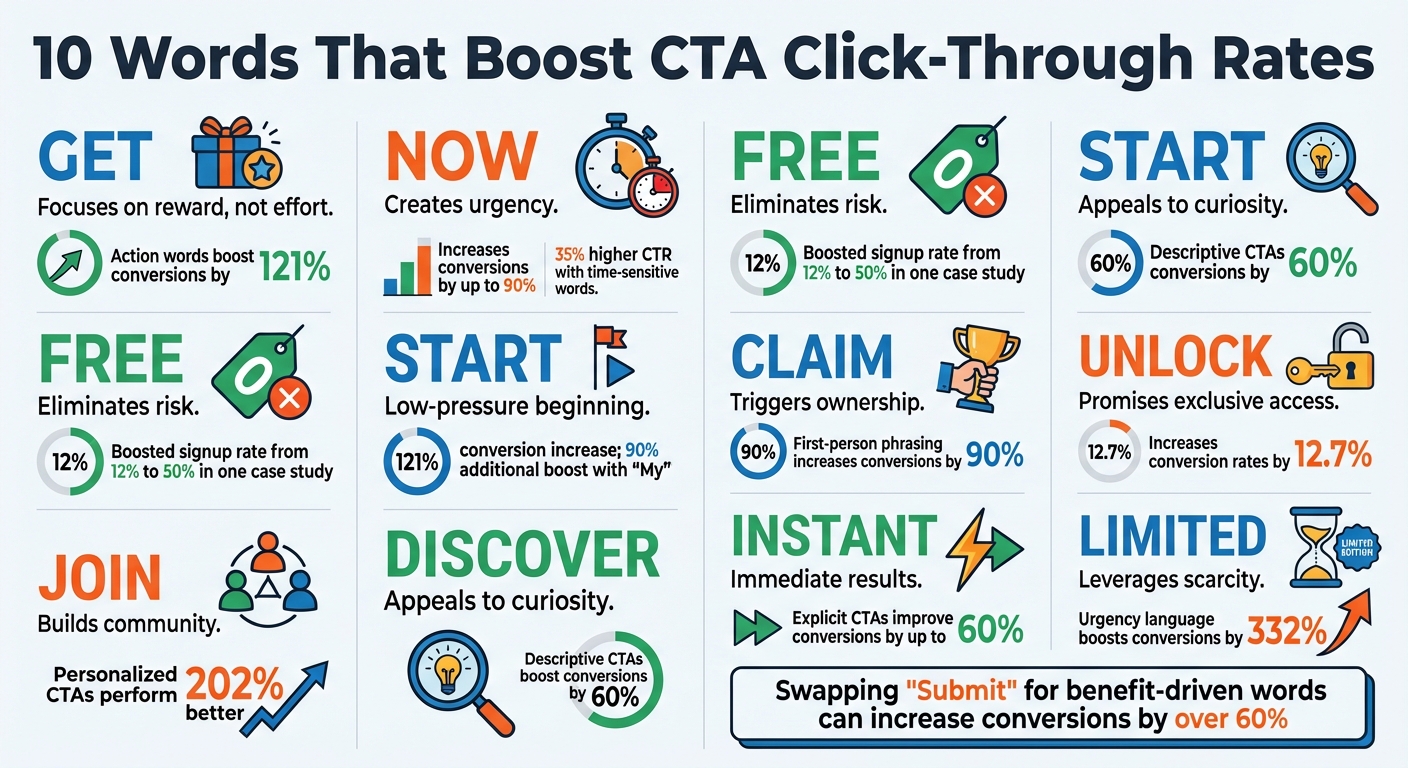
10 High-Converting CTA Words with Performance Data
1. Get
Drives Action
"Get" is one of those action verbs that immediately sparks momentum. Unlike passive options like "Submit" or "Register", which focus on the effort users need to make, "Get" shifts the spotlight to the reward waiting for them. It’s all about what users gain, not what they have to do.
Here’s why it works: humans are wired to chase progress and achievement. For instance, swapping "Download Guide" with "Get My Free Guide" changes the tone entirely – it feels like an instant win instead of a chore. And this isn’t just theory. Using action-forward words like "Get", "Start", or "Claim" has been shown to boost conversions by a whopping 121%.
"Words like ‘Get,’ ‘Start,’ ‘Claim,’ and ‘Discover’ create momentum and urgency. They suggest immediate benefit and forward motion, which appeals to our brain’s desire for progress and achievement." – Casey Miller, Founder, Casey’s SEO
But the magic of "Get" doesn’t stop at driving action. It also plays a key role in making users feel comfortable and confident.
Builds Trust
"Get" has a knack for reducing friction. It makes the next step feel smaller and less intimidating. For example, saying "Get your first lesson" feels like a low-pressure invitation rather than a big commitment. This works because it eliminates uncertainty – users know exactly what they’re stepping into.
Combine "Get" with first-person phrasing, and you take things up a notch. Think about "Get My Custom Quote" versus a generic alternative. That slight tweak makes users feel like the offer is already theirs. It’s no surprise that personalized CTAs using this strategy perform 202% better than generic ones.
sbb-itb-7a4ada9
2. Now
Encourages Urgency
The word "now" carries a sense of immediacy that pushes people from merely considering an action to actually doing it. For example, seeing "Download Now" eliminates the option to delay, creating a sense of urgency.
Numbers back this up. Adding "now" to a call-to-action (CTA) can increase conversion rates by as much as 90%. CTAs that include time-sensitive words like "now" or "today" tend to see a 35% higher click-through rate compared to those that don’t.
"The word ‘now’ alone can boost conversions by up to 90% because it eliminates the option to procrastinate." – Casey Miller, Founder, Casey’s SEO
Drives Action
The urgency created by "now" becomes even more effective when paired with strong verbs. Phrases like "Claim Your Discount Now" or "Get Instant Access Now" not only motivate but also make the next step clear and actionable.
For instance, Billshark switched its homepage CTA from "Get Estimate" to "Save Now!" to emphasize the immediate benefit, resulting in a complete website transformation. Similarly, Cleaning Lovers, a cleaning service in Virginia, uses a prominent blue button with the phrase "Get a Free Estimate Now" at the top of its homepage to encourage quick responses.
"Time-sensitive words like ‘now,’ ‘today’ or ‘instant’ communicate immediacy. Pairing these with tangible benefits helps increase click potential." – Cody Kluge, Best Version Media
This combination of urgency and clarity not only drives clicks but lays the groundwork for building trust.
Builds Trust
Using "now" effectively does more than prompt action – it also reassures users that the offer is current and legitimate. When used authentically, "now" signals that the opportunity is real and active, which builds trust. For instance, offering instant access to content or a timely discount confirms that you’re delivering on your promise. However, misleading urgency, like fake deadlines or false scarcity, can erode trust and harm your brand’s reputation.
When your offer provides a real, immediate benefit, "now" becomes a powerful trust-building tool that assures users they aren’t wasting their time.
3. Free
Drives Action
The word "free" is one of the most compelling tools in marketing – it speaks directly to our instincts. When people encounter "free", they often stop weighing risks. It eliminates the cost barrier entirely.
Phrases like "Start My Free Trial" or "Get Your Free Marketing Plan" work so well because they make taking the first step feel simple and risk-free. This can lead to immediate engagement. For instance, marketing expert Rich Page boosted his signup rate from 12% to 50% by tweaking an exit popup with "free" and other persuasive words.
"The word ‘Free’ assures visitors there’s no downside to clicking… people love free offers because there’s no perceived risk." – Wishpond
Builds Trust
Beyond driving clicks, "free" helps build trust by making the benefits clear and cost-free. Transparency is key when using "free" effectively – it reassures users about what they won’t be paying for. For example, Teespring added the phrase "don’t worry" to explain that users wouldn’t be charged unless a sales goal was met. This small adjustment led to a 12.7% increase in conversions.
Pairing "free" with terms like "No credit card required" or "Cancel anytime" can ease fears about hidden fees or commitments. A great example is Cleaning Lovers, a Virginia-based cleaning service, which used a bold blue button labeled "Get a Free Estimate Now" to build trust and generate leads.
"If the result is complimentary or free, say so." – Knotch
4. Start
Drives Action
The word "start" sets the tone for a low-pressure beginning, making it feel like the start of a rewarding journey rather than a heavy decision to commit. When people see "start", it sparks a sense of progress and momentum. This straightforward verb signals the next step clearly and effectively. For instance, phrases like "Start My Free Trial" or "Start Earning" work well because they are direct and action-oriented.
Research shows that using "start" instead of more passive phrases can boost conversion rates by 121%. Taking it a step further, swapping "Start Your Free Trial" with "Start My Free Trial" increases conversions by an additional 90%. Why? It’s all about ownership.
"When users read ‘my,’ their brain automatically begins to take possession of the outcome. They’re no longer being directed – they’re choosing to claim something for themselves."
- Casey Miller, Founder, Casey’s SEO
Builds Trust
"Start", like other action-driven words, fosters trust by promoting clarity and ease. It frames the action as a simple, manageable first step rather than something overwhelming. Pairing it with words like "free" or "risk-free" strengthens this effect, signaling a low-risk entry point that reassures users they have little to lose. For example, a phrase like "Start My Stress-Free Optimization" not only addresses potential doubts but also promises a straightforward and approachable process.
Learn Call to Action Copywriting in Less Than 5 Minutes
5. Join
After emphasizing urgency and action with words like "Get", "Now", "Free", and "Start", the term "Join" takes a different approach. It taps into the power of community and social proof to encourage conversions.
Builds Trust
The word "join" triggers a psychological response tied to social proof. When users see phrases like "Join 10,000+ subscribers" or "Join 2,500+ PMMs", they immediately sense that others have already taken part. Take the example of the Product Marketing Alliance in October 2021. Their CTA, "Join 2,500+ PMMs", for a certification course, showcased the number of professionals already involved. This simple addition of a number transformed the call-to-action into a trust-building statement, making it clear that users were stepping into a well-regarded and credible space.
This approach not only establishes credibility but also lays the groundwork for turning curiosity into action, which is explored further below.
Drives Action
Once trust is established, "join" works to encourage immediate participation. Unlike "sign up", which can feel transactional, "join" carries a sense of belonging and community. It invites users to become part of something meaningful. For instance, OkCupid’s use of "Join OkCupid" positions the brand as a welcoming community rather than just a service. This subtle shift can make a big difference – personalized CTAs using "join" have been shown to perform up to 202% better.
"The difference between ‘joining’ and ‘signing up’ is the difference between fellowship and enlisting. A word changes the meaning, the mood, and the motivation." – Buffer
Pairing "join" with risk-free offers, like "Join Free for a Month", further lowers barriers to entry. Netflix used this exact CTA in 2025 on its landing page, combining a compelling offer with a no-risk trial to drive engagement. It’s this combination of trust, belonging, and ease that makes "join" a powerful tool for action.
6. Discover
When it comes to encouraging action, "discover" takes a different route by appealing to curiosity and exploration. As one of the top-performing words for boosting CTA click-through rates, it taps into the natural human desire to learn and uncover.
Appeals to Curiosity
"Discover" plays directly into our innate curiosity, encouraging users to seek out answers or insights.
This word works because it hints at something worth uncovering – whether that’s a hidden treasure, a secret strategy, or exclusive knowledge. For instance, Grey Goose effectively used "Discover More" in their campaigns to tease details about new products. By pairing the phrase with visually compelling content, they sparked curiosity and invited users to dive deeper.
Builds Trust
Unlike more direct commands, "discover" takes a softer, more inviting approach, making it ideal for users in the awareness stage.
The word creates a sense of exploration rather than obligation. It’s far more engaging than generic phrases like "Click here" because it hints at valuable information while avoiding pushiness. This subtlety helps build trust – users feel guided instead of pressured, which makes them more likely to engage and take the next step.
Drives Action
Though gentle in tone, "discover" is inherently action-oriented. It encourages forward motion, appealing to our brain’s preference for progress. In fact, descriptive CTAs using "discover" can outperform generic alternatives, boosting conversion rates by as much as 60%.
"Words like ‘Get,’ ‘Start,’ ‘Claim,’ and ‘Discover’ create momentum and urgency. They suggest immediate benefit and forward motion." – Casey Miller, Casey’s SEO
To maximize effectiveness, pair "discover" with a clear benefit. Phrases like "Discover Solutions" or "Discover the Benefits" resonate because they promise answers to problems. For users in the research phase, options like "Discover How It Works" or "Explore Options" perform better than high-pressure commands such as "Buy Now".
7. Claim
"Claim" transforms a call-to-action (CTA) into a personal achievement. Instead of feeling directed, users perceive themselves as taking ownership of something that’s already theirs. This subtle shift can significantly boost conversions.
Triggers Ownership and Agency
The word "claim" taps into the endowment effect, making users feel like they already own the benefit before they even act. Phrasing matters too – using first-person language like "Claim My Discount" instead of "Claim Your Discount" can increase conversions by 90%. Personalized CTAs like this consistently outperform generic ones.
"They’re no longer being directed – they’re choosing to claim something for themselves. This psychological shift empowers passive visitors into active participants in their own success story." – Casey Miller, Casey’s SEO
Encourages Urgency
"Claim" carries a sense of value and exclusivity, implying that what’s available won’t last forever. It’s especially effective for purchase-ready visitors who need a final push. Pairing it with time-sensitive phrases like "Claim Your Spot" heightens urgency and taps into the fear of missing out (FOMO). This combination can make users feel like they’re gaining access to something special and fleeting.
Drives Action
As a verb, "claim" inspires immediate action and creates a sense of momentum. Replacing passive language with action-driven words like "claim" can increase conversions by 121%. Keeping CTAs concise – ideally 2 to 5 words – ensures clarity and reduces cognitive load. This word works particularly well for tangible benefits, such as free trials, toolkits, or exclusive discounts, amplifying their perceived value.
"Claim helps users feel valued by promoting access only available to some of the audience." – Cody Kluge, Best Version Media
Next, learn how the word "Unlock" can further engage users by promising exclusive access to benefits.
8. Unlock
Building on the sense of ownership from "Claim", the word "Unlock" shifts attention to offering access to exclusive perks.
"Unlock" adds a sense of allure to your CTA by hinting at exclusivity. It taps into people’s curiosity, suggesting there’s something valuable just waiting to be discovered. When visitors see "Unlock", they instinctively feel there’s a hidden benefit they can access.
Appeals to Curiosity
"Unlock" is a curiosity-driven power word because it suggests the presence of premium content or benefits that require action to access. Unlike generic phrases like "Click here", it promises a direct path to something specific – whether that’s a feature, discount, or resource. This clarity reduces hesitation by letting users know exactly what they’ll gain. In fact, using "Unlock" can increase conversion rates by 12.7%.
Drives Action
As an action-oriented verb, "Unlock" adds a sense of urgency and emotional pull, portraying the CTA as a gateway to exclusive rewards. It works particularly well for promoting premium content, service enhancements, or clear value offerings. By making the benefit feel both clear and within reach, "Unlock" directly impacts conversions. For example, Keyword Hero effectively uses "Unlock (not provided)" to connect with SEO professionals, addressing a specific pain point.
Encourages Urgency
When combined with time-sensitive phrases, "Unlock" pushes users to act quickly. Phrases like "Unlock your potential now" or "Unlock your savings today" create a sense of immediacy, making the opportunity feel fleeting. This approach works especially well at the bottom of the marketing funnel, where urgency can result in a 35% higher click-through rate. It’s a powerful way to nudge users toward taking that final step.
"Power words are persuasive words that trigger strong psychological or emotional responses. Marketers use them to create compelling content that deeply influences readers and encouraging their readers to take the desired action." – OptinMonster
Next, discover how "Instant" helps eliminate hesitation for faster conversions.
9. Instant
The word "Instant" taps into our desire for immediate results. It promises no waiting, no delays – just quick, straightforward access. This makes the offer feel easy to achieve and low-risk, which can be incredibly appealing to visitors.
Encourages Urgency
"Instant" is more than just a word; it’s a signal of urgency. It tells users they won’t have to wait, creating a sense of immediacy that can drive quicker engagement. Adding this term to calls-to-action (CTAs) – like "Get Instant Access" – can make offers feel more compelling. When paired with clear benefits, it can significantly boost the likelihood of someone taking action right away.
Builds Trust
When people see "Instant", they know exactly what to expect: immediate results, whether it’s an instant download, quick access, or a fast quote. This clarity helps reduce skepticism and friction. In fact, CTAs that explicitly outline what users will get can improve conversion rates by up to 60%. But here’s the catch – if there’s any delay, it can damage your brand’s credibility. So, it’s crucial to deliver on the promise of immediacy.
Drives Action
"Instant" resonates with users looking for quick fixes or immediate solutions. It lowers the mental hurdle of clicking by offering a fast payoff. Cody Kluge from Best Version Media sums it up perfectly:
"Time-sensitive words like ‘now,’ ‘today’ or ‘instant’ communicate immediacy. Pairing these with tangible benefits helps increase click potential."
This term works best for low-friction offers like instant toolkits, quick quotes, or immediate access to digital content.
Next, explore how "Limited" uses scarcity to drive conversions.
10. Limited
The term "Limited" taps into the power of scarcity to drive action, creating a sense of urgency that compels users to act quickly. It builds on the idea that opportunities perceived as rare or fleeting often feel more valuable.
Encourages Urgency
When you use the word "Limited", it shifts decision-making from logical analysis to instinctive action. People feel a sense of urgency to seize the opportunity before it vanishes. Calls-to-action (CTAs) that include time-sensitive phrases like "Limited Time Offer" or "Only 3 Left" can significantly increase engagement. As Casey Miller from Casey’s SEO puts it:
"Adding simple phrases like ‘Limited Time,’ ‘Only 3 Left,’ or ‘Expires Soon’ creates immediate pressure to act."
In fact, urgency-driven language has been shown to boost conversions by as much as 332%. When paired with specific timeframes or quantities, the effect becomes even more compelling.
Builds Trust
The effectiveness of "Limited" hinges on authenticity. If the scarcity isn’t real, users will likely catch on, which can damage your credibility. False claims of scarcity erode trust and can harm your reputation in the long run. Richard Fong, Founder of Bliss Drive, emphasizes this point:
"Scarcity highlights limited availability, making the offer appear more valuable".
To maintain trust, use "Limited" only when there are actual constraints, such as stock shortages, time-sensitive deals, or capacity limits. When scarcity is genuine and paired with clear, actionable language, it can seamlessly turn trust into immediate engagement.
Drives Action
Pairing "Limited" with strong action verbs like "Claim", "Get", or "Secure" amplifies its impact. For example, "Claim My Limited-Time Discount" is more effective than simply saying "Limited Discount." The use of first-person phrasing, like "My", fosters a sense of ownership and urgency. Additionally, placing these CTAs strategically – such as above the fold or using contrasting colors – further reinforces the need to act quickly .
Conclusion
Words have the power to spark action. Using terms like Get, Now, Free, Start, Join, Discover, Claim, Unlock, Instant, and Limited taps into psychological triggers such as urgency, curiosity, and a sense of belonging. For instance, swapping a dull word like "Submit" for something benefit-driven can boost conversions by up to 60%. That small change can mean the difference between a modest 2% conversion rate and a game-changing 6%.
The numbers back this up: urgency-focused language can increase conversions by 332%, while personalized calls-to-action (CTAs) outperform generic ones by 202%. These aren’t just minor adjustments – they reshape how users perceive and engage with your content, influencing their decisions in meaningful ways.
But knowing which words to use is only part of the equation. Success comes from testing and refining. Your CTA language needs to align with the buyer’s journey, reflect genuine urgency (not gimmicky scarcity), and stand out visually with contrasting colors and strategic placement. A/B testing different word combinations will reveal what resonates most with your audience, ensuring your CTAs remain effective over time.
Upward Engine specializes in helping businesses apply these principles across their digital marketing efforts. From SEO and paid campaigns to custom web design, they craft strategies that optimize CTAs for better results. By focusing on testing and aligning CTAs with each stage of the funnel, they ensure every word contributes to turning visitors into loyal customers.
When you understand what drives people to act and use language that speaks directly to those motivations, you lay the groundwork for higher click-through rates and better overall performance. Make these insights part of your ongoing strategy to keep improving your results.
FAQs
Which CTA word should I test first?
"Get Started for Free" is a classic phrase that has proven to work wonders for conversions. Why? It highlights the value users receive while removing any sense of risk. This combination makes it incredibly appealing and encourages people to take action. It’s no surprise it’s often recommended as a go-to choice for driving engagement.
How do I avoid fake urgency and still boost clicks?
To increase clicks without resorting to fake urgency, offer clear and genuine reasons for taking action. Highlight authentic deadlines or promotions that reflect the real value of your call-to-action (CTA). This approach fosters trust and motivates engagement without relying on misleading tactics like false scarcity.
How can I A/B test CTA copy the right way?
To test your CTA copy effectively, try creating several versions with changes in wording, design, or placement. Then, use A/B testing tools to randomly display these variations to different audience segments. Keep an eye on key metrics like click-through rates and conversions to see which version performs better. Once you’ve identified the winner, apply it across your campaigns. By testing in a structured way, you can fine-tune your CTAs to boost engagement and drive more conversions.