
Maintaining a consistent brand voice is essential for building trust, improving recognition, and driving growth. A unified tone across platforms ensures your audience knows what to expect, creating a reliable and memorable experience. Research shows that consistent branding can boost revenue by up to 23% and improve customer perception by 70%. On the other hand, inconsistent messaging can confuse customers, damage trust, and weaken your brand identity.
Key takeaways:
- Trust and Loyalty: 90% of U.S. consumers prioritize trust when choosing brands.
- Recognition: Consistent messaging improves brand recall and visibility.
- Revenue Growth: Unified branding can lead to a 23% increase in revenue.
To achieve this, define your brand’s personality, document it in a style guide, and train your team. Regular audits and updates ensure alignment across all channels. Tools like Upward Engine can help streamline this process, ensuring your brand remains clear and dependable.
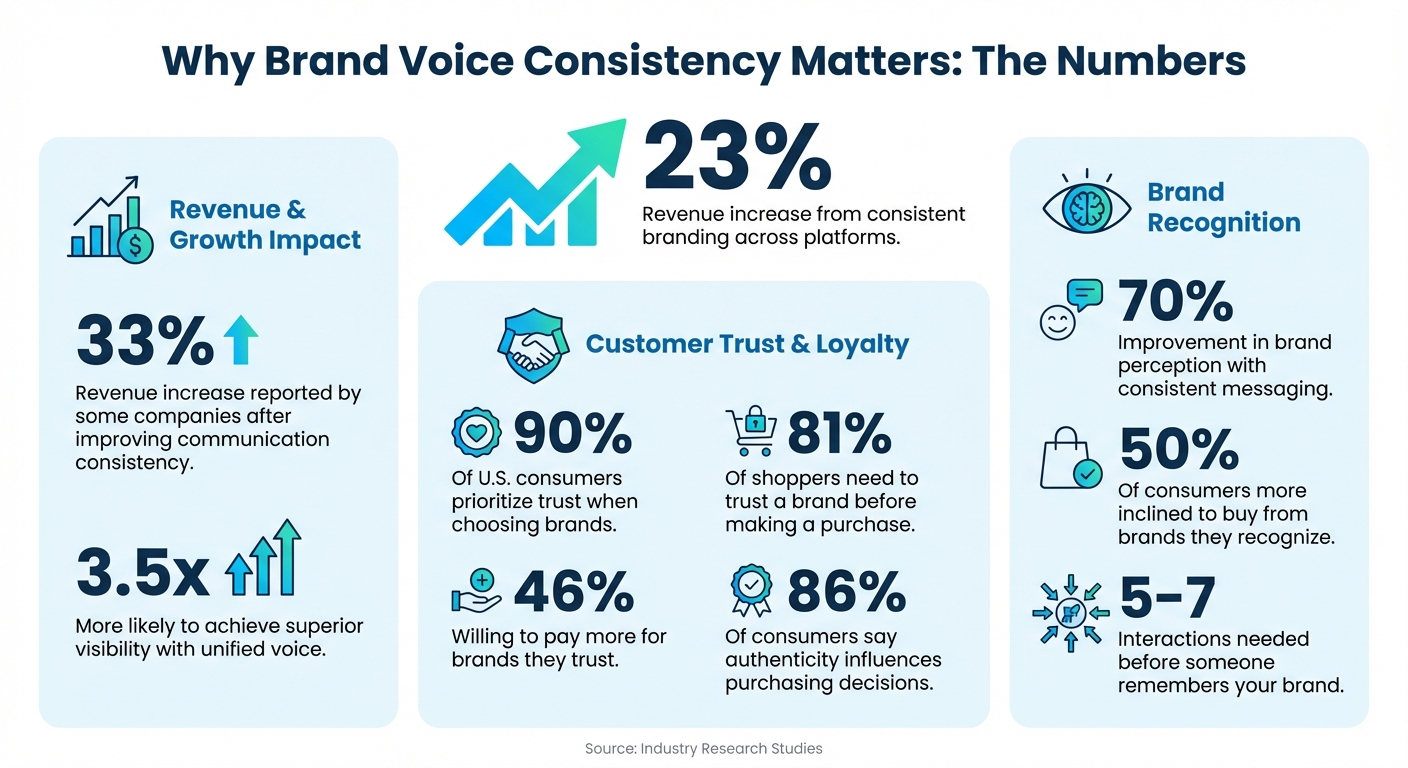
Brand Voice Consistency Statistics: Impact on Revenue, Trust, and Recognition
How to Create a Consistent Brand Voice
sbb-itb-7a4ada9
Problems Caused by Inconsistent Brand Voice
When your brand voice shifts unpredictably across different channels, it can confuse your audience and weaken the connection they feel with your business. These inconsistencies create deeper challenges that affect how customers perceive your brand and whether they choose to engage with it.
Customer Confusion and Damaged Trust
Imagine seeing a formal, polished ad for a brand, only to visit their website and find casual, almost playful language. It’s jarring, right? Ramona Sukhraj from HubSpot puts it perfectly: "When your voice shifts this dramatically from one step to the next, it can confuse people and make them want to bounce". This kind of inconsistency not only drives customers away but also makes them question your authenticity.
The issue becomes even more pronounced when your messaging contradicts your stated values. For instance, if your website champions sustainability but your email campaigns never reference it, customers might wonder whether you’re genuinely committed to those principles. This is no small problem – 81% of shoppers say they need to trust a brand before making a purchase.
On top of that, inconsistent messaging can make your business seem disorganized. If your social media posts, website copy, and customer support interactions all have wildly different tones, it’s hard for customers to form a clear and consistent relationship with your brand. Over time, this erosion of trust chips away at your overall credibility.
Weakened Brand Identity
A scattered brand voice leads to a fragmented identity, making it harder for customers to remember or recognize you. For example, if your social media posts are lighthearted and fun but your website reads like a legal contract, customers won’t know what to make of you. This lack of alignment undermines one of the most powerful aspects of branding: being instantly recognizable, even without your logo.
Every inconsistency in tone weakens your brand’s equity. A unified voice isn’t just about standing out – it’s about creating a lasting impression in a crowded market. Inconsistent branding can cause your business to fade into the background while competitors with stronger, more cohesive identities capture attention and loyalty. This weakened identity not only affects how customers perceive you but also impacts their willingness to engage and make purchases.
Reduced Engagement and Sales
When your messaging feels disjointed, it’s hard for customers to form an emotional connection with your brand. Without that connection, building long-term loyalty becomes a challenge. And the stakes are high: maintaining a consistent voice across all platforms can increase revenues by as much as 23%.
Audio and video content make these inconsistencies even more obvious. Variations in tone, pacing, or confidence can quickly erode trust. If potential customers sense something feels off, they’re likely to turn to competitors who present a clearer, more consistent message.
Benefits of Consistent Brand Voice
Inconsistent messaging can confuse customers and weaken your brand’s identity. On the flip side, a unified brand voice creates clarity, strengthens relationships with your audience, and helps your marketing efforts go further.
Stronger Customer Trust and Loyalty
When your messaging remains consistent across all platforms, customers know exactly what to expect. This reliability builds trust. In fact, 90% of U.S. consumers say that trusting a brand is important, and 46% are willing to pay more for brands they trust.
"Consistency fosters connection in business relationships as it does in personal ones." – Grammarly Business
A consistent voice makes your brand feel dependable and authentic across every interaction – whether it’s a social media post, your website, or customer support. This authenticity resonates with buyers, with 86% of consumers stating it influences their purchasing decisions. Trust leads to emotional connections, turning casual buyers into loyal supporters who recognize and appreciate your brand’s personality.
Better Brand Recognition
A unified voice doesn’t just build trust – it makes your brand unforgettable. When your tone and personality remain steady across all platforms, customers recognize and remember you more easily. The numbers are clear: consistent and clear messaging improves brand perception by 70%, and companies with a unified voice are 3.5 times more likely to achieve superior visibility. Additionally, 50% of consumers are more inclined to buy from brands they recognize.
It typically takes 5 to 7 interactions before someone remembers your brand. But if your voice keeps changing, those impressions won’t add up. Consistency ensures that every interaction reinforces your identity, helping you stand out in crowded markets.
Higher ROI and Revenue Growth
Consistency isn’t just about looking good – it delivers measurable results. Presenting your brand consistently across platforms can boost revenues by up to 23%, while some companies have seen revenue increases as high as 33% after improving the consistency of their communications. A clear, unified voice shortens the sales process by building buyer confidence, ultimately driving faster decisions and higher conversions.
"A consistent brand voice does more than just make your writing sound good. It actually reduces friction throughout your brand and customer experience." – Ramona Sukhraj, Author, HubSpot
Beyond revenue, a consistent voice streamlines operations. Clear guidelines reduce the need for revisions, speed up content approvals, and help teams launch campaigns faster. This efficiency not only saves time but also ensures your brand can seize opportunities without unnecessary delays.
How to Create and Maintain Your Brand Voice
To tackle the challenges of inconsistent messaging, you need a structured approach to shaping your brand voice. Consistency doesn’t come from guessing – it stems from a clear, repeatable process that everyone on your team can follow. The good news? Your brand’s voice already exists in your current content; it just needs refining and safeguarding.
Define Your Brand Personality and Values
Start by auditing your current communications – social posts, emails, website copy – and look for patterns in how your brand naturally speaks. Then, bring together team members from various departments to discuss what makes your company stand out. Ask them to describe your culture in just three words.
Next, choose three to five core values that represent your brand, and define each one clearly. For instance, if "Rigorous" is a value, explain that it means "reliable and thoroughly tested" rather than "rigid or robotic." This ensures everyone understands the boundaries and avoids misinterpretation.
"Your brand voice is who you are, while your brand tone is how you adapt to the moment." – Charlotte Baxter-Read, Lead Marketing Manager, Markup AI
Remember to factor in your audience. Think about their demographics, interests, and how they prefer to communicate. A brand speaking to Gen Z on TikTok will naturally sound different from one addressing CFOs on LinkedIn. That’s the beauty of tailoring your voice – it ensures your message resonates with the right people.
Create a Brand Voice Style Guide
Once you’ve nailed down your brand’s personality, document it in a style guide. This guide should serve as a practical tool for your team, helping them make quick, consistent decisions. Start by distinguishing between voice (your brand’s consistent personality) and tone (how that personality adjusts to different contexts).
Develop a tone matrix to illustrate how your voice shifts across platforms or scenarios. For example, your tone might be "professional but approachable" on LinkedIn and "casual and playful" on TikTok, but the underlying personality stays the same. Include "do and don’t" lists with specific word choices and phrases to use or avoid, along with before-and-after examples of off-brand text edited to align with your voice. These examples help explain the reasoning behind your guidelines.
Make your guide easy to access. Many brands are moving away from static PDFs in favor of live digital hubs that update in real time. This is especially helpful as teams increasingly use AI tools to draft content. A dynamic style guide ensures automated drafts stay aligned with your brand’s voice while providing clear benchmarks for quality.
With your guide in place, focus on training your team and monitoring how well the guidelines are applied.
Train Teams and Monitor Consistency
A style guide is only useful if your team actually uses it. Make brand voice training an essential part of onboarding for all new hires. Offer quick, focused sessions – like a 30-minute workshop on adapting your voice for social media trends or handling customer complaints.
Regularly review your channels to catch and correct inconsistencies early. Periodic surveys can also help you gauge how well your brand voice is being implemented. Update your style guide annually to reflect any changes in your brand’s direction or audience preferences.
"The way your team executes on your voice and tone guidelines has a measurable impact on people’s trust in your brand." – Erin Crews, Senior Design Manager of Content Strategy, Mailchimp
Establish clear approval workflows to ensure content is reviewed for voice consistency before going live. While AI tools can help flag mismatches, human review is crucial for handling subtle cultural nuances and complex tone shifts. Keep an eye on customer interactions, like call transcripts and social media mentions, to see if your audience is naturally adopting your brand’s language. When they do, it’s a strong indicator that your voice is hitting the mark.
How Upward Engine Helps with Brand Voice Consistency

Upward Engine provides tailored solutions to establish and maintain a consistent brand voice across all channels. Achieving this consistency goes beyond crafting a style guide – it requires expertise, strategic planning, and regular updates. They offer the tools and support needed to ensure your brand voice remains cohesive and recognizable in every interaction.
Branding and Graphic Design Services
Upward Engine works to define your brand voice by creating detailed style guides that cover language, tone, and messaging. Their branding services also extend to visual identity, ensuring that everything from website design to social media graphics aligns with your brand’s personality and values.
"Think of your brand voice as an expression of your brand’s personality. It’s the way you communicate with your customers, the tone you use in your marketing materials, and the overall feeling people get when they interact with your brand".
Using AI tools, they ensure that automated content consistently reflects your unique selling points. By identifying your core values and mission, they create a strong foundation for all visual and written communications. This approach ensures your brand is perceived as professional and reliable at every touchpoint.
Custom Web Design and Content Creation
Your website is the hub of your brand, and Upward Engine specializes in building custom sites where every element – from headlines to microcopy – embodies your brand voice. Even UX details like button labels and error messages are designed to reinforce your identity.
They also create frameworks that adapt your core message for different platforms. For example, a single idea can be transformed into blog posts, videos, or social media snippets, each tailored to its audience while staying true to your brand’s tone. This strategic approach not only strengthens your brand identity but also drives measurable growth.
Continuous Support and Optimization
Maintaining a consistent brand voice is an ongoing task. Upward Engine provides regular evaluations and updates, recommending monthly reviews of marketing content to ensure alignment with your brand identity. Their team monitors elements like sentence structure and tone to keep your communication style intact.
"At Upward Engine, we recommend reviewing AI-generated content at least once a month and making updates or revisions as needed. This process will help maintain the authenticity of your brand voice and ensure that it remains consistent across all marketing channels".
They also update mission statements, key messaging, and terminology to keep your brand voice fresh and prevent it from drifting. With clear and consistent messaging capable of improving brand perception by up to 70%, their ongoing efforts ensure your brand remains sharp and impactful.
Conclusion
A consistent brand voice plays a critical role in driving business growth. When your brand communicates with the same tone and personality across all channels, it builds trust, strengthens recognition, and directly contributes to revenue growth. On the flip side, inconsistency creates confusion and erodes trust.
As mentioned earlier, maintaining consistency doesn’t just enhance trust – it also delivers measurable financial benefits. Research shows that businesses with a cohesive brand presentation experience increased revenue and improved customer perception.
"Clarity and consistency in communication build credibility and trust, the foundations of long-term brand strength and loyalty." – Brandality
To make this happen, focus on defining your brand’s core personality, creating a clear style guide, and ensuring your team is well-trained. Regularly auditing your communication can help identify and resolve inconsistencies before they impact your reputation.
If you’re looking for professional guidance, Upward Engine offers services in branding, web design, and content creation. They specialize in helping businesses establish and maintain a strong brand voice across all platforms, ensuring your brand remains trustworthy, recognizable, and ready for long-term success.
FAQs
What’s the difference between brand voice and brand tone?
Think of brand voice as the personality of your brand – it’s consistent, unchanging, and reflects the core values and identity of your business. It’s the who in your communication, the essence that remains steady no matter where or how your brand shows up.
Now, brand tone is where things get a little more flexible. Tone is the emotional layer or attitude you apply to that voice. It shifts depending on the situation, audience, or platform. In other words, while voice stays the same, tone is the how – how your brand speaks in different contexts to connect with people effectively.
How can I tell if my brand voice is inconsistent?
Inconsistent brand voice appears when the tone or style shifts across different platforms. For example, your social media might come off as casual, while your emails feel overly formal. It can also happen when different teams create messages that don’t align, leaving the audience with a disconnected impression.
To identify this issue, take a close look at your content across all channels. If it doesn’t convey a consistent personality, it’s time to set up clear brand voice guidelines. Regularly auditing your content can help ensure consistency, which is key to building trust with your audience.
What should a brand voice style guide include?
A brand voice style guide lays out the personality and tone of a brand – whether it’s formal, casual, or even humorous. It highlights preferred vocabulary, phrases, and words to steer clear of, ensuring consistency. The guide also explains how to adjust the tone for various contexts and often includes examples or templates to make this process easier. By following these guidelines, brands can maintain consistent communication, foster trust, and deepen audience connections.