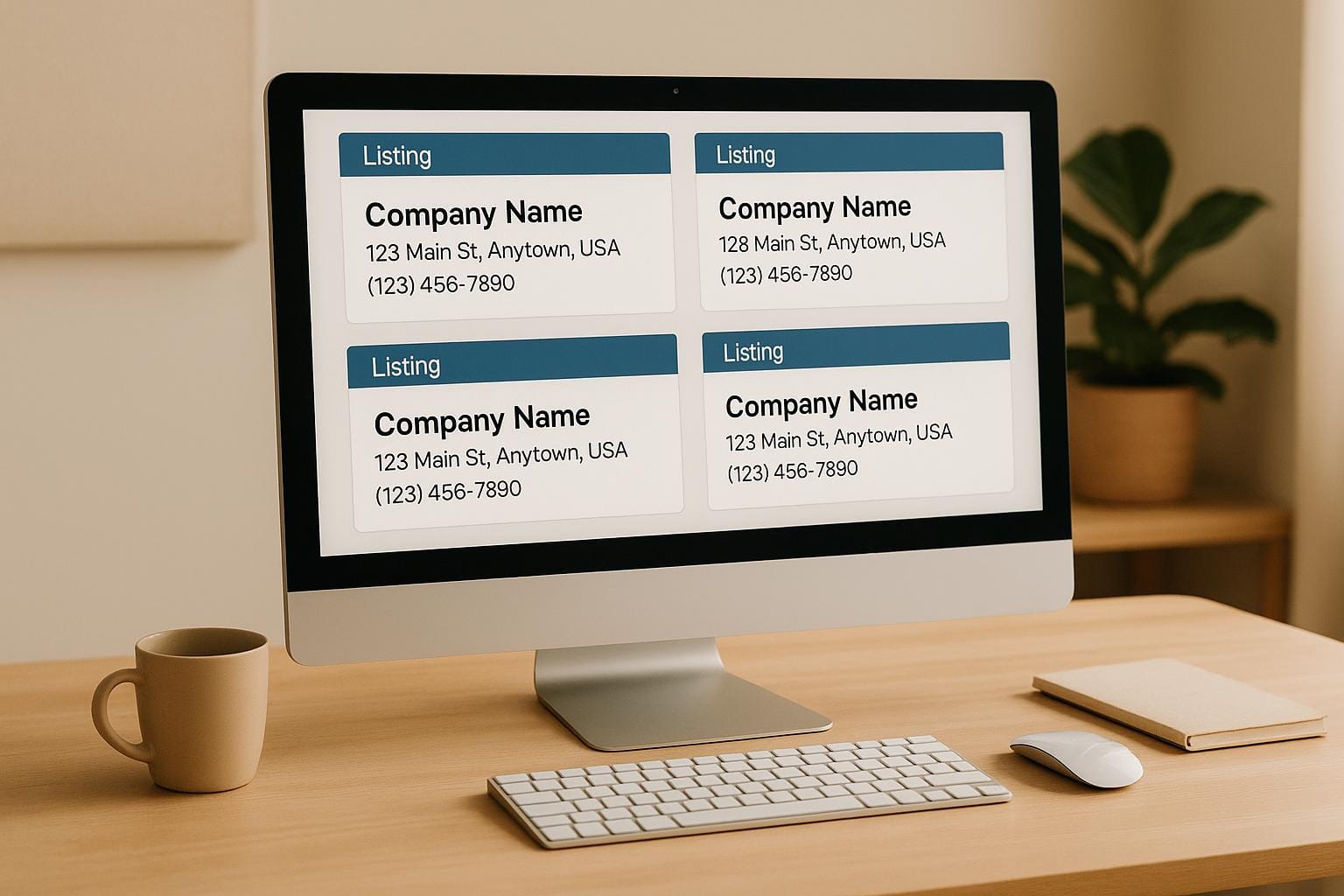
NAP consistency – ensuring your business’s Name, Address, and Phone number are identical across all platforms – is critical for local SEO. Search engines prioritize businesses with uniform details, boosting rankings and visibility. Inconsistent NAP data can confuse search engines, lower rankings, and frustrate potential customers, leading to lost trust and sales.
Key takeaways:
- 70% more calls for businesses with consistent NAP data.
- 73% of users lose trust in brands with inaccurate information.
- 28% of local searches lead to purchases within a day.
To maintain consistency:
- Conduct regular NAP audits.
- Use a centralized system for managing business information.
- Update listings immediately after changes.
- Leverage tools like BrightLocal, Moz Local, or Yext to streamline updates.
Accurate NAP data ensures better rankings, customer trust, and higher engagement.
What is NAP in Local SEO, and Why is it Important?
Why NAP Consistency Matters for Local SEO
Ensuring uniformity in your business’s Name, Address, and Phone number (NAP) across all platforms is crucial for both search engine rankings and customer trust. NAP consistency serves as a cornerstone of local SEO, signaling to search engines that your business is credible and worthy of better visibility.
Better Local Search Rankings
When your business information is consistent across trusted directories, search engines recognize this as a sign of legitimacy. This alignment boosts your chances of ranking higher in local search results. In fact, businesses with consistent NAP details are 40% more likely to appear in Google’s local pack.
Matching information across platforms reassures search engines about your business’s authenticity and location. This consistency not only enhances your local rankings but also strengthens your E-A-T scores (Expertise, Experience, Authority, Trustworthiness), which are key components of Google’s algorithm. On the flip side, inconsistent NAP data can confuse search engines, leading to lower rankings and reduced visibility.
Building Customer Trust
Accurate NAP information doesn’t just help search engines – it also builds trust with your customers. When people see the same details about your business across multiple platforms, it reassures them that your business is professional and reliable.
Mistakes in NAP data can lead to customer frustration. For instance, 36% of consumers have called incorrect phone numbers because of inaccurate online information. Worse, 22% have visited a business location only to find it didn’t match the online listing. These errors can quickly erode trust, making customers less likely to choose your business over competitors.
By maintaining consistent NAP data, you show potential customers that your business is dependable, which often becomes the deciding factor in their purchasing decisions.
Problems with Inconsistent NAP Data
Inconsistent NAP information can create serious problems for your business. Research shows that 41% of businesses struggle with mismatched NAP data, making it the most frequent issue impacting local search rankings.
These inconsistencies can lead to SEO penalties, which may cause your business to drop significantly in local search results. For businesses that depend on local visibility, this could be disastrous. In severe cases, a suspended Google Business Profile could result in a 90% drop in customer calls.
The impact on customer behavior is just as damaging. A staggering 68% of consumers say they would stop using or hesitate to engage with a business after encountering incorrect online information. This loss of trust can lead to reduced visibility, fewer leads, and lower revenue.
“Your brand isn’t what you say it is, it’s what Google says it is.” – Chris Anderson, Former editor of Wired magazine
When potential customers encounter conflicting details about your business, they may question your credibility before even reaching out. This doubt can harm your reputation, sales, and overall success.
Common Causes of NAP Inconsistencies
Understanding why NAP inconsistencies occur is key to avoiding the problems they create. Most businesses don’t deliberately provide conflicting details, but a lack of attention or oversight can lead to these issues.
Typing Errors and Outdated Information
Simple human mistakes are a frequent cause of NAP inconsistencies. A misspelled name, a missing digit in a phone number, or outdated details after a business relocation can confuse both search engines and customers. For example, when businesses move or change their phone numbers, they often forget to update this information on every platform.
Address formatting can also be a culprit. For instance, one listing might say “123 Main Street”, while another shows “123 Main St.” Even though they refer to the same location, search engines might struggle to verify the business information due to these small differences. On top of that, unauthorized changes – whether intentional or accidental – can introduce errors when customers or competitors submit incorrect details to directories.
To avoid these pitfalls, it’s important to establish a standard format for your business’s name, address, and phone number. Share this format with your team to ensure consistency. Keeping a master document with the most up-to-date NAP information can also help. Use it as a reference whenever you’re updating listings. And don’t wait – update your NAP details immediately after any changes, like a new address or phone number.
Different Formatting Styles
Every online platform has its own way of displaying business information, which can lead to inconsistencies. For example, your business might appear as “ABC Marketing LLC” on one site, “ABC Marketing, LLC” on another, and simply “ABC Marketing” elsewhere.
Formatting differences like “Street” vs. “St.”, phone numbers written as “(555) 123-4567” versus “555-123-4567”, or name truncations due to character limits can all create confusion. While these variations may seem minor, search engines might interpret them as separate entities.
“Inconsistencies across websites will only lead to issues with both search engines and users alike being confused by the inconsistencies.” – Adtrak
These small discrepancies can weaken your local SEO efforts because search engines rely on consistent information to verify your business. Even slight variations can disrupt that process.
No Central Data Management
The lack of a centralized system for managing business information is a major contributor to NAP inconsistencies, especially for growing companies. Without a single source of truth, different team members might update listings with slightly varying details, leading to mismatched information across platforms.
Manually updating multiple directories is prone to mistakes. When businesses try to manage dozens of listings individually, errors are almost inevitable. This issue becomes even more complicated for businesses with multiple locations. Each location might have its own team handling updates, resulting in inconsistent formatting and timelines.
| Problem | Consequence |
|---|---|
| Duplicate Listings | Confuses search engines and lowers search visibility |
| Inconsistent Business Name Variations | Makes it harder for customers to recognize and trust the brand |
Studies show that 68% of consumers would stop using a local business if they found incorrect contact details online . Additionally, inconsistent NAP information can reduce a site’s performance by as much as 16%.
Using a centralized platform to manage your listings can solve this problem. With such a system, you can update and synchronize your business information across all major directories from one dashboard. This approach minimizes errors, ensures consistency, and helps maintain a unified brand presence. Addressing these common causes lays the groundwork for better NAP practices, which we’ll explore further in the next sections.
Best Practices for NAP Consistency
To maintain consistency in your business’s Name, Address, and Phone number (NAP) across the web, it’s essential to address the common causes of discrepancies and follow these straightforward practices.
How to Conduct a NAP Audit
A NAP audit involves reviewing your business information to ensure it’s accurate and consistent across all platforms where your business is listed. This process helps identify errors that could hurt your local search performance.
Start by gathering all your listings from major platforms like Google My Business, Yelp, Apple Maps, and Bing Places. Use a spreadsheet to track every site or directory where your business appears, including social media profiles, review platforms, and niche directories.
Next, carefully check that your business name, address, and phone number are identical across all platforms. Even small differences, like abbreviations or formatting changes, can confuse search engines.
Focus on directories and platforms most relevant to your business. These could include high-traffic directories, local business listings, and city-specific platforms. While reviewing, look for duplicate entries that may weaken your online authority. Merge or remove duplicates as needed.
Using tools can simplify this process. For example:
- BrightLocal scans multiple directories to spot inconsistencies.
- SEMrush offers a free tool to identify listing errors and find opportunities for new citations.
- Moz Local provides a consistency score based on the accuracy of your business’s listings.
Once discrepancies are identified, correct them immediately. Use a standardized format for your business details and apply it consistently across all platforms.
Creating a Single Source of Truth
A Single Source of Truth (SSOT) is a centralized hub for storing your official business information. It ensures that everyone in your organization uses the same, accurate data.
Select a platform for your SSOT, such as a CRM or a knowledge management tool. Look for features like intuitive search, simple content creation, and clear organization. Consolidate your NAP data into this system, removing any outdated or incorrect information.
Standardize your business details by identifying inconsistencies in your current data. Create a uniform format for your business name, address, and phone number, and document any necessary variations for platforms with character limits.
Assign specific roles within your team to maintain the SSOT. Designate individuals to add, edit, and approve NAP information, ensuring data security and accountability.
Centralizing your NAP data can significantly improve efficiency. According to a Chief Operating Officer quoted by Knowmax, implementing a knowledge management system led to a 12% increase in first-call resolution (FCR), a 10% reduction in average handling time (AHT), and a 28% improvement in customer satisfaction (C-SAT) scores.
To maintain consistency, appoint “data masters” familiar with your business operations. They should oversee NAP accuracy and establish quality control processes to keep your information reliable over time.
With centralized data in place, ongoing oversight is key to preserving its accuracy.
Regular Monitoring and Updates
Keeping your NAP details consistent requires continuous effort. Regular monitoring ensures your data remains accurate as your business and online platforms evolve.
Set a routine schedule to review and update your master list of platforms displaying your NAP information, including industry-specific sites and local organizations like chambers of commerce.
When business details change, update all listings immediately. Tools like Yext allow you to manage your information across platforms from one dashboard. Similarly, Whitespark‘s Citation Finder can help identify and flag inconsistencies.
Keep an eye out for errors, as even minor discrepancies can impact your search rankings. Use alerts or periodic checks to catch unauthorized or incorrect changes.
In July 2024, Direction.com highlighted the importance of regular NAP audits. They recommended tools like Direction Local, Whitespark Citation Finder, and BrightLocal Citation Tracker to uncover inconsistencies and understand how search engines view your business information.
“Regular monitoring and updating of NAP information are critical to preserving this consistency, ultimately promoting improved local search performance and greater online visibility.”
Claiming and verifying your Google My Business listing with accurate NAP details should be a top priority, as this has the greatest impact on your local search visibility.
Finally, create a feedback system within your organization. Encourage team members – from customer service to sales and marketing – to report any NAP-related issues they encounter. This proactive approach helps identify and resolve inconsistencies quickly, strengthening your local SEO efforts. Regular audits not only prevent errors but also ensure your business stays visible and trustworthy online.
sbb-itb-7a4ada9
Tools and Resources for Managing NAP Consistency
Keeping your NAP (Name, Address, Phone number) data consistent across multiple online directories can feel like a juggling act. Thankfully, there are platforms designed to automate much of the process, saving you time, reducing errors, and ensuring your business information stays accurate and reliable – key factors for local SEO success.
Top NAP Management Tools
If you’re serious about maintaining accurate NAP data and boosting your local SEO, these tools are worth considering:
- Google Business Profile Manager
This free tool gives you direct control over your Google listing, ensuring your business appears correctly in local search results and on Google Maps. - BrightLocal
BrightLocal offers features like citation audits, rank tracking, review management, and competitor analysis. Plans start at $39/month, and there’s a 14-day free trial to test it out. - Whitespark
Specializing in citation building and management, Whitespark helps you discover new citation opportunities and monitor your NAP data. Campaigns start at $20, with both free and premium tools available. - Moz Local
Moz Local simplifies business listing management across major platforms. Starting at $14/month per location, it’s a practical choice for businesses with multiple locations. - Yext
Yext automates citation building and NAP management. However, be aware that if you cancel your subscription, your listings may revert to their previous state. - dbaPlatform
Designed for businesses with more complex needs, dbaPlatform offers a full suite of local SEO tools, including citation building, Google Business Profile management, and grid-style tracking of your business’s online presence.
Here’s a quick comparison of these tools:
| Tool | Monthly Cost | Best For | Key Features | Limitations |
|---|---|---|---|---|
| Google Business Profile Manager | Free | All businesses | Direct Google control, customer messaging, insights | Limited to Google listings |
| BrightLocal | Starts at $39/month | Comprehensive local SEO | Citation audits, rank tracking, review management | Higher cost for full features |
| Whitespark | ~$20 per campaign | Citation building | Competitor research, citation finder | Campaign-based pricing |
| Moz Local | From $14 per location | Multi-location businesses | Automated distribution, major platform coverage | Costs can add up per location |
| Yext | Varies | Citation management | Automation of citation building and management | Citations may revert post-cancellation |
| dbaPlatform | Custom pricing | Enterprise-level businesses | Complete local SEO suite, grid tracking | Pricing not transparent |
These tools allow you to update your NAP information across multiple directories from a single dashboard, removing the need for manual updates.
How to Choose the Right Tool
The right tool depends on your business’s size, needs, and budget. Start by identifying your specific requirements – like the number of locations you manage or the complexity of your citation profile. Also, consider how much time your team can commit to NAP management. Look for a tool that not only meets your current needs but can also scale as your business grows. Collaboration features are a bonus, ensuring your team can work together efficiently.
How Upward Engine Can Help
Beyond tools, professional services can take your NAP consistency to the next level. Upward Engine specializes in local SEO strategies tailored to US businesses, managing the entire citation process so you can focus on running your business.
“Partnering with Upward Engine allows you to enhance your company’s online visibility through local SEO. With our tailored strategies, we aim to bring your business to the forefront of search engine results, ensuring that local customers find you with ease.”
Upward Engine doesn’t just manage existing listings – they also optimize your Google Business Profile by adding essential keywords, services, and accurate contact details. If you don’t already have a profile, they’ll create one designed for maximum local search visibility. Their citation distribution service ensures your business information is consistent across 50 to 300 directories and link aggregators, including Google, Bing, and Yahoo.
“We ensure that your business’s name, address, and phone number (NAP) are consistent across all online listings to improve your local search ranking.”
Conclusion
Keeping your NAP (Name, Address, Phone Number) information consistent is a cornerstone of local SEO success. It directly impacts how visible your business is online and how much customers trust your brand. In fact, 73% of users lose trust in a brand when they encounter inaccurate business information, and 80% of consumers feel confused by inconsistent names or contact details. These numbers highlight just how critical it is to ensure your business details are accurate and unified across the web.
Start by performing a thorough NAP audit across all platforms where your business is listed, from Google Business Profile to niche directories. Create a single, reliable source for your business information and make it your standard. Many businesses struggle with inconsistent listings, but resolving this issue can set you apart from competitors.
The strategies and tools mentioned in this guide – like optimizing your Google Business Profile or using services such as BrightLocal and Moz Local – offer practical ways to manage your business information effectively. Whether you handle NAP consistency on your own or work with experts like Upward Engine, the most important step is to act consistently and stay proactive.
FAQs
What’s the best way to keep my business’s NAP (Name, Address, Phone) consistent online?
To keep your NAP (Name, Address, Phone Number) consistency in check, start by setting up a master document with your business’s precise details. This document should serve as your go-to reference for all online listings, ensuring the format stays consistent across platforms. Make it a habit to review and update your listings whenever changes occur, and schedule regular audits to spot and correct any discrepancies. Staying consistent not only builds trust with search engines but also makes it easier for customers to locate your business.
What are the common causes of NAP inconsistencies, and how can businesses prevent them?
NAP (Name, Address, Phone Number) Inconsistencies
Mistakes like failing to update online listings after a rebrand, using varied formats for different locations, manual entry errors, outdated details, or inconsistent abbreviations and punctuation can lead to NAP inconsistencies. These errors create confusion for both customers and search engines, which can negatively impact your local SEO.
To tackle this, businesses should make it a habit to audit and update NAP details on all platforms. Stick to a consistent format – for example, always choosing “St.” instead of “Street” across listings. Using tools or services to monitor and maintain accuracy can also help keep everything in check. Staying on top of this ensures your business stays easy to locate online.
Why is using a centralized system for managing NAP information important for local SEO?
Using a centralized system to manage your Name, Address, and Phone number (NAP) is essential for keeping your business information consistent across all online platforms. This consistency plays a major role in local SEO, as search engines favor accurate details. Any discrepancies can lower your rankings and leave potential customers confused.
Centralizing your NAP management offers several advantages:
- Improves search engine rankings by ensuring your business details match across directories, maps, and websites.
- Builds customer confidence by presenting accurate and trustworthy information.
- Saves time and minimizes mistakes by allowing you to update your details in one place instead of multiple platforms.
In short, consistency in your business information not only boosts your visibility but also makes it easier for customers to find and trust you.